
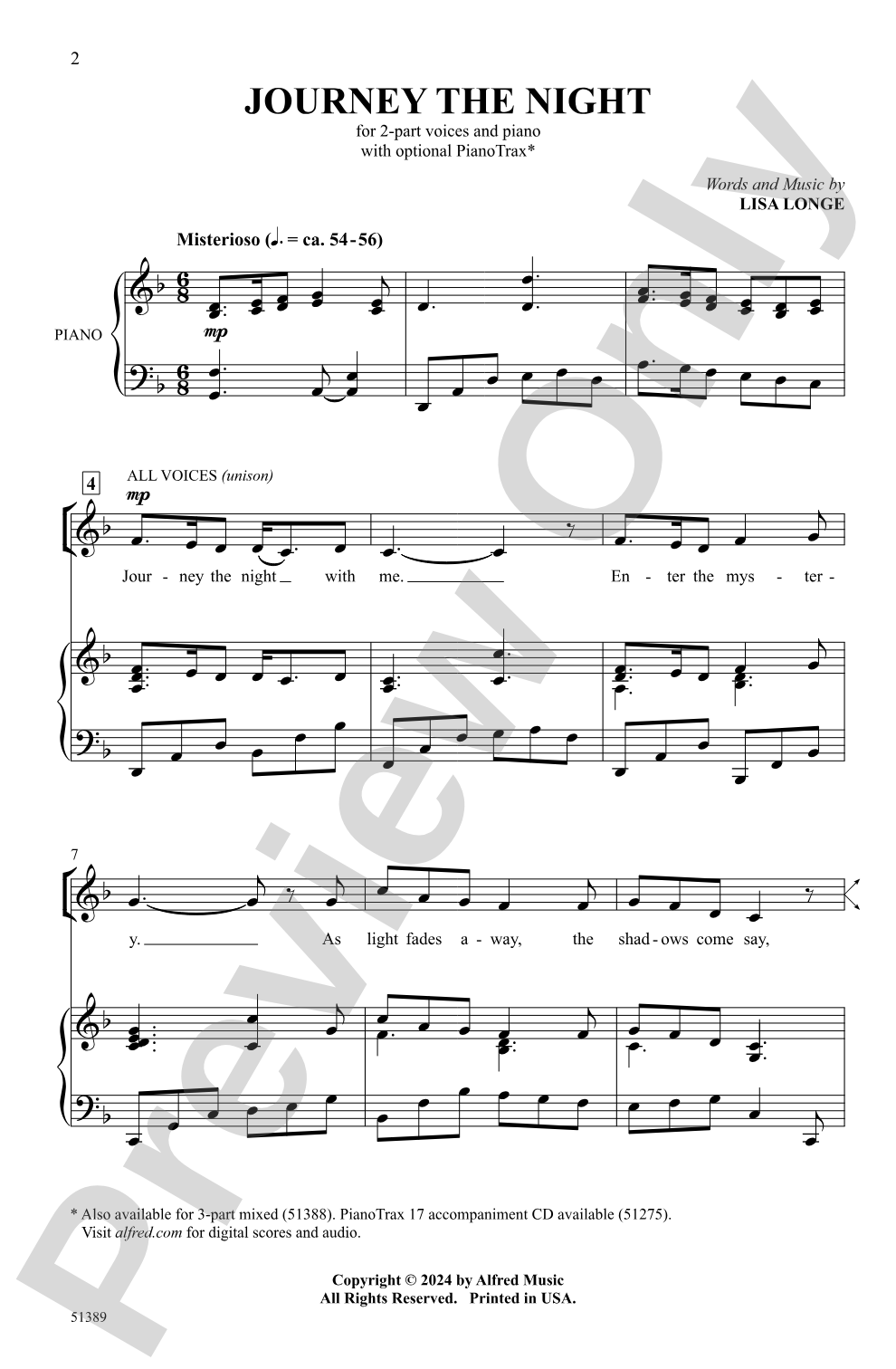

Journey the Night: 2-Part Choral Octavo
Words and music by Lisa Longe
Item: 00-PO-0007321
$2.30
Minimum order quantity: 20 copies
Pickup currently not available
Description
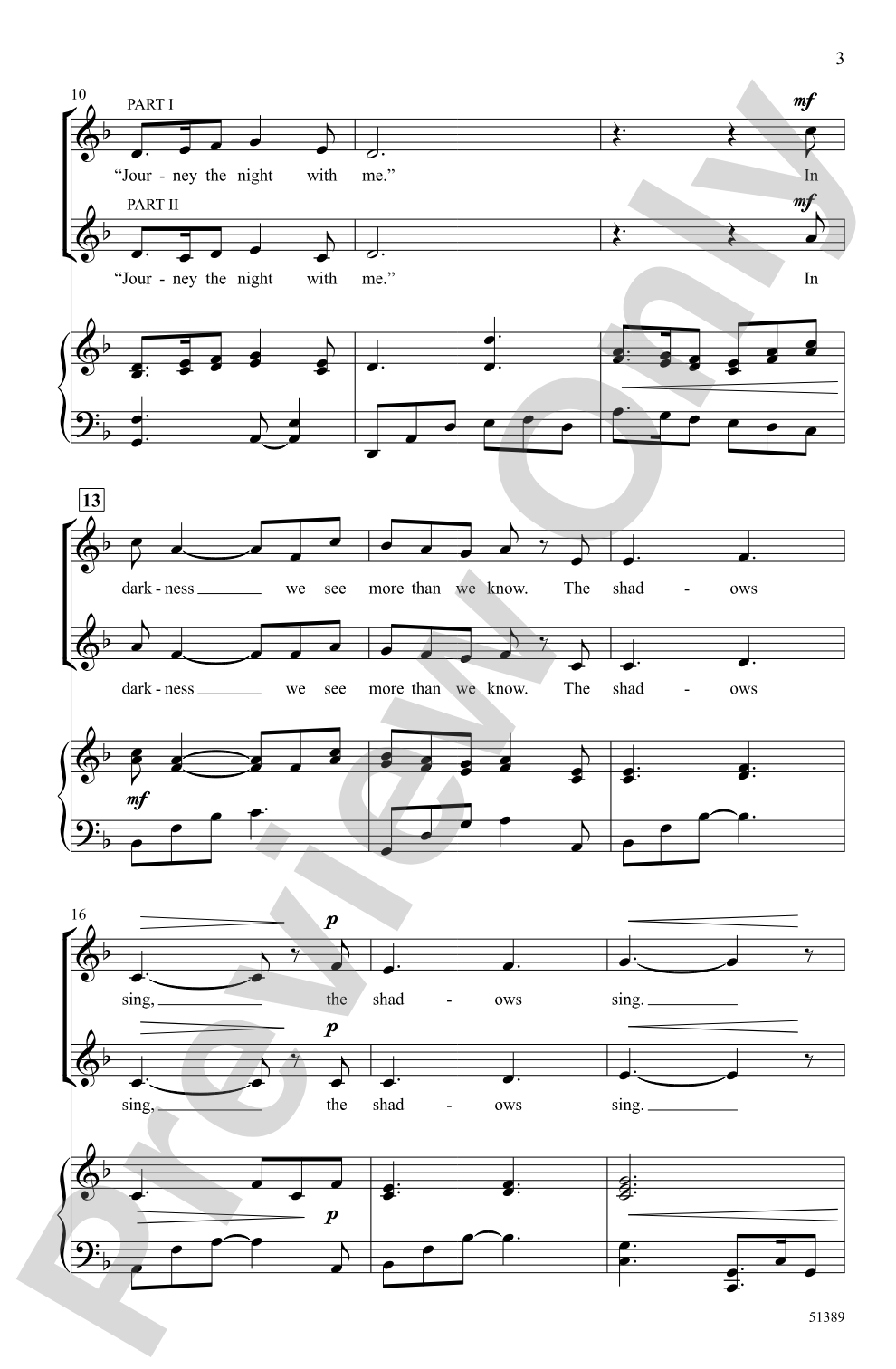
"In darkness, we see more than we know." This haunting 6/8 original is carefully crafted for developing groups with moderate-range voice parts and a supportive, uncomplicated accompaniment. Poetic lyrics about the mystique and wonder of nighttime evoke sounds of singing shadows. Composed mostly in D minor, the final bars soften and slow with an uplifting shift to the relative major. The tonality seamlessly fluctuates between D minor and F major, symbolizing both the darkness and the glow of night.


Journey the Night: 2-Part Choral Octavo isn't in MakeMusic Cloud just yet...but it could be. Let us know you'd like to see it, and you'll help shape what comes next. In the meantime, start a free trial and dive into thousands of interactive titles your students can play along with today.
Request This Title
Tell us you want it.
Start Your Free Trial
Explore everything that's ready to play right now.
Sample Audio
1
Audio File
--:--
0:00
0:00
Sample Video
Additional Details
Series:
Alfred Choral Designs
Publisher:
Alfred Music
Page Count:
8
SKU:
00-PO-0007321
More about this title
About the Composer: Lisa Longe

Lisa Longe earned dual master's degrees from SUNY Potsdam's Crane School of Music and Fordham University, grounding her work in both music pedagogy and spiritual reflection. For over twenty years, she has taught music in Schenectady City Public Schools in Upstate New York, where she transitioned from general music instruction to directing instrumental ensembles. Her deepest professional satisfaction comes from the moment a young musician discovers their voice or picks up an instrument for the first time, and she brings that same care to every piece she writes.
At the heart of Longe's teaching philosophy is a conviction that children's voices possess a unique beauty worthy of careful cultivation. She regularly accompanies the choirs in her district and channels that lived experience of ensemble singing into compositions that respect developing voices while challenging them to grow. She resides in Albany with her family and menagerie of animals that have learned to coexist with the sounds of music filling the home.
Why we love this
Longe has crafted a piece that feels genuinely poetic without asking young singers to wrestle with technical complexity. The tonal journey from D minor into F major gives the arrangement architectural purpose, so the moment of harmonic lift at the end becomes musically earned rather than arbitrary. Most refreshingly, the accompaniment stays out of the way, trusting the voices to carry the song.
What to expect
The piece wraps you in quiet mystery, letting D minor establish a contemplative mood before gradually drawing you toward something more luminous. There's a meditative quality to the harmonies, with the final turn to F major arriving like starlight breaking through clouds, leaving singers and listeners with a sense of quiet wonder.
Who it's for
Developing 2-part choirs ready to explore minor tonality and tonal contrast without overwhelming vocal ranges or ensemble coordination demands. This works equally well for middle school students discovering their voices or high school groups seeking meaningful repertoire that doesn't require advanced sight-reading.
How to get the most out of it
- Emphasize the 6/8 pulse as a gentle sway rather than a march; let the rhythm feel like breath moving through the phrases.
- Balance the shift into F major near the close by bringing out the warmth in the upper voices without losing the intimacy of the lower line.
- Use the recorded accompaniment as a rehearsal tool to establish harmonic security, then consider performing with a live accompanist to deepen the connection between singers and piano.
- Shape the text painting around 'shadows' and 'glow' with dynamic nuance; these words deserve subtle emphasis that helps the narrative unfold naturally.
How to use it
Nest this among other secular concert pieces to open or close a set with a moment of reflection. It pairs well with more energetic selections, offering contrast and emotional depth without demanding an advanced ensemble; it also stands effectively as a standalone contest piece for groups developing their interpretive skills.
Skills your students will build
- Reading and sustaining minor tonality (D minor with relative major modulation)
- Executing compound meter rhythm accurately (6/8 time)
- Balancing harmonic independence between two vocal lines
- Shaping phrases expressively while maintaining ensemble blend
- Understanding tonal function as a storytelling tool (darkness to light)