
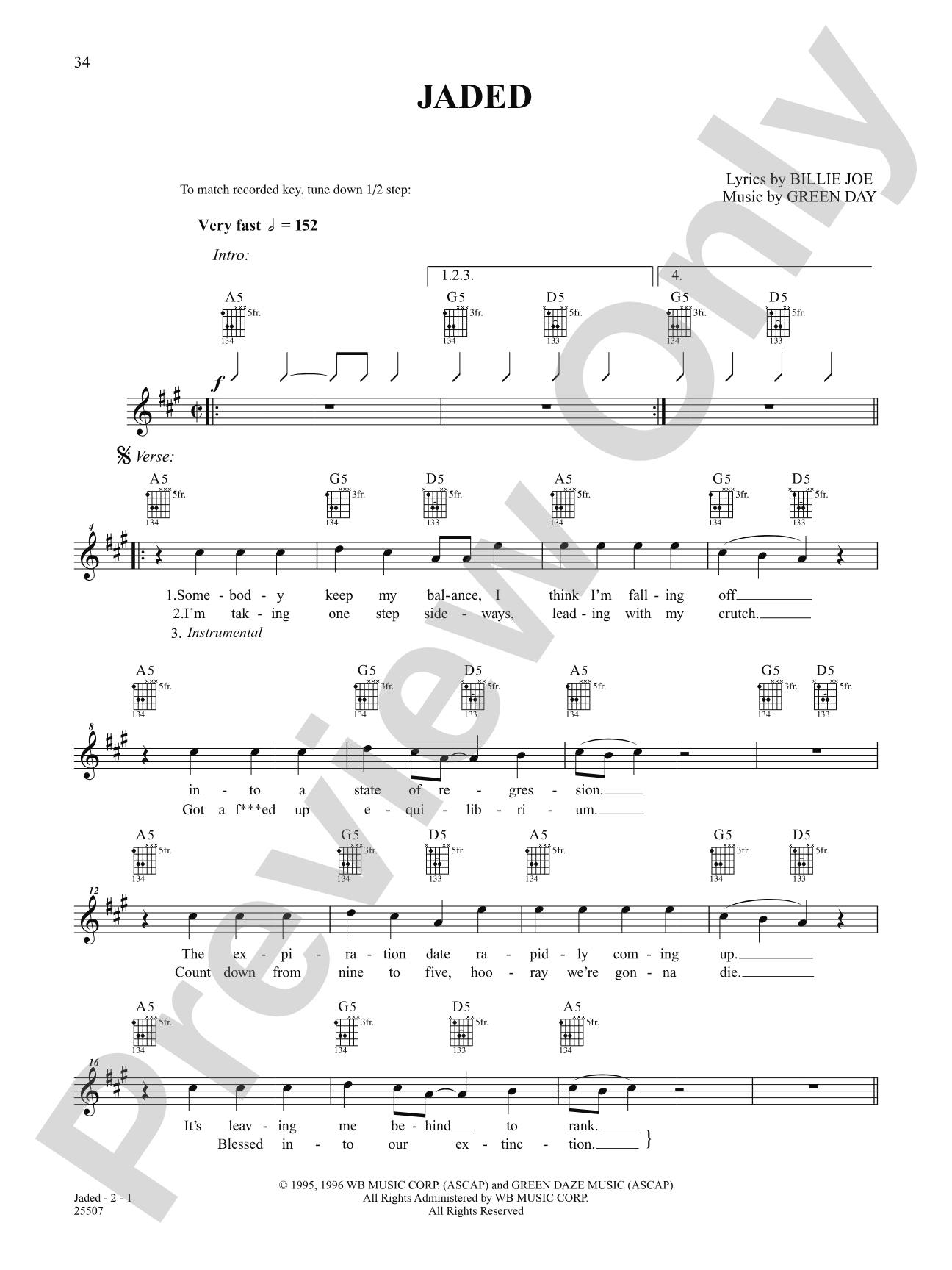

Jaded: Easy Guitar
20 Greatest Hits
Green Day
Item: 00-PS-0000167
$4.99
One moment…
Related Items
Nice Guys Finish Last: Easy Guitar |
$4.99
|
View | |
Hitchin' a Ride: Easy Guitar |
$4.99
|
View | |
Good Riddance (Time of Your Life): Easy Guitar |
$4.99
|
View | |
Espionage: Easy Guitar |
$4.99
|
View | |
Waiting: Easy Guitar |
$4.99
|
View | |
Minority: Easy Guitar |
$4.99
|
View | |
Macy's Day Parade: Easy Guitar |
$4.99
|
View | |
Longview: Easy Guitar |
$4.99
|
View | |
Basket Case: Easy Guitar |
$4.99
|
View | |
When I Come Around: Easy Guitar |
$4.99
|
View | |
Stuck With Me: Easy Guitar |
$4.99
|
View | |
Brain Stew: Easy Guitar |
$4.99
|
View | |
American Idiot: Easy Guitar |
$4.99
|
View | |
Holiday: Easy Guitar |
$4.99
|
View | |
Wake Me Up When September Ends: Easy Guitar |
$4.99
|
View | |
Boulevard of Broken Dreams: Easy Guitar |
$4.99
|
View |
Description
Twenty of Green Day's greatest hits, arranged to be easily playable. With tablature and guitar chord grids throughout. Titles are: American Idiot * Basket Case * Boulevard of Broken Dreams * Brain Stew * Espionage * Good Riddance (Time of Your Life) * Hitchin' a Ride * Holiday * Jaded * Longview * Macy's Day Parade * Minority * Nice Guys Finish Last * Stuck with Me * Waiting * Wake Me Up When September Ends * Walking Contradiction * Warning * Welcome to Paradise * When I Come Around.


Jaded: Easy Guitar isn't in MakeMusic Cloud just yet...but it could be. Let us know you'd like to see it, and you'll help shape what comes next. In the meantime, start a free trial and dive into thousands of interactive titles your students can play along with today.
Request This Title
Tell us you want it.
Start Your Free Trial
Explore everything that's ready to play right now.
Sample Audio
No sample audio found.
Sample Video
No sample videos found.
Additional Details
Series:
Easy Guitar Anthology
Publisher:
Alfred Music
Page Count:
72
SKU:
00-PS-0000167
More about this title
About the Composer: Green Day
Green Day emerged from the East Bay punk scene in the late 1980s and became one of rock's defining bands of the 1990s and 2000s. Billie Joe Armstrong, Mike Dirnt, and Tré Cool developed a distinctive sound that blended punk's raw energy with pop sensibilities and introspective songwriting, earning them multiple Grammy Awards and a global following that spans generations.
Their catalog showcases the range of modern rock composition: from biting social commentary to vulnerable ballads, from explosive anthems to intimate acoustic moments. For guitar students, their work offers direct access to how melody, power chord progressions, and groove-based playing can reach millions while remaining fundamentally rooted in guitar craft.
Why we love this
These are songs your students actually want to play, which changes everything about motivation and practice consistency. The simplified arrangements preserve what makes Green Day's catalog iconic while removing the technical barriers, so players can focus on nailing the feel and rhythm that define these tracks rather than wrestling with complex voicings or fast picking.
What to expect
These songs carry the swagger and urgency of punk rock but wrap it in melodies that stick with you long after you stop playing. Whether you're powering through an anthem or picking through an intimate moment, you're capturing the emotional directness that made Green Day resonate across multiple generations of listeners.
Who it's for
Guitarists in the early intermediate range who are ready to move beyond single-note exercises but need arrangements that don't demand advanced techniques. High school rock band programs, middle school guitar classes, and private students working toward fuller repertoire all benefit from music that feels current and achievable.
How to get the most out of it
- Anchor the rhythm in the kick pattern underneath the chords. Green Day's power chord work lives or dies by pocket; lock into the drums (or the drummer's foot if you're playing live) rather than rushing ahead.
- Use muted strumming on verses to build dynamics. Many of these songs soften in the verses before exploding into choruses; don't play everything at full intensity.
- Pay attention to where the chord grids show open strings versus muted strings. That distinction shapes the tone and sustain in ways that matter for recognition.
- Lean into the simplicity on acoustic tracks like 'Good Riddance (Time of Your Life)' and 'Wake Me Up When September Ends.' Clarity and clean fingering work harder than speed here.
How to use it
Stage this collection throughout the year as students build skills, moving from acoustic ballads early on to full-band rock arrangements as the ensemble matures. The variety lets you assign different tracks to different skill levels within the same program, and the repertoire naturally clusters into themed concerts (acoustic evening, punk anthems, etc.).
Skills your students will build
- Power chord shapes and transitions at moderate tempo
- Muted versus open string distinction in rhythm playing
- Groove-based strumming patterns and dynamic control
- Reading tablature and chord grids in tandem
- Balancing precision with feel in rock contexts