
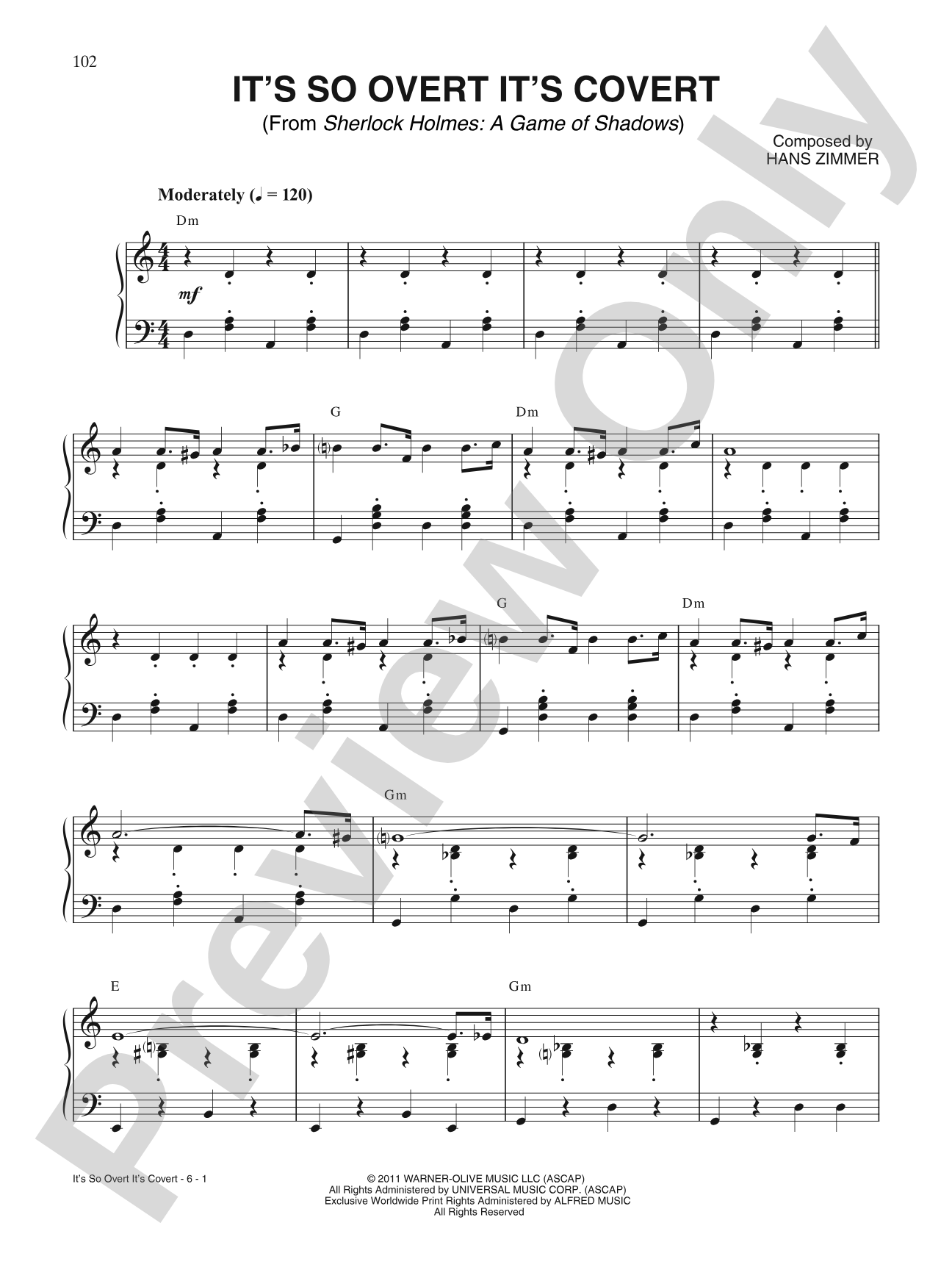
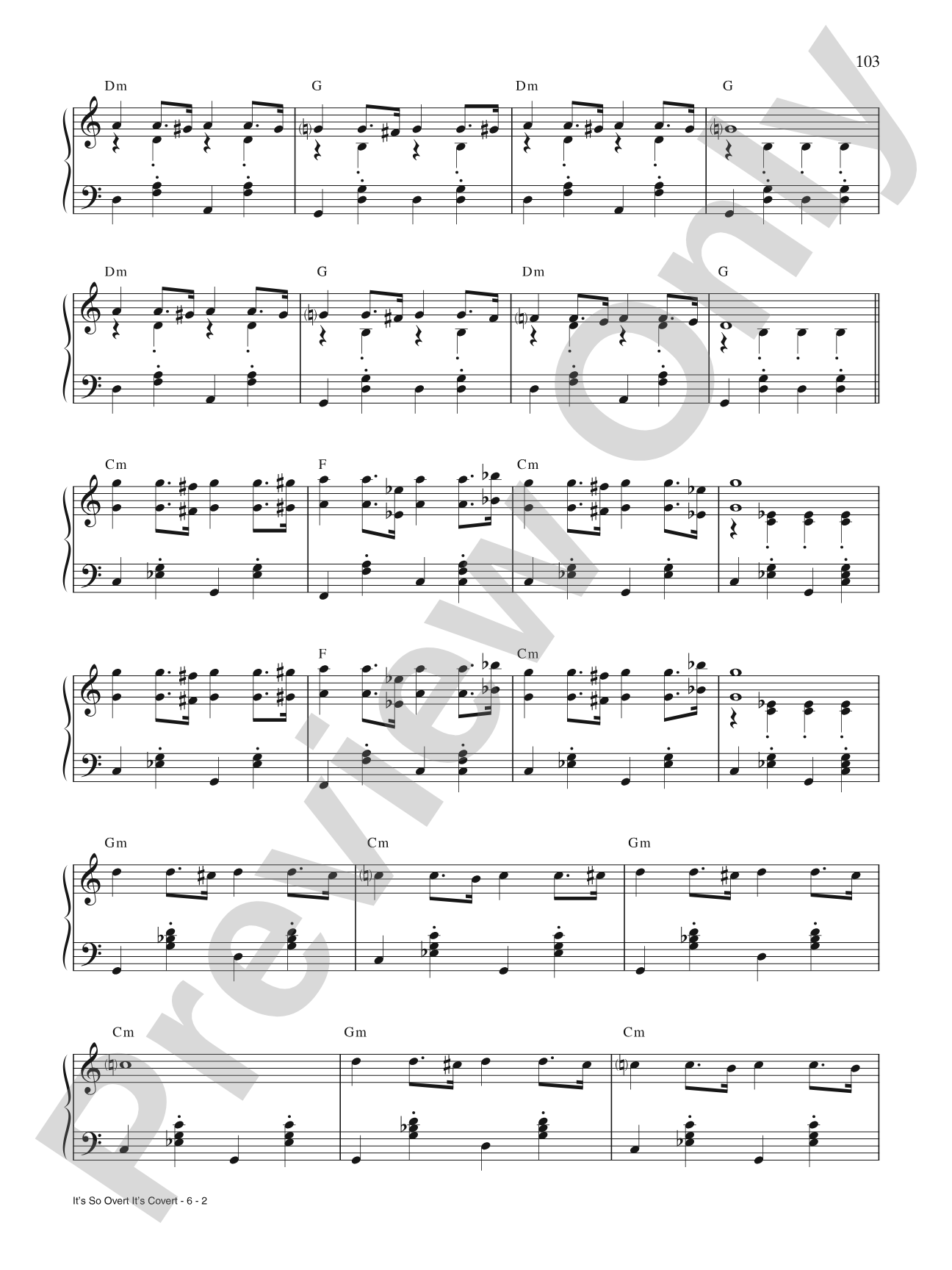

It's So Overt It's Covert: Piano
Composed by Hans Zimmer
Item: 00-PS-0015809
$5.99
Pickup currently not available
Description
Hans Zimmer's film scores are bold and unmistakable. Over the course of his prolific career, he has provided music for some of the world's most beloved films, including Disney's The Lion King and Christopher Nolan's The Dark Knight. This collection features faithful arrangements of some of the best known titles by this brilliant composer. Titles: 160 BPM (Angels and Demons) * Ah, Putrefaction (Sherlock Holmes) * All of Them! (King Arthur) * The Burning Bush (The Prince of Egypt) * Can You Hear Your Heart? (Winter's Tale) * Cheldorado (The Road to Eldorado) * Chevaliers de Sangreal (The Da Vinci Code) * Corynorhinus (Batman Begins) * The Dark Knight Overture (The Dark Knight) * Days of Thunder (Main Title) (Days of Thunder) * Discombobulate (Sherlock Holmes) * Doomsday Is Family Time (The Simpsons Movie) * Dream Is Collapsing (Inception) * Drink Up Me Hearties (Pirates of the Caribbean: At World's End) * Driving Miss Daisy (Driving Miss Daisy) * Homeland (Main Title) (Spirit: Stallion of the Cimarron) * Honor Him (Gladiator) * In the Beginning (The Bible) * It's So Overt It's Covert (Sherlock Holmes: A Game of Shadows) * Krypton's Last (Man of Steel) * Life Goes On (A League of Their Own) * Maestro (The Holiday) * The Nativity (The Bible) * Now We Are Free (Gladiator) * Roll Tide (Crimson Tide) * Tennessee (Pearl Harbor) * This Is Clark Kent (Man of Steel) * This Land (The Lion King) * What Are You Going to Do When You Are Not Saving the World (Man of Steel).


Discover MakeMusic Cloud: thousands of interactive titles your students can play along with today.
Sample Audio
No sample audio found.
Sample Video
No sample videos found.
Additional Details
Publisher:
Alfred Music
Page Count:
144
SKU:
00-PS-0015809
More about this title
About the Composer: Hans Zimmer
Hans Zimmer stands among the most influential film composers of the past four decades. His work spans genres from intimate character studies to epic blockbusters, earning him an Academy Award, three Golden Globes, and a Grammy. Zimmer's approach to composition balances orchestral sophistication with memorable melodic lines, making his scores both critically acclaimed and widely accessible to audiences worldwide.
As a music educator's resource, Zimmer's catalog offers students an exceptional window into how thematic material drives narrative and emotion. His scores demonstrate masterful orchestration, harmonic innovation, and the structural discipline required to support visual storytelling. For pianists, his works present the challenge of translating cinematic textures and emotional arcs into keyboard writing that maintains compositional integrity.
Why we love this
This collection captures Zimmer's signature sound at its most recognizable, giving pianists direct access to the themes that defined contemporary film scoring. Each arrangement preserves the melodic and harmonic essence of the original while making the music pianistically viable, meaning students encounter authentic Zimmer rather than simplified pastiche. The range of styles—from the driving intensity of Dark Knight material to the lyrical warmth of The Lion King—keeps the book engaging across multiple practice sessions and performance contexts.
What to expect
These arrangements invite you into Zimmer's world of dramatic tension, soaring heroism, and intimate reflection. Whether you're navigating the driving percussion-inflected ostinatos of a thriller cue or the sweeping orchestral lyricism of an epic theme, the music asks you to be both pianist and storyteller. The pieces breathe with cinematic scope while remaining grounded in the physical reality of two hands at a keyboard.
Who it's for
This book serves pianists who want to explore contemporary film music in a format that respects both the original compositions and keyboard technique. Intermediate to advanced students will find pieces that challenge harmonic understanding and interpretive maturity while remaining grounded in the melodic strength that made these themes famous. Teachers seeking crossover material that engages students through recognizable film music will find the collection versatile enough to support varied learning goals.
How to get the most out of it
- Study the original film scores alongside these arrangements to understand how Zimmer uses tempo, orchestration, and layering to build emotional momentum; then return to the piano version with that context shaping your phrasing and dynamics.
- Approach the harmonic language with attention to unexpected chord progressions and chromaticism, which often signal emotional turning points in Zimmer's writing. Let those harmonic shifts guide your hand positioning and voice leading.
- Balance virtuosic passage work with the legato, sustained material that anchors each piece. Zimmer frequently alternates between kinetic rhythmic figures and spacious melodic breathing, so resist the urge to rush technical sections.
- Track the emotional arc within each arrangement rather than treating it as static. Many of these themes build from introduction to climax, so shape your interpretation to support that trajectory.
How to use it
Feature these arrangements in contemporary music recitals or film score themed concerts, where they anchor the evening with immediately recognizable material that brings audiences closer to the score. Intermediate-level students can perform individual pieces within student recitals to showcase technical growth, while advanced players may sequence multiple Zimmer cues to demonstrate thematic and emotional variety. The collection works equally well in film studies collaborations, where the arrangements serve as musical primary sources for analysis and discussion.
Skills your students will build
- Harmonic analysis of contemporary film scoring, including extended tertian harmony and modal mixture
- Pedal technique for sustaining complex harmonic textures across dynamic range
- Tempo and rhythmic stability when managing driving ostinatos and syncopated accompaniment patterns
- Emotional phrasing and structural awareness by following cinematic narrative arcs within each piece
- Voice leading through chromatic and non-functional harmonic progressions
- Sight-reading of varied notational conventions typical of commercial film score arrangements