
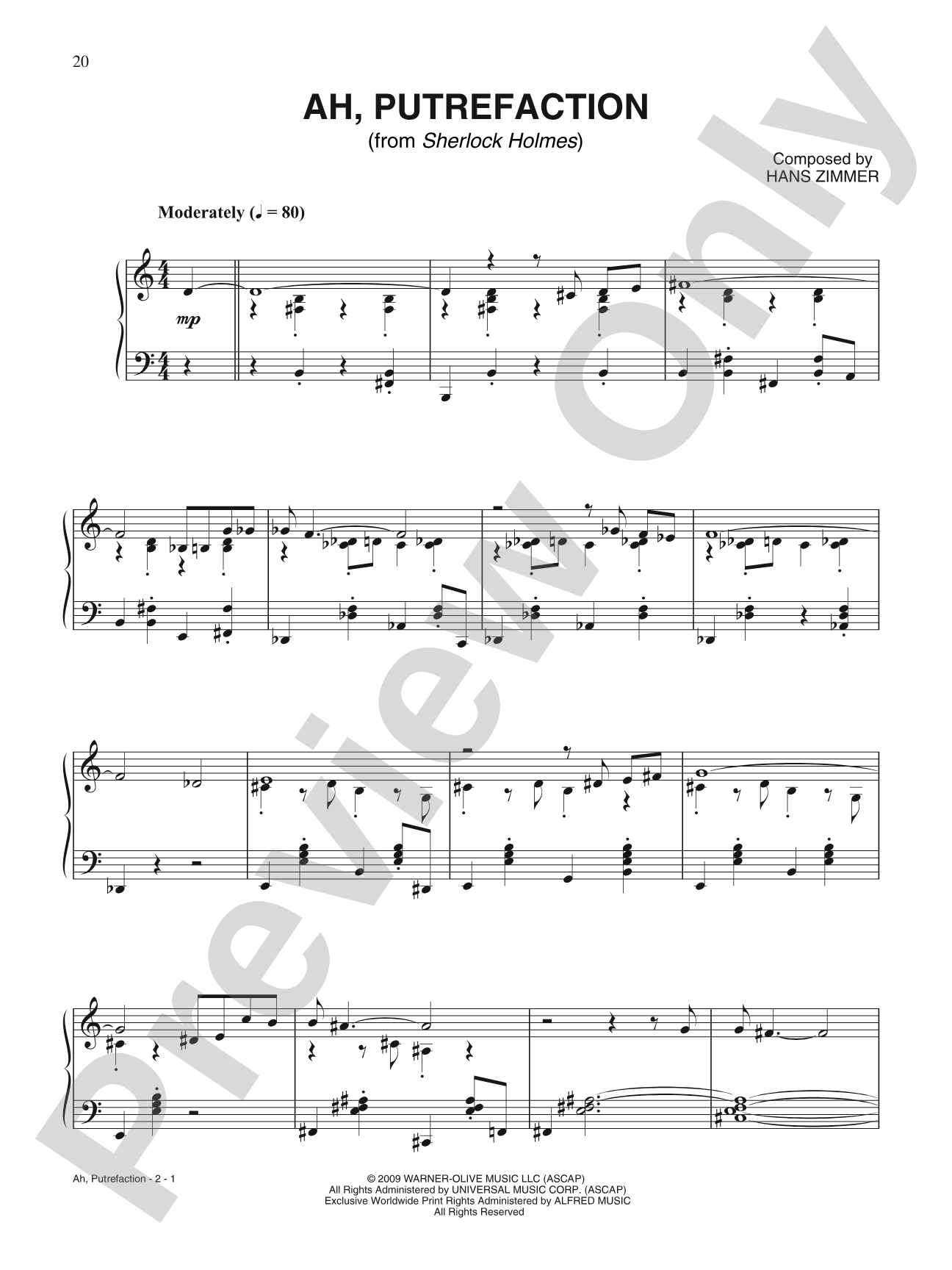

Ah, Putrefaction: Piano
Composed by Hans Zimmer
Item: 00-PS-0015808
$4.99
Pickup currently not available
Description
Hans Zimmer's film scores are bold and unmistakable. Over the course of his prolific career, he has provided music for some of the world's most beloved films, including Disney's The Lion King and Christopher Nolan's The Dark Knight. This collection features faithful arrangements of some of the best known titles by this brilliant composer. Titles: 160 BPM (Angels and Demons) * Ah, Putrefaction (Sherlock Holmes) * All of Them! (King Arthur) * The Burning Bush (The Prince of Egypt) * Can You Hear Your Heart? (Winter's Tale) * Cheldorado (The Road to Eldorado) * Chevaliers de Sangreal (The Da Vinci Code) * Corynorhinus (Batman Begins) * The Dark Knight Overture (The Dark Knight) * Days of Thunder (Main Title) (Days of Thunder) * Discombobulate (Sherlock Holmes) * Doomsday Is Family Time (The Simpsons Movie) * Dream Is Collapsing (Inception) * Drink Up Me Hearties (Pirates of the Caribbean: At World's End) * Driving Miss Daisy (Driving Miss Daisy) * Homeland (Main Title) (Spirit: Stallion of the Cimarron) * Honor Him (Gladiator) * In the Beginning (The Bible) * It's So Overt It's Covert (Sherlock Holmes: A Game of Shadows) * Krypton's Last (Man of Steel) * Life Goes On (A League of Their Own) * Maestro (The Holiday) * The Nativity (The Bible) * Now We Are Free (Gladiator) * Roll Tide (Crimson Tide) * Tennessee (Pearl Harbor) * This Is Clark Kent (Man of Steel) * This Land (The Lion King) * What Are You Going to Do When You Are Not Saving the World (Man of Steel).


Discover MakeMusic Cloud: thousands of interactive titles your students can play along with today.
Sample Audio
No sample audio found.
Sample Video
No sample videos found.
Additional Details
Publisher:
Alfred Music
Page Count:
144
SKU:
00-PS-0015808
More about this title
About the Composer: Hans Zimmer
Hans Zimmer stands as one of the most influential film composers of the past four decades. His work spans blockbuster franchises (The Dark Knight trilogy, Man of Steel, Pirates of the Caribbean), prestige dramas (Gladiator, Driving Miss Daisy), and animated features (The Lion King, The Road to Eldorado), demonstrating an extraordinary range across genres and emotional registers. Zimmer's scores are characterized by bold orchestral writing, innovative use of electronic elements, and a gift for creating instantly recognizable themes that elevate storytelling.
For pianists and vocalists, Zimmer's compositions offer rich material for exploring film scoring techniques, harmonic sophistication, and the relationship between music and narrative. His melodies are often singable yet complex, and his harmonic language rewards close study of how contemporary classical and popular idioms intersect.
Why we love this
This collection brings together some of Zimmer's most iconic and musically substantial work in arrangements that honor the original scores without requiring a full orchestra. The pieces span widely recognizable films, making them engaging for audiences who know the music but may not know its composer. For pianists seeking contemporary material with genuine compositional depth, these arrangements offer the chance to inhabit some of the most sophisticated and emotionally powerful scores of recent cinema.
What to expect
These pieces embody cinematic scope and emotional immediacy. Whether you're playing an action sequence arranged for dramatic effect or a quieter moment designed to reveal character, Zimmer's melodic gift and harmonic sophistication create music that feels both accessible and artistically substantial. There's a visceral quality to the playing experience, a sense of commanding a large emotional gesture even on a solo instrument.
Who it's for
Pianists with intermediate to advanced skills seeking contemporary classical and film score repertoire will find this collection substantial and rewarding. Singers and pianist-vocalist duos can use these arrangements in recitals, studio sessions, or as programming that connects film music to concert performance. This book serves music teachers and advanced students who want to explore modern compositional techniques through music they find genuinely moving.
How to get the most out of it
- Study the original film score recordings alongside the sheet music. Zimmer's orchestrations often suggest specific articulations, dynamics, and phrasing that translate powerfully to solo piano when executed with intention.
- Pay close attention to harmonic movement, particularly in slower pieces. Zimmer frequently uses chromatic voice leading and unexpected chord progressions that require precise hand independence and pedal control.
- Treat thematic material as narrative. Each piece was written to support specific moments on screen; understanding that context deepens the musical interpretation and guides pacing choices.
- In arrangements with vocal parts, maintain clarity between the melody line and accompaniment by balancing touch and dynamics carefully, especially in pieces with dense harmonic textures.
How to use it
Include individual pieces in recitals to demonstrate range and showcase contemporary composition alongside classical standards. A piano recital pairing a Zimmer piece with traditional repertoire creates compelling contrast and broadens appeal to film-familiar audiences. For singer-pianist duos, these arrangements offer a bridge between classical and contemporary performance that programs nicely with art song cycles or hybrid programming.
Skills your students will build
- Harmonic analysis of contemporary film scoring language (chromatic voice leading, unexpected chord progressions)
- Balance between melody and accompaniment in dense textures
- Pedal control in sustaining complex harmonic colors
- Narrative pacing and phrasing connected to orchestral models
- Technical facility with Zimmer's characteristic rhythmic and dynamic patterns