
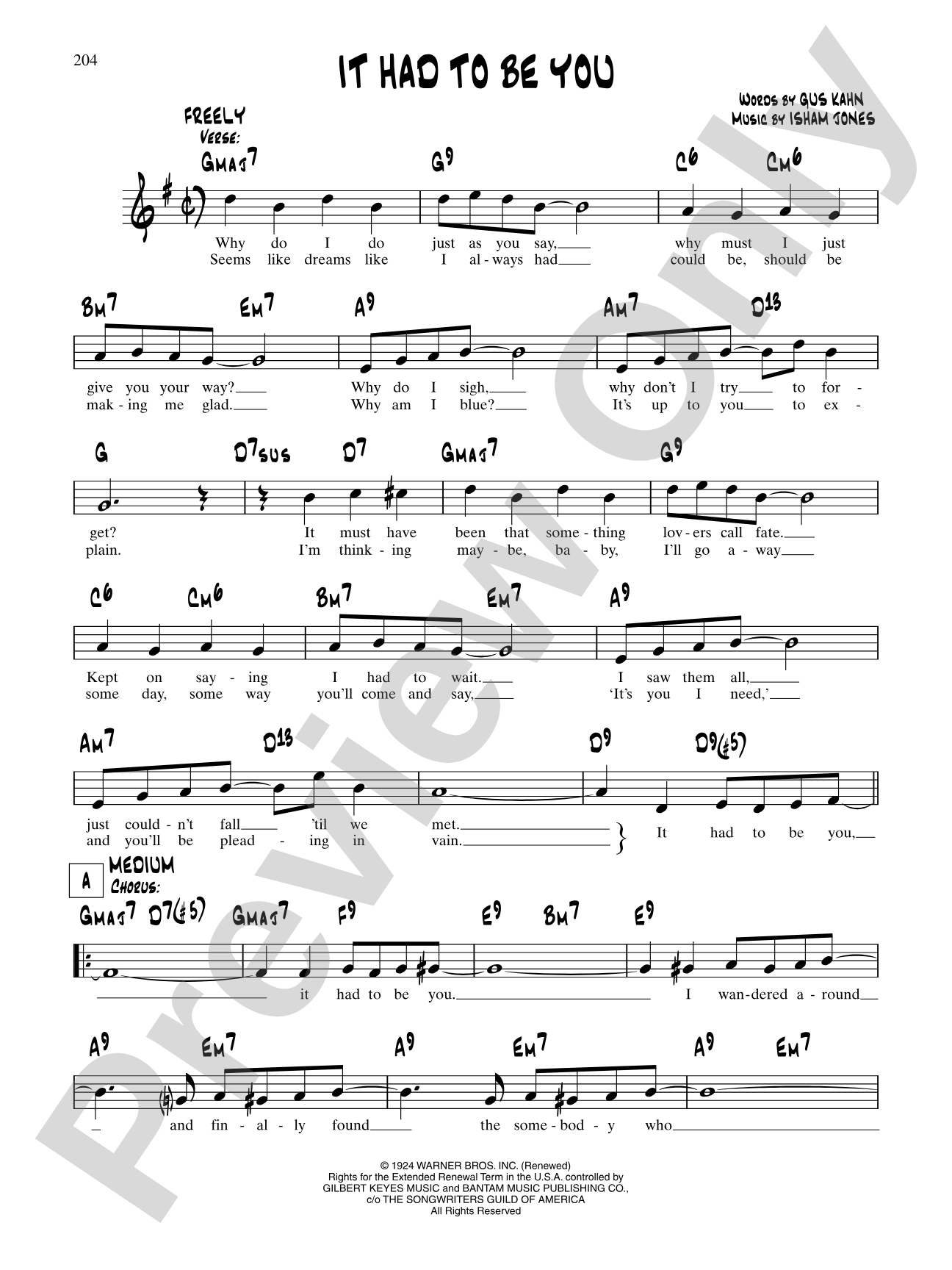

It Had To Be You: Lead Sheet
Tony Bennett
Item: 00-PSL-000276
$4.99
One moment…
Description
Legendary jazz musician Tony Bennett needs little introduction. Winner of both Grammy and ASCAP Lifetime Achievement Awards, and long-time inductee of the Big Band and Jazz Hall of Fame, Tony's latest release features classic favorites covering three decades of recording. While fans flocked to purchase the CD, PBS's "American Masters" series celebrated the release with a special entitled "Tony Bennett: The Music Never Ends." All music in this album-matching folio includes lyrics, melody line, and chord changes with professionally arranged piano accompaniment.
Titles: Anything Goes * The Very Thought of You * The Way You Look Tonight * Ev'ry Time We Say Goodbye * That Old Black Magic * A Foggy Day * I'll Be Seeing You * Ain't Misbehavin' * It Had to Be You * Moonglow (Duet w with K.D. Lang) * She's Funny That Way * You Go to My Head * They Can't Take That Away from Me * You'll Never Get Away from Me * Taking a Chance on Love.


Titles: Anything Goes * The Very Thought of You * The Way You Look Tonight * Ev'ry Time We Say Goodbye * That Old Black Magic * A Foggy Day * I'll Be Seeing You * Ain't Misbehavin' * It Had to Be You * Moonglow (Duet w with K.D. Lang) * She's Funny That Way * You Go to My Head * They Can't Take That Away from Me * You'll Never Get Away from Me * Taking a Chance on Love.
It Had To Be You: Lead Sheet isn't in MakeMusic Cloud just yet...but it could be. Let us know you'd like to see it, and you'll help shape what comes next. In the meantime, start a free trial and dive into thousands of interactive titles your students can play along with today.
Request This Title
Tell us you want it.
Start Your Free Trial
Explore everything that's ready to play right now.
Sample Audio
No sample audio found.
Sample Video
No sample videos found.
Additional Details
Publisher:
Alfred Music
Page Count:
76
SKU:
00-PSL-000276
More about this title
About the Artist: Tony Bennett
Tony Bennett stands as one of the most celebrated interpreters of the American songbook. His career spanning more than seven decades established him as a master of vocal phrasing, emotional authenticity, and jazz sensibility. A Grammy and ASCAP Lifetime Achievement Award recipient and member of both the Big Band and Jazz Hall of Fame, Bennett brought classical training and genuine musicianship to popular standards, influencing generations of singers and musicians.
Bennett's artistry rests on meticulous attention to lyrical meaning and melodic nuance. Rather than chasing trends, he remained devoted to the Great American Songbook, recording repeatedly with different arrangers and ensembles to discover fresh interpretations of familiar melodies. His approach to a standard teaches musicians that repertoire depth comes not from novelty but from understanding the composer's intent and the lyricist's craft.
Why we love this
This folio captures fifteen standards from Bennett's most recent recordings, offering pianists and singers a curated collection of the material he returned to most powerfully in his final decades. Each arrangement respects the vocal line while providing harmonic substance for accompanists; the chord symbols are precise enough for jazz improvisation without overwhelming classical pianists new to jazz notation. Programming these pieces signals to your audience that you value standard vocal literature and understand that timeless songwriting belongs in recitals alongside art songs.
What to expect
These songs breathe with the elegance and emotional directness Bennett made his signature. They feel intimate even in their sophistication, balancing lyricism with subtle harmonic color. Each melody carries the weight of decades of interpretation, yet the arrangements leave room for your own voice and phrasing to emerge.
Who it's for
Pianists accompanying jazz singers or working in vocal studio settings will find reliable, professionally realized accompaniments that honor Bennett's interpretations. Singers seeking substantial material that sits well in the voice while remaining connected to jazz tradition will appreciate both the melodic accessibility and harmonic depth of these arrangements.
How to get the most out of it
- Study the recordings first. Bennett's phrasing often sits behind or slightly ahead of the beat in ways that sheet music notation flattens; listening reveals the conversational quality his interpretations achieve.
- Shape the piano accompaniment to serve the lyrics. These arrangements supply harmonic color and rhythmic drive, but they succeed only when they listen to and support the vocalist's storytelling.
- Treat the chord symbols as a foundation, not a cage. Jazz standards thrive on tasteful reharmonization and comping choices that respond to the moment; use the changes as a map, not a script.
- Balance sophistication with accessibility. These melodies are beloved because they sing easily, yet the harmonies demand respect; resist oversimplifying either element.
How to use it
Feature this folio in recitals celebrating the American songbook or programs honoring jazz vocal tradition. The collection spans intimate ballads and uptempo standards, allowing you to build varied sets that showcase different moods and pianistic textures. Consider pairing selections with other standards by the same composers to deepen listeners' familiarity with this foundational repertoire.
Skills your students will build
- Reading jazz chord symbols and interpreting chord changes expressively
- Accompanying jazz and popular vocal music with sensitivity to lyrical phrasing
- Understanding the relationship between standard song lyrics and melodic shape
- Developing tasteful improvisation and reharmonization in a jazz context
- Building fluency with the harmonic language of mid-20th-century American songwriting