
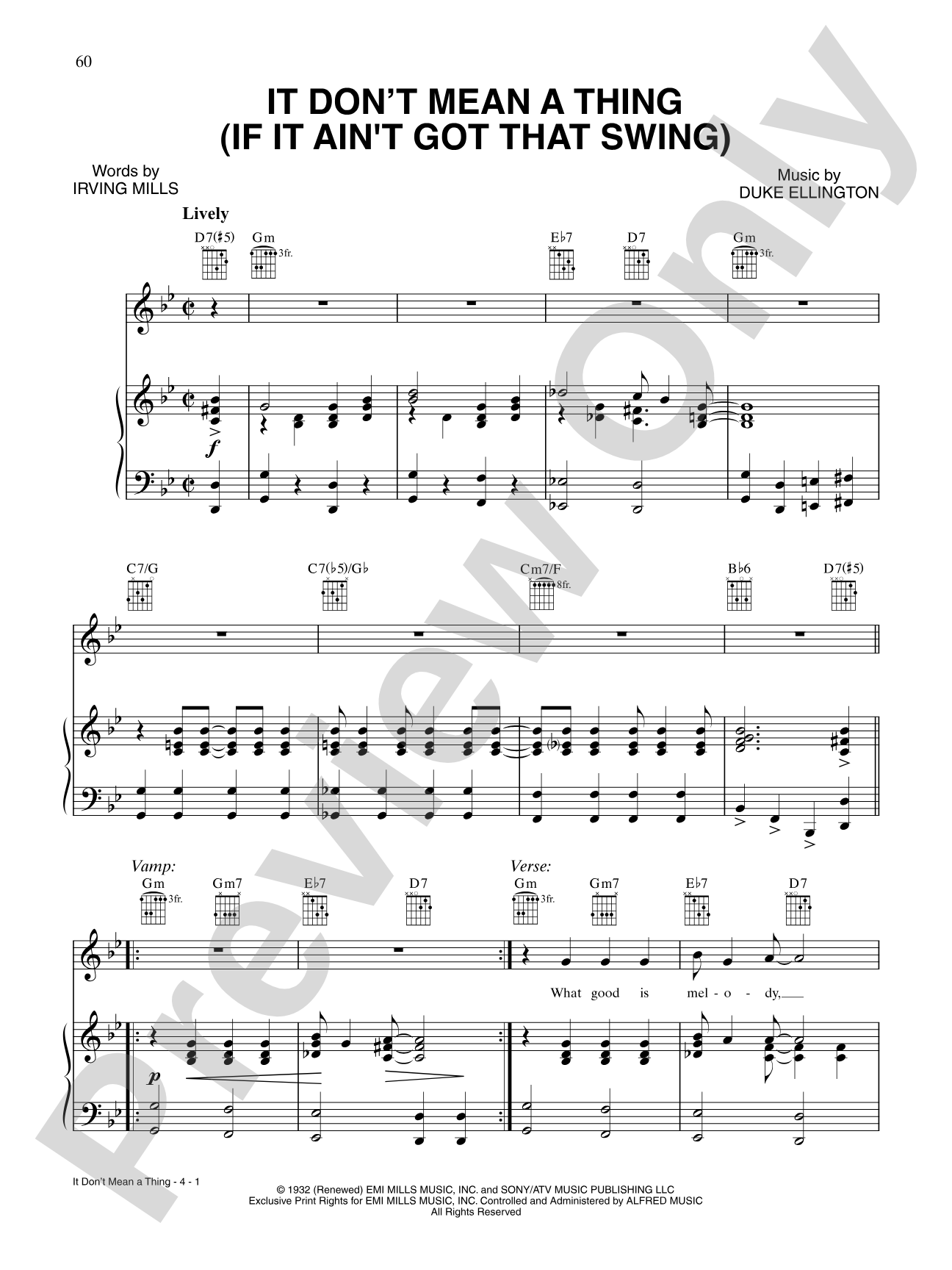

It Don't Mean a Thing (If It Ain't Got That Swing): Piano/Vocal/Chords
Tony Bennett
Item: 00-PS-0015717
$4.99
One moment…
Related Items
Once Upon a Time: Piano/Vocal/Chords |
$4.99
|
View | |
Night and Day: Piano/Vocal/Chords |
$4.99
|
View | |
Boulevard of Broken Dreams: Piano/Vocal/Chords |
$5.99
|
View | |
Just in Time: Piano/Vocal/Chords |
$4.99
|
View | |
Rags to Riches: Piano/Vocal/Chords |
$4.99
|
View | |
When Joanna Loved Me: Piano/Vocal/Chords |
$4.99
|
View | |
If I Ruled the World: Piano/Vocal/Chords |
$4.99
|
View | |
Tony Bennett: The Classics: Piano/Vocal/Chords Book |
$24.99
|
View |
Description
No one in popular American music has recorded for so long and at such a high level of excellence as Tony Bennett. This collection of classics spans his career from the beginning, to the current hits he continues to send onto the charts. Also included are rare photos, a biography, and a timeline of Tony's career highlights. Titles: Because of You * The Best Is Yet to Come (with Diana Krall) * Blue Velvet * Body and Soul (with Amy Winehouse) * The Boulevard of Broken Dreams * Don't Get Around Much Anymore (with Michael Bublé) * Fly Me to the Moon (In Other Words) * For Once in My Life (with Stevie Wonder) * How Do You Keep the Music Playing? * I Left My Heart In San Francisco * I Wanna Be Around (with Bono) * If I Ruled the World * It Don't Mean a Thing (If It Ain't Got That Swing) * It Had To Be You (with Carrie Underwood) * Just in Time * The Lady Is a Tramp (with Lady Gaga) * Mood Indigo * My Favorite Things * Night and Day * Once Upon a Time * One for My Baby (And One More for the Road) * Put On a Happy Face (with James Taylor) * Rags to Riches * The Shadow of Your Smile * Smile (with Barbra Streisand) * Speak Low (with Norah Jones) * Steppin' Out with My Baby * Stranger in Paradise (with Andrea Bocelli) * This Is All I Ask (with Josh Groban) * The Very Thought of You (with Paul McCartney) * The Way You Look Tonight (with Faith Hill) * When Do the Bells Ring for Me (with Mariah Carey) * When Joanna Loved Me * Who Can I Turn To When Nobody Needs Me (with Queen Latifah) * Yesterday I Heard the Rain (with Alejandro Sanz).


It Don't Mean a Thing (If It Ain't Got That Swing): Piano/Vocal/Chords isn't in MakeMusic Cloud just yet...but it could be. Let us know you'd like to see it, and you'll help shape what comes next. In the meantime, start a free trial and dive into thousands of interactive titles your students can play along with today.
Request This Title
Tell us you want it.
Start Your Free Trial
Explore everything that's ready to play right now.
Sample Audio
No sample audio found.
Sample Video
No sample videos found.
Additional Details
Publisher:
Alfred Music
Page Count:
180
SKU:
00-PS-0015717
More about this title
About the Composer: Duke Ellington
Duke Ellington (1899-1974) stands as one of the most prolific and influential composers in American music history. His sophisticated harmonies, innovative orchestrations, and ability to blend jazz with classical forms established him as a towering figure in 20th-century composition. Ellington's legacy extends far beyond jazz; his melodies and harmonic language have become the backbone of the American songbook, recorded and reinterpreted by artists across every genre and generation.
As a bandleader, pianist, and composer, Ellington created a body of work spanning five decades that includes extended compositions, film scores, and standards that define jazz and popular music. His compositions demonstrate the kind of harmonic sophistication and melodic craftsmanship that make them endlessly rewarding for musicians and singers to perform and study.
Why we love this
This collection captures the breadth of how Ellington's masterwork has traveled through decades of music history, from its original jazz context to its home in the Great American Songbook. The pairing of Tony Bennett's iconic interpretations with the full scores and lyrics gives pianists and singers a chance to understand how a timeless melody can be freshly interpreted while maintaining its essential character. For any musician diving into the jazz and pop standard repertoire, having Bennett's readings alongside the sheet music creates a valuable reference point.
What to expect
These songs carry the elegance and swing of mid-century American sophistication, combined with the emotional depth that comes from Bennett's lifetime of refinement as an interpreter. The music moves between wistful nostalgia, romantic yearning, and genuine joy, all rendered with the kind of harmonic richness that rewards careful listening and repeated performance.
Who it's for
This book serves singers and pianists who want to master the Great American Songbook and understand how standards live in performance. It works equally well for jazz vocalists developing interpretive skills, musical theater singers building a cabaret repertoire, and accompanists who need reliable, complete scores for coaching sessions and performances.
How to get the most out of it
- Listen to Bennett's recorded versions before you rehearse; his phrasing and subtle rubato offer pedagogical insight into how to approach the melodic line and shape phrases across bar lines.
- Pay close attention to chord symbols and their voicings, especially in the jazz standards. Ellington's harmonic language often includes extensions and alterations that significantly affect the emotional color of each phrase.
- When accompanying a singer, support the lyrical content by adjusting dynamics and tempo subtly; Bennett's interpretations model how restraint and listening create space for the text to land.
How to use it
Program selections from this collection alongside contemporary pieces to show students how standards continue to evolve and remain vital. Use individual songs in recitals, jazz combos, or musical theater productions where singers need reliable, professionally arranged scores with full lyrical and harmonic information. This book also serves as a reference for private coaching, allowing teachers to guide students through the interpretive choices that separate competent performances from memorable ones.
Skills your students will build
- Interpreting jazz chord symbols and extensions in real time
- Phrasing over chord changes and managing musical phrases across harmonic rhythm
- Balancing melodic line with lyrical text to create meaningful interpretation
- Understanding how cultural and historical context shapes performance choices in American songbook material
- Accompanying singers with sensitivity to text and emotional subtext