
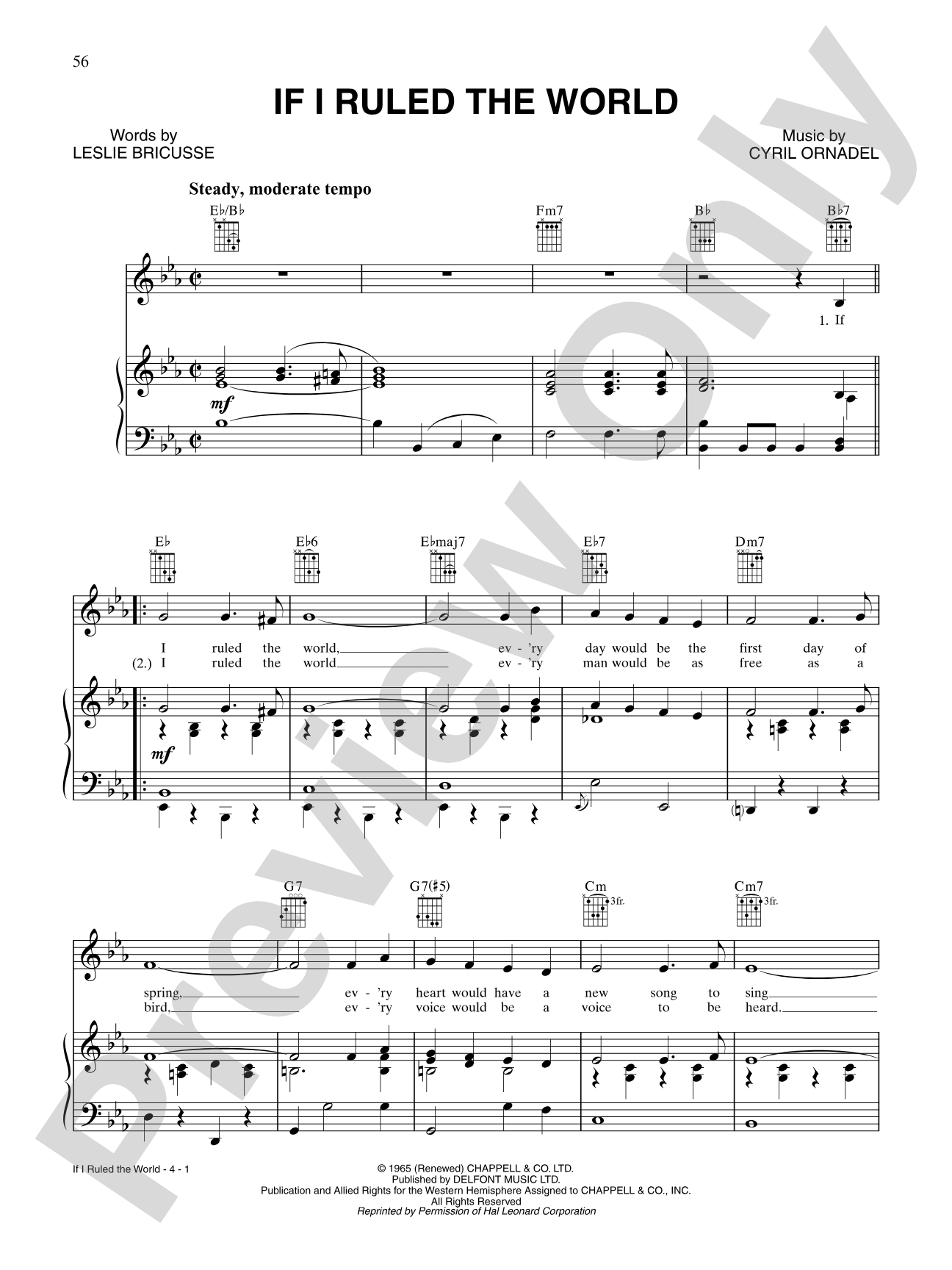

If I Ruled the World: Piano/Vocal/Chords
Tony Bennett
Item: 00-PS-0015724
$4.99
One moment…
Related Items
Once Upon a Time: Piano/Vocal/Chords |
$4.99
|
View | |
It Don't Mean a Thing (If It Ain't Got That Swing): Piano/Vocal/Chords |
$4.99
|
View | |
Night and Day: Piano/Vocal/Chords |
$4.99
|
View | |
Boulevard of Broken Dreams: Piano/Vocal/Chords |
$5.99
|
View | |
Just in Time: Piano/Vocal/Chords |
$4.99
|
View | |
Rags to Riches: Piano/Vocal/Chords |
$4.99
|
View | |
When Joanna Loved Me: Piano/Vocal/Chords |
$4.99
|
View | |
Tony Bennett: The Classics: Piano/Vocal/Chords Book |
$24.99
|
View |
Description
No one in popular American music has recorded for so long and at such a high level of excellence as Tony Bennett. This collection of classics spans his career from the beginning, to the current hits he continues to send onto the charts. Also included are rare photos, a biography, and a timeline of Tony's career highlights. Titles: Because of You * The Best Is Yet to Come (with Diana Krall) * Blue Velvet * Body and Soul (with Amy Winehouse) * The Boulevard of Broken Dreams * Don't Get Around Much Anymore (with Michael Bublé) * Fly Me to the Moon (In Other Words) * For Once in My Life (with Stevie Wonder) * How Do You Keep the Music Playing? * I Left My Heart In San Francisco * I Wanna Be Around (with Bono) * If I Ruled the World * It Don't Mean a Thing (If It Ain't Got That Swing) * It Had To Be You (with Carrie Underwood) * Just in Time * The Lady Is a Tramp (with Lady Gaga) * Mood Indigo * My Favorite Things * Night and Day * Once Upon a Time * One for My Baby (And One More for the Road) * Put On a Happy Face (with James Taylor) * Rags to Riches * The Shadow of Your Smile * Smile (with Barbra Streisand) * Speak Low (with Norah Jones) * Steppin' Out with My Baby * Stranger in Paradise (with Andrea Bocelli) * This Is All I Ask (with Josh Groban) * The Very Thought of You (with Paul McCartney) * The Way You Look Tonight (with Faith Hill) * When Do the Bells Ring for Me (with Mariah Carey) * When Joanna Loved Me * Who Can I Turn To When Nobody Needs Me (with Queen Latifah) * Yesterday I Heard the Rain (with Alejandro Sanz).


If I Ruled the World: Piano/Vocal/Chords isn't in MakeMusic Cloud just yet...but it could be. Let us know you'd like to see it, and you'll help shape what comes next. In the meantime, start a free trial and dive into thousands of interactive titles your students can play along with today.
Request This Title
Tell us you want it.
Start Your Free Trial
Explore everything that's ready to play right now.
Sample Audio
No sample audio found.
Sample Video
No sample videos found.
Additional Details
Publisher:
Alfred Music
Page Count:
180
SKU:
00-PS-0015724
More about this title
About the Composer: Cyril Ornadel
Cyril Ornadel (1925-2014) was a British composer and conductor whose work spanned film, television, and musical theater. His gift for melody and orchestration made him a sought-after collaborator in entertainment, particularly in crafting songs that bridged classical sensibility with popular appeal.
Ornadel's compositions were recorded by countless artists across multiple decades, a testament to the enduring craftsmanship of his writing. His music often served as a vehicle for vocalists to shine, balancing harmonic sophistication with singability.
Why we love this
This collection puts 32 standards within reach of pianists and singers at intermediate to advanced levels, with chord symbols that support solo performance or duo collaboration. The duet arrangements with contemporary artists demonstrate how these timeless songs remain relevant across generations, offering teaching moments about vocal phrasing, jazz interpretation, and the craft of the American songbook.
What to expect
Sophisticated yet approachable. These are songs shaped by decades of recorded tradition, carrying the warmth of Bennett's interpretive legacy while remaining playable in intimate settings. The chord symbols invite interpretation, creating space for personal musicality within a framework of proven material.
Who it's for
Pianists and singers in their late teens through adulthood who want to expand their standards repertoire without lengthy arrangements or excessive vocal range demands. This collection also serves music teachers and coaches who accompany singers and need accessible arrangements of jazz and popular standards.
How to get the most out of it
- Study the original Tony Bennett recordings alongside the printed chords to understand his phrasing choices and where he sits rhythmically against the beat, especially in ballads like 'The Boulevard of Broken Dreams.'
- Treat chord symbols as a springboard, not a constraint. Listen to how Bennett voices chords and experiment with reharmonization to find voicings that suit your hand size and musical instincts.
- Balance melody clarity with harmonic support. Many of these standards reward a touch approach on the piano; let the lyrics breathe rather than filling every eighth note.
- When performing duet versions, review recordings of the featured artists (Diana Krall, Amy Winehouse, Stevie Wonder, etc.) to appreciate the vocal character and range each brings to the song.
How to use it
Select individual standards to pair with other jazz or American songbook material in recitals, showcases, or studio recital programs. The duet versions are especially effective for demonstrating how vocalists from different eras and styles can interpret the same song, working well in educational concerts or master class settings. The included biography and career timeline make this resource valuable for contextualizing jazz history in a learning environment.
Skills your students will build
- Reading chord symbols and realizing them at the piano with appropriate voicings
- Interpreting jazz phrasing and swing articulation from chord-based notation
- Balancing vocal melody with harmonic accompaniment
- Sustaining legit singing technique over a full album's worth of material
- Understanding the harmonic language of standards (ii-V-I progressions, secondary dominants, jazz substitutions)