
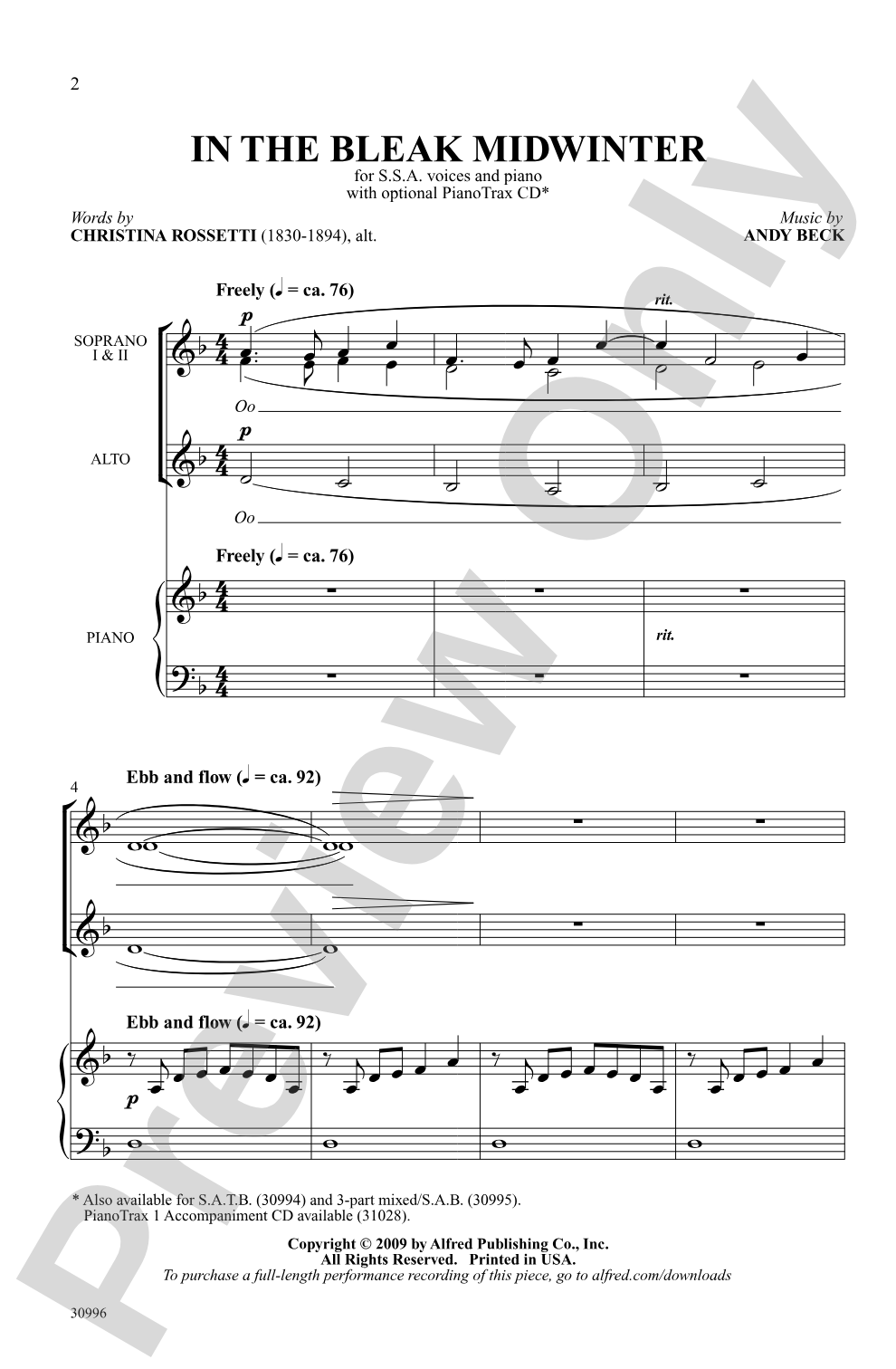

In the Bleak Midwinter: SSA Choral Octavo
Words by Christina Rossetti, music by Andy Beck
Item: 00-PO-0000738
$1.75
Minimum order quantity: 20 copies
Pickup currently not available
Related Items
In the Bleak Midwinter: PianoTrax Digital Download |
$9.99
|
View | |
In the Bleak Midwinter: SATB Choral Octavo |
$1.75
|
View | |
In the Bleak Midwinter: 3-Part / SAB Choral Octavo |
$1.75
|
View | |
In the Bleak Midwinter: SATB Choral Octavo |
$1.75
|
View | |
In the Bleak Midwinter: 3-Part / SAB Choral Octavo |
$1.75
|
View | |
In the Bleak Midwinter: SSA Choral Octavo |
$1.75
|
View |
Description
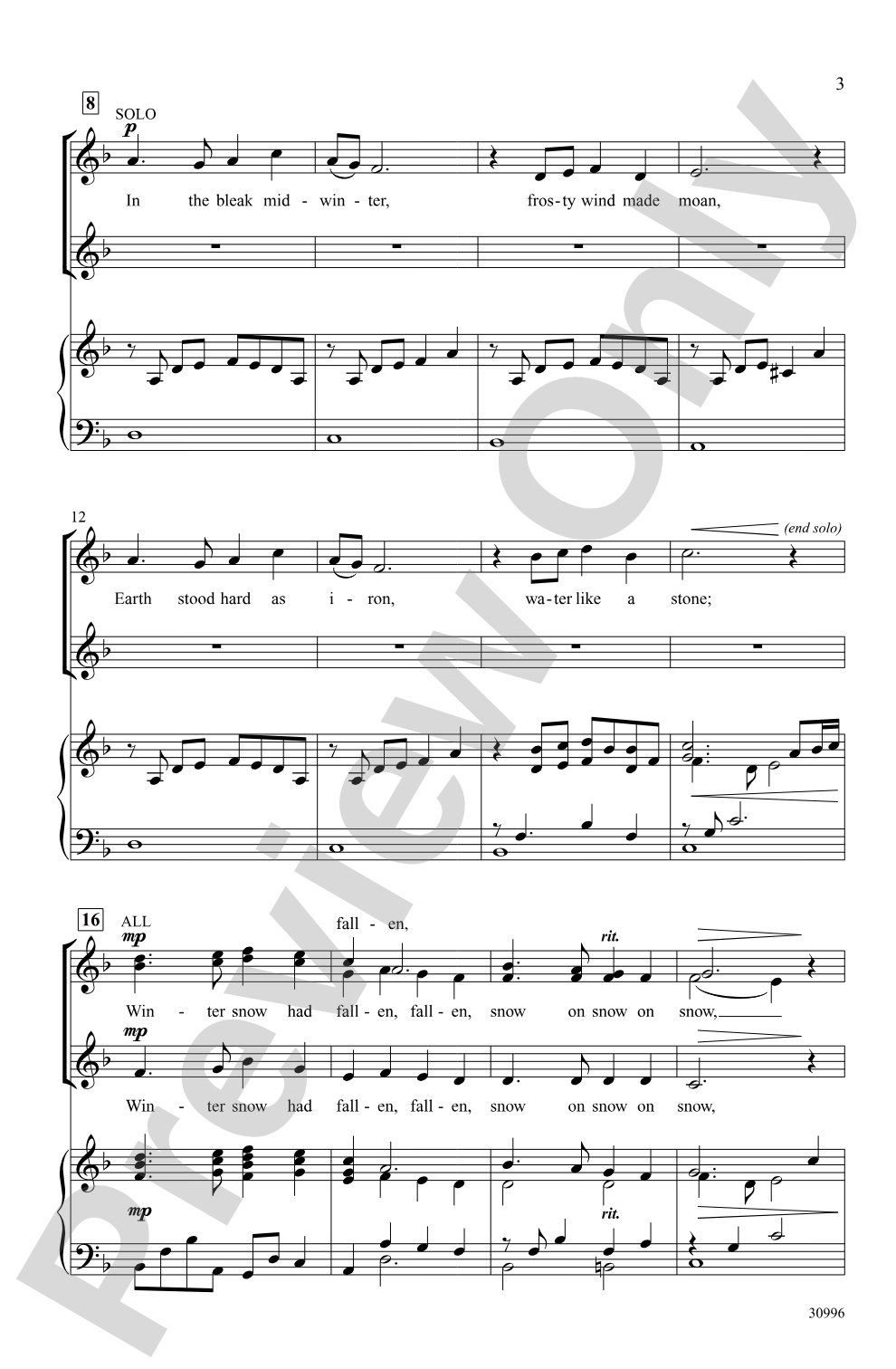
This artful choral setting captures all of the beauty and splendor of Christina Rossetti's famous text. While the minor key and biting dissonance depict the cold of winter, the rich chords and lyrical melodies evoke the warmth of a heartfelt message. Stunning. Accompaniment included on PianoTrax 1 CD (00-31028).


In the Bleak Midwinter: SSA Choral Octavo isn't in MakeMusic Cloud just yet...but it could be. Let us know you'd like to see it, and you'll help shape what comes next. In the meantime, start a free trial and dive into thousands of interactive titles your students can play along with today.
Request This Title
Tell us you want it.
Start Your Free Trial
Explore everything that's ready to play right now.
Sample Audio
1
Audio File
--:--
0:00
0:00
Sample Video
No sample videos found.
Additional Details
Series:
Alfred Choral Designs
Publisher:
Alfred Music
Page Count:
8
SKU:
00-PO-0000738
More about this title
About the Composer: Andy Beck

Andy Beck directs choral publications at Alfred Music and has composed and arranged over 450 choral works now in active circulation. His output spans sacred and secular repertoire, children's musicals, and influential choral resources including Sing at First Sight and Vocalize! 45 Vocal Warm-Ups That Teach Technique. He holds a Bachelor's degree in Music Education from Ithaca College and a Master's degree from Northwest Missouri State University.
Beck's choral music reaches singers on every continent. He regularly serves as a guest conductor, clinician, and adjudicator for honor choirs and all-state ensembles, particularly throughout the Southeast. A tenor himself, he has been a studio singer for Alfred Music since 1992 and remains active in performance and musical theatre direction. His work consistently reflects deep knowledge of what singers need to grow musically and technically.
Why we love this
Beck's treatment preserves every ounce of Rossetti's emotional weight while remaining entirely singable for developing treble choirs. The dissonance lands with purpose rather than difficulty; the minor key and rich harmonies feel deliberate and moving, not forced. Directors appreciate that this setting honors the poetry without demanding a virtuosic ensemble.
What to expect
Cold and austere at first, then luminous. The minor key and biting dissonance capture winter's sharp edge, but the lyrical melodies and rich harmonic motion gradually warm the space with devotion and hope. By the end, the small miracles in Rossetti's text feel intimate and profound.
Who it's for
SSA and SSAA choirs at the middle school through early college level will find this setting both accessible and genuinely artistic. The part-writing lies comfortably for developing singers, yet the harmonic language and text setting reward careful preparation and musical maturity.
How to get the most out of it
- Shape the minor key and dissonance with intention. These aren't obstacles to overcome; they're the musical embodiment of winter's bite. Lean into the darker colors without sacrificing warmth in the legit.
- Balance the melodic lines across voices so no single part dominates. The beauty emerges from how the voices move together, not from any one line standing apart.
- Use the accompanying CD to lock in harmonic movement during rehearsal. Once singers hear where their chords sit in context, intonation and blend settle quickly.
- Anchor the lyrical moments with breath and space. These phrases breathe; don't rush them just because the text is familiar.
How to use it
This works beautifully as the centerpiece of a Christmas program that leans toward contemplative repertoire rather than purely celebratory material. Pair it with lighter seasonal pieces to create depth and variety, or program it alongside other minor-key sacred works to emphasize the spiritual dimensions of the season.
Skills your students will build
- Reading and sustaining harmonic dissonance with accurate intonation
- Balancing blend across three or four parts while maintaining distinct melodic lines
- Interpreting minor tonality and dissonance as expressive tools, not technical challenges
- Attending to text underlay and phrasing in poetry-driven settings