
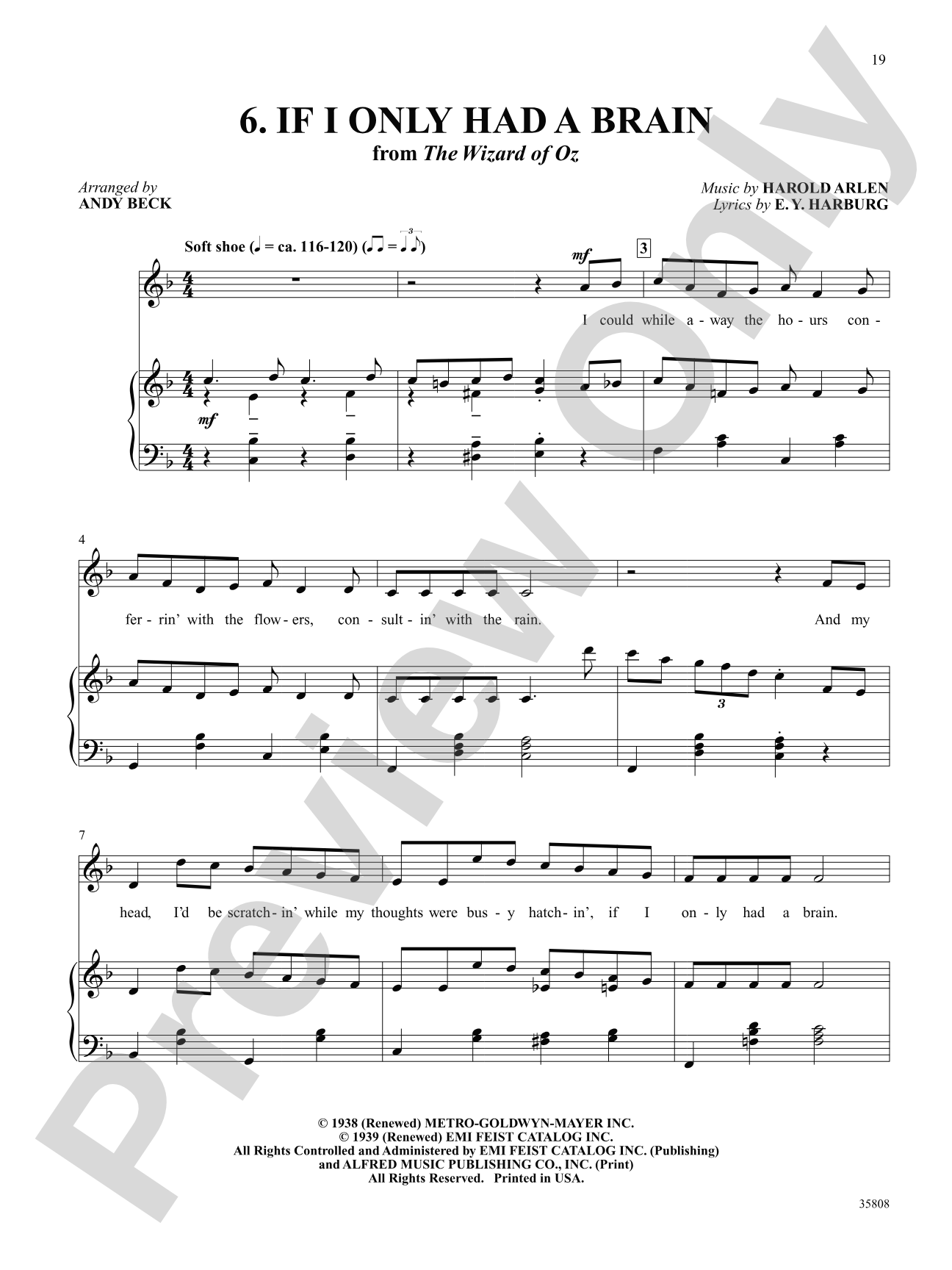

If I Only Had a Brain (from "The Wizard of Oz") - Piano/Vocal Solo with Optional Unison Reproducible Student Pages: Piano/Vocal Solo
12 Showtunes, Simply Arranged for Voice and Piano for Solo or Unison Singing
Arr. Andy Beck
Item: 00-PS-0017679
$4.99
One moment…
Related Items
Give My Regards to Broadway (from "Little Johnny Jones") - Piano/Vocal Solo with Optional Unison Reproducible Student Pages: Piano/Vocal Solo |
$5.99
|
View | |
Hushabye Mountain (from "Chitty Chitty Bang Bang") - Piano/Vocal Solo with Optional Unison Reproducible Student Pages: Piano/Vocal Solo |
$5.99
|
View | |
Ready to Sing... Broadway: Vocal Book & Online Audio/PDF |
$29.99
|
View | |
Ready to Sing... Broadway: Vocal Book |
$19.99
|
View | |
Ready to Sing... Broadway: Vocal Acc. CD |
$19.99
|
View |
Description
Appropriate for beginning soloists, unison classroom singing, and elementary choral groups. This budget-stretching publication is designed to support the teaching of basic singing skills. Includes reproducible song sheets. Titles: Forty-Second Street * Give My Regards to Broadway * Heart * How Lucky You Are * Hushabye Mountain * If I Only Had a Brain * It's Possible * Lullaby of Broadway * Round Shouldered Man * Shy * Try to Remember * Wouldn't It Be Loverly. A Federation Festivals 2020-2024 selection. A Federation Festivals 2024-2028 selection.


If I Only Had a Brain (from "The Wizard of Oz") - Piano/Vocal Solo with Optional Unison Reproducible Student Pages: Piano/Vocal Solo isn't in MakeMusic Cloud just yet...but it could be. Let us know you'd like to see it, and you'll help shape what comes next. In the meantime, start a free trial and dive into thousands of interactive titles your students can play along with today.
Request This Title
Tell us you want it.
Start Your Free Trial
Explore everything that's ready to play right now.
Sample Audio
1
Audio File
--:--
0:00
0:00
Sample Video
No sample videos found.
Additional Details
Series:
Ready to Sing
Publisher:
Alfred Music
Page Count:
64
SKU:
00-PS-0017679
More about this title
About the Composer: Harold Arlen
Harold Arlen (1905-1986) composed some of the most enduring melodies in American musical theater, with a gift for writing songs that lodge themselves in memory instantly. His collaborations with lyricist E.Y. Harburg on "The Wizard of Oz" produced a soundtrack that has shaped popular music for generations, and his work across Broadway and film demonstrates a mastery of both theatrical storytelling and singable, accessible melody.
Arlen's compositions have become staples of music education precisely because they balance musical sophistication with immediate appeal. Teachers and students encounter his work constantly, from elementary classrooms to college programs, making him one of the most influential composers for building foundational vocal skills and fostering genuine love of singing.
Why we love this
This arrangement preserves the charm of one of Broadway's most recognizable melodies while making it genuinely accessible to beginning singers. The unison option keeps ensemble voices unified without sacrificing the Scarecrow's personality, and the reproducible pages stretch limited budgets while supporting consistent, structured skill-building across your whole program.
What to expect
Earnest and wistful, with a touch of gentle humor. The melody moves with an almost conversational quality, letting words land naturally while the harmonic support quietly deepens emotion. It's the sound of longing expressed simply, the way someone might pour their heart out to a friend.
Who it's for
Beginning soloists preparing their first recital or audition will find a supportive, well-known melody with reasonable range and straightforward rhythms. Elementary and middle school choirs use this piece to develop ensemble blend, phrasing, and lyrical connection without overwhelming students with vocal or musical demands.
How to get the most out of it
- Keep the rhythm conversational and slightly lilting in the verses; this song lives in its natural speech patterns, not strict metronomic precision.
- Shape the phrase "if I only had a brain" with warmth rather than comedic exaggeration; let the character's yearning come through.
- Use dynamic contrast between verses and the more insistent repeated section to maintain interest and show musical architecture.
- Encourage singers to connect the text emotionally to the melody; this song works because the Scarecrow's wish feels genuine.
How to use it
Program this solo at a young singer's first recital alongside other accessible standards that build confidence. In a classroom setting, use it to teach legit phrasing and how to honor a song's emotional core. The unison arrangement works beautifully as a warm-up or as part of a concert section celebrating American musical theater.
Skills your students will build
- Legit vocal tone production in a comfortable range
- Sustaining phrases through text and breath management
- Connecting lyrical meaning to melodic shape
- Reading standard vocal-line notation with piano accompaniment
- Interpreting character and emotion through song