
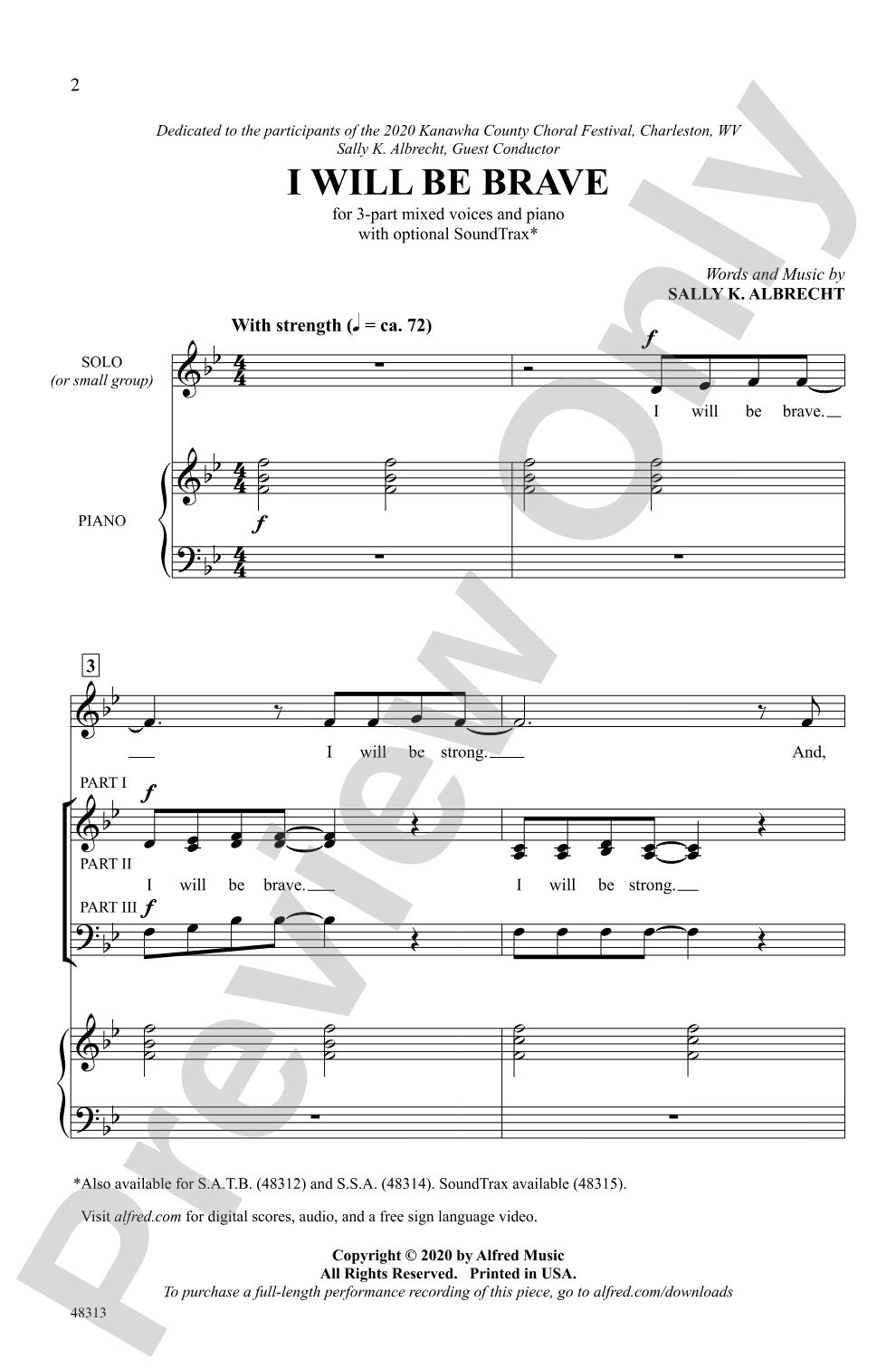

I Will Be Brave: 3-Part Mixed Choral Octavo
Words and music by Sally K. Albrecht
Item: 00-PO-0006311
$2.05
Minimum order quantity: 20 copies
Pickup currently not available
Related Items
I Will Be Brave: SoundTrax Digital Audio Download |
$29.99
|
View | |
I Will Be Brave: SATB Choral Octavo |
$2.05
|
View | |
I Will Be Brave: SSA Choral Octavo |
$2.05
|
View | |
I Will Be Brave: SATB Choral Octavo |
$2.05
|
View | |
I Will Be Brave: 3-Part Mixed Choral Octavo |
$2.05
|
View | |
I Will Be Brave: SSA Choral Octavo |
$2.05
|
View | |
I Will Be Brave: Choral Octavo SoundTrax CD |
$29.99
|
View |
Description
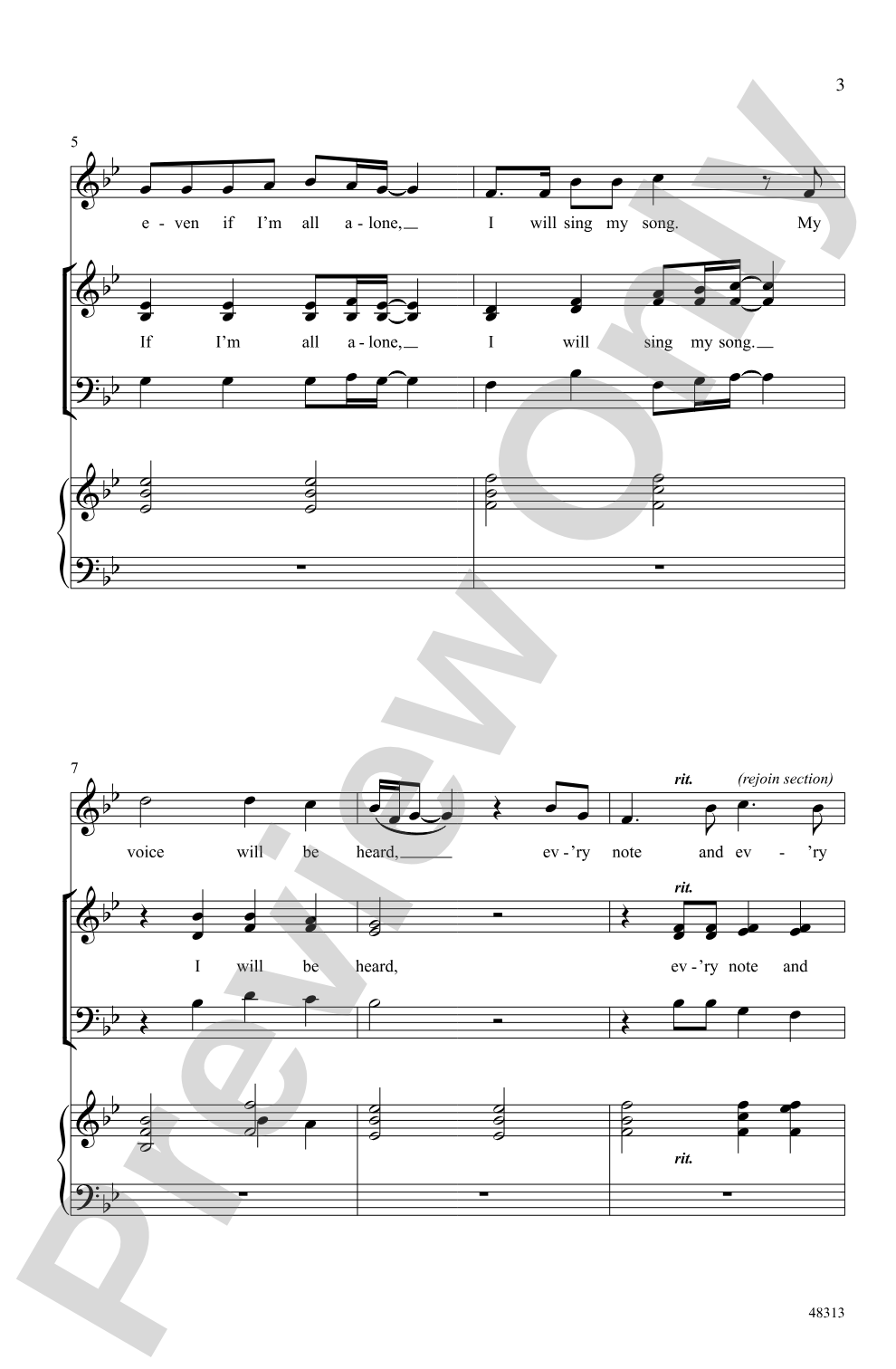
"I will be brave, I will be strong" echoes from choir to soloist (or small group) at the powerful start of this inspirational gospel-style original. Soon, a bright tempo kicks in to deliver an undeniably uplifting choral experience. Just right for combined concerts, festival groups, graduation celebrations, or at any time of year! A free online video invites the use of sign language, demonstrated by the author herself. This title is available in MakeMusic Cloud. This title is available in MakeMusic Cloud.


I Will Be Brave: 3-Part Mixed Choral Octavo isn't in MakeMusic Cloud just yet...but it could be. Let us know you'd like to see it, and you'll help shape what comes next. In the meantime, start a free trial and dive into thousands of interactive titles your students can play along with today.
Request This Title
Tell us you want it.
Start Your Free Trial
Explore everything that's ready to play right now.
Sample Audio
1
Audio File
--:--
0:00
0:00
Sample Video
1 / 3
Additional Details
Series:
Alfred Choral Designs
Publisher:
Alfred Music
Page Count:
12
SKU:
00-PO-0006311
More about this title
About the Composer: Sally K. Albrecht

Sally K. Albrecht has shaped American choral music for over three decades as a composer, conductor, and clinician with particular expertise in movement integration. An ASCAP award recipient since 1987, she has published more than 600 choral works alongside 75 larger musicals and songbooks, and has conducted honor choirs at venues including Lincoln Center, Carnegie Hall, and The Kennedy Center. She served as Director of School Choral, Vocal, and Elementary Publications for Alfred Music and held faculty positions at Oakland University, Jersey City State College, and Meredith College.
Albrecht holds a B.A. in Music and Theater from Rollins College (1976), an M.A. in Drama from the University of Miami (1977), and an M.M. in Accompanying from Miami (1979). She has chaired the Board of Trustees for the Omicron Delta Kappa National Leadership Honor Society and received their Pillar of Leadership award. In 2021, she was honored with Distinguished Alumna Awards from both the University of Miami Frost School of Music and Rollins College, where she currently serves on the Board of Trustees. She lives in Wake Forest, North Carolina, with her husband, composer and arranger Jay Althouse.
Why we love this
The arc of this piece moves from introspective power to infectious joy, giving your singers a genuine emotional arc to perform rather than a single mood held throughout. Albrecht's gospel-influenced harmonic language and rhythmic vitality feel contemporary without alienating singers unfamiliar with the idiom, making it equally effective at festivals, graduation ceremonies, or community concerts where you want something with real substance and warmth.
What to expect
The opening carries quiet conviction, like a promise being made aloud. Once the tempo lifts, the piece radiates optimism and forward motion, anchored by Albrecht's straightforward harmonic language and propulsive rhythm that feels both modern and deeply rooted in American choral tradition.
Who it's for
Directors programming combined or festival choirs who need a piece that lands emotionally without being heavy, and singers who respond to music with a contemporary gospel aesthetic and clear inspirational intent. This works equally well for experienced singers seeking accessible variety and developing choirs ready to tackle three-part writing with rhythmic independence.
How to get the most out of it
- Allow the opening exchange between choir and soloist (or small group) to breathe. The solo line carries the message; the choir response should feel like a collective affirmation rather than a rushed echo.
- When the tempo shifts, commit fully to the brighter energy. This isn't a gradual lift; it's a deliberate change in character that should feel like momentum has arrived.
- The free online video demonstrating sign language offers a concrete visual layer. Even if you don't teach the full vocabulary, learning key phrases adds dimension to the performance and deepens student investment in the message.
- Pay attention to the harmonic color in the mixed voicing. SAB writing can blur sonority if not balanced carefully; prioritize clarity in the soprano and alto parts so the contemporary chords read distinctly.
How to use it
Position this near the end of a graduation ceremony program or the closing section of a spring concert where it can serve as an emotional high point. It also pairs naturally with other contemporary sacred or secular choral works on a festival program, offering a tonal palate cleanser that isn't hymn-based and maintains audience engagement.
Skills your students will build
- Reading and singing rhythmic patterns in a contemporary gospel idiom
- Balancing independent melodic lines across three voices while maintaining harmonic blend
- Performing ensemble dynamics that shift between intimate (opening) and full-voiced (tempo change) textures
- Interpreting text with conviction and connecting physical gesture (sign language) to vocal expression
- Managing transitions between contrasting tempos and moods within a single piece