
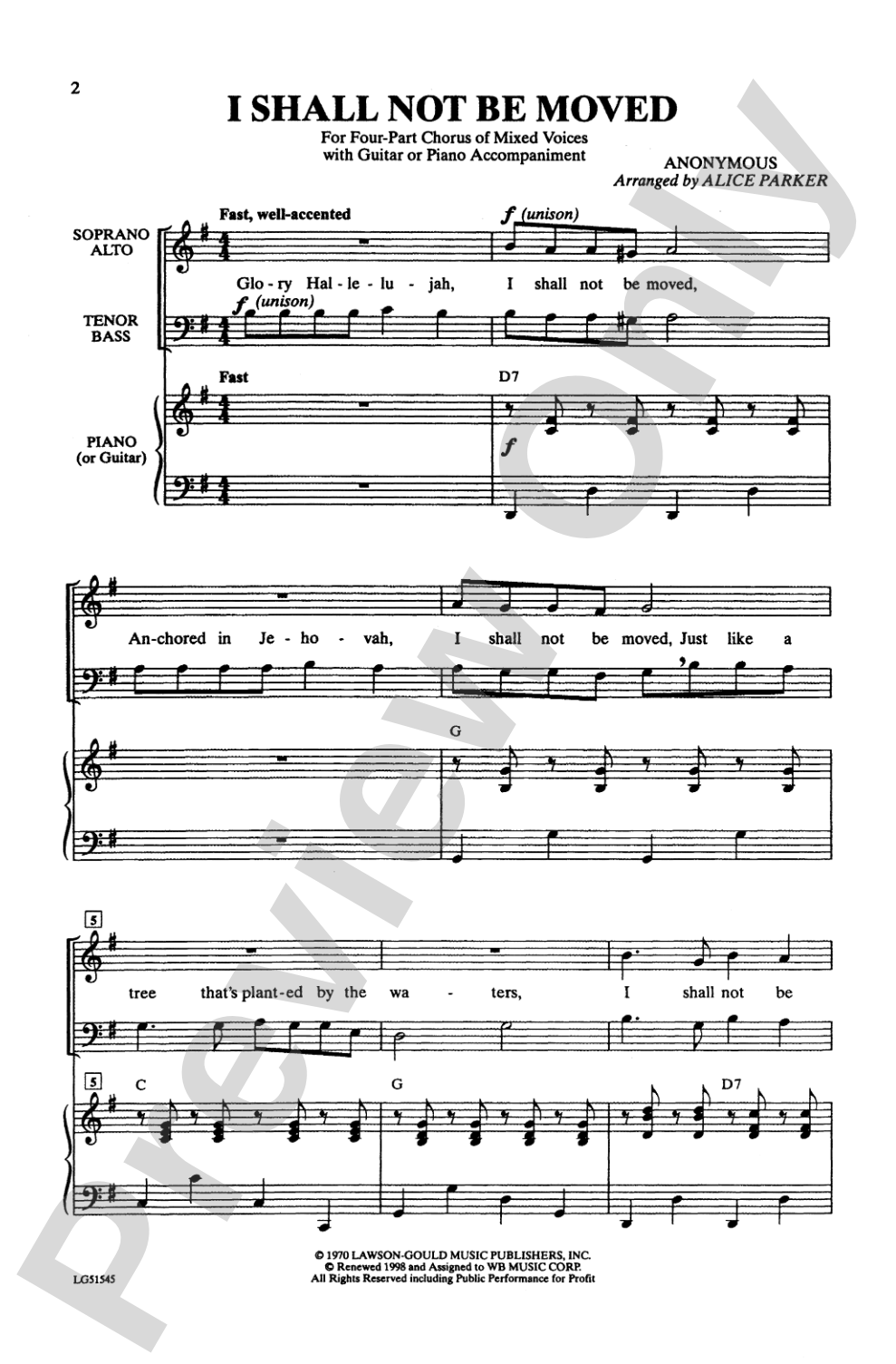
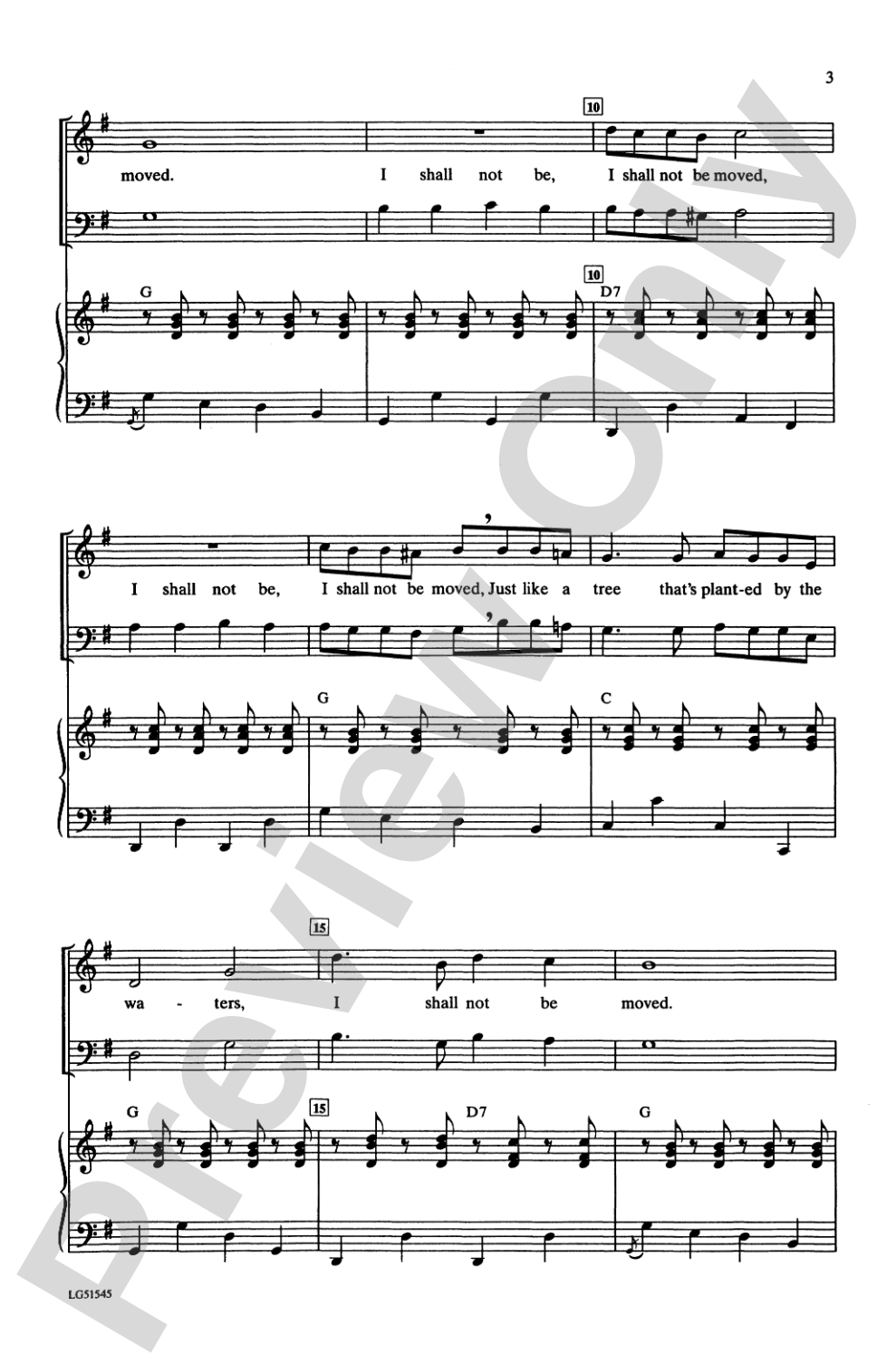

I Shall Not Be Moved: SATB Choral Octavo
Arr. Alice Parker
Item: 00-PO-0003020
$2.25
Minimum order quantity: 20 copies
Pickup currently not available
Description


I Shall Not Be Moved: SATB Choral Octavo isn't in MakeMusic Cloud just yet...but it could be. Let us know you'd like to see it, and you'll help shape what comes next. In the meantime, start a free trial and dive into thousands of interactive titles your students can play along with today.
Request This Title
Tell us you want it.
Start Your Free Trial
Explore everything that's ready to play right now.
Sample Audio
No sample audio found.
Sample Video
No sample videos found.
Additional Details
Series:
Alfred Archive Edition: Lawson-Gould Music Publishers
Publisher:
Alfred Music
Page Count:
12
SKU:
00-PO-0003020
More about this title
About the Arranger: Alice Parker

Alice Parker built her reputation on a singular mission: making the melody sing. A composer and conductor trained at Smith College and Juilliard, she formed a creative partnership with Robert Shaw that produced hundreds of settings of American spirituals, folksongs, and hymns. These arrangements have become foundational to choral repertoire, performed by ensembles worldwide.
Parker's influence extended far beyond the page. In 1985, she established Melodious Accord, Inc., directing her energies toward vocal pedagogy and the art of congregational singing. She authored influential texts on choral improvisation and church music, served as Director Laureate of Chorus America, and received major honors including the Robert Shaw Award from the American Choral Directors Association and the Harvard Glee Club Foundation Medal. Her legacy rests on a deceptively simple belief: a great melody, well arranged and well sung, is transformative.
Why we love this
Parker's arrangements of spirituals have an architectural clarity that lets text and melody do the emotional work. This setting avoids both over-arrangement and under-arrangement; instead, it gives each voice part something to sing that feels inevitable. Choirs find these pieces rewarding because the writing sits naturally in the voice, the harmony supports rather than clutters, and the spiritual itself remains the center of attention.
What to expect
The piece carries the weight and resilience of the spiritual tradition without ornamentation. There is quiet conviction in the writing, a sense that these words and this melody have survived because they matter. The harmony feels both rooted and buoyant, creating space for genuine expression without drama.
Who it's for
This octavo serves choirs seeking authentic, singable arrangements of spirituals for worship services, concert programs, or festival performances. Directors working with SATB ensembles of moderate capability will find the vocal ranges and part-writing accessible while still musically substantial.
How to get the most out of it
- Shape the melody with attention to text stress, not phrase length. Parker's phrasing often follows the natural rhythm of the words rather than symmetrical four-bar phrases; let the meaning guide your breath marks.
- Balance the SATB texture so the spiritual's core melody emerges clearly, whether it sits in the soprano line or moves between voices. Every part contributes texture, but none should bury the tune.
- Approach the rhythmic simplicity with intentionality. What might appear straightforward deserves the same care you would give a complex arrangement. The power lies in restraint and clarity of sound.
- Set a tempo that honors the hymn-like dignity of the piece while allowing the text to breathe. Spiritual settings often benefit from a measured pace that lets each phrase land fully.
How to use it
Program this alongside other spirituals or hymn-based works for a concert exploring American sacred music traditions, or use it in a service of worship where the text resonates with the liturgical moment. Its moderate length and accessible voicing make it suitable for singers of varying experience levels, allowing you to include it in a diverse choral program without creating technical strain.
Skills your students will build
- Singing spirituals with textual integrity and historical awareness
- Balancing four-part harmony to highlight the primary melodic line
- Phrasing according to textual meaning rather than symmetrical bar structures
- Sustaining tone quality and ensemble blend in slow-moving, hymn-like arrangements