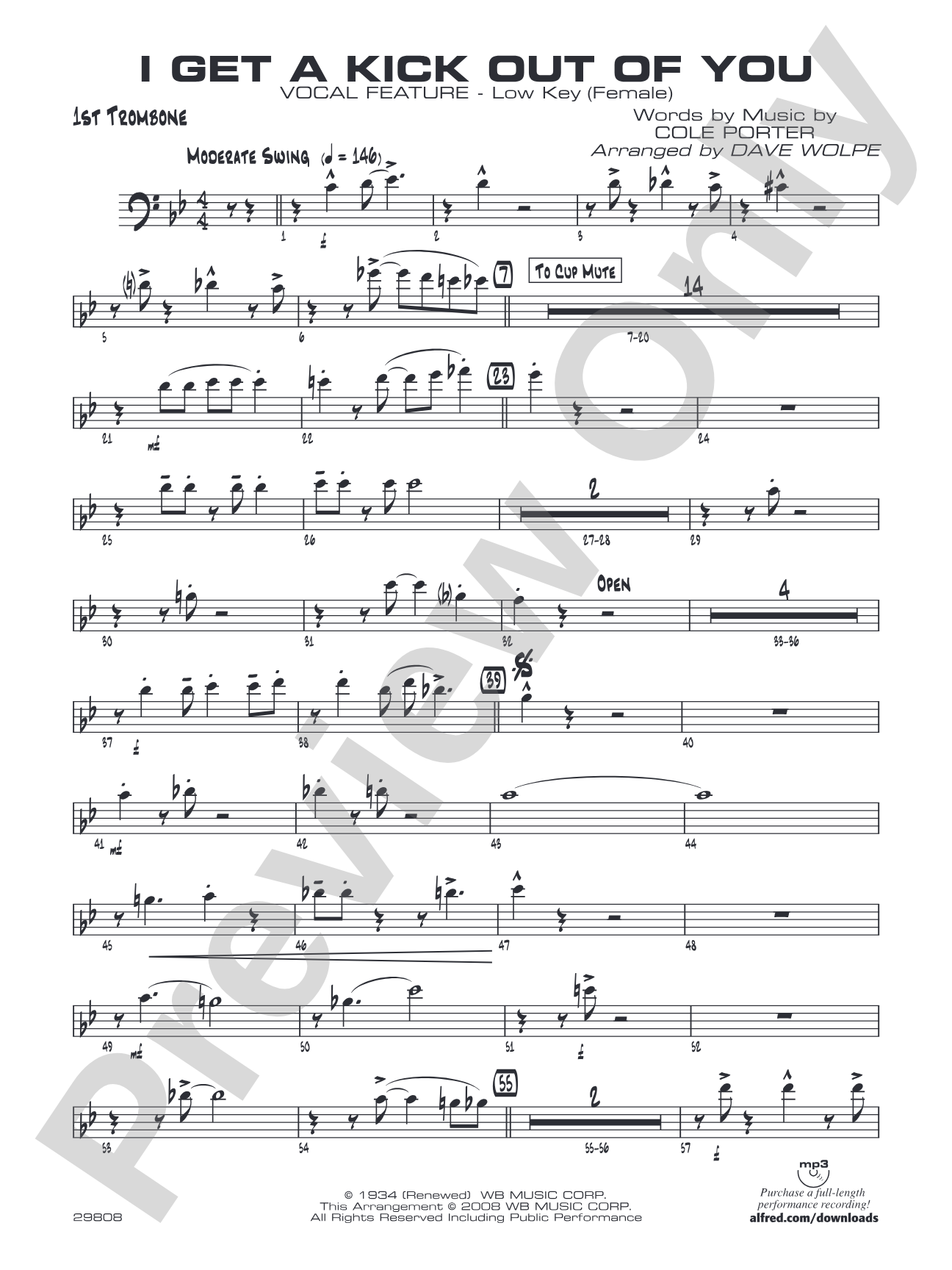
I Get a Kick Out of You: 1st Trombone Sheet Music Preview

I Get a Kick Out of You: 1st Trombone

Arr. Dave Wolpe

Grade: 3.5 (Medium)

Item: 00-PC-0016185_TN1

Digital Download
$3.00
Description
A staple of every jazz singer's repertoire, arranger Dave Wolpe delivers another great chart with plenty of musical space for the vocalist. Dave knows how to arrange better than just about anyone and this chart proves it with perfect ensemble writing, an alto solo, and it's arranged in two keys: female (low) key of B-flat---G below middle C to 3rd space C, male (high) key of E-flat---middle C to top line F, treble clef. Includes two scores and reversible parts---just flip the page for the key that suits your vocalist. You'll get a kick out of this chart! (4:02)

I Get a Kick Out of You: 1st Trombone isn't in MakeMusic Cloud just yet...but it could be. Let us know you'd like to see it, and you'll help shape what comes next. In the meantime, start a free trial and dive into thousands of interactive titles your students can play along with today.

Sample Audio
0:00
0:00
Sample Video
Additional Details
Series: Jazz Vocal Series
Publisher: Alfred Music
Page Count: 102
SKU: 00-PC-0016185_TN1

More about this title

About the Arranger: Dave Wolpe

Dave Wolpe

Dave Wolpe began his arranging career in 1965 and has spent decades crafting charts for some of the most celebrated big band orchestras in American music. His work with the Glenn Miller Orchestra alone spans dozens of arrangements, and he served as co-arranger on the platinum-certified recording In the Christmas Mood. Beyond the Miller legacy, his arrangements have graced the stands of Ray Anthony, Lawrence Welk, and Les Brown, cementing his reputation as one of the most reliable voices in traditional jazz orchestration.

Why we love this

Wolpe's chart gives your vocalist room to breathe while keeping the ensemble engaged throughout. The dual-key format (B-flat and E-flat on reversible parts) means you can cast this standard with confidence, whether your singer sits low or high, without reprinting a single page. The alto solo and clean ensemble writing make this feel like a genuine jazz conversation, not a backing track.

What to expect

Sophisticated and swinging, with the ease of a seasoned performer settling into a familiar song. The arrangement lets the vocal melody float above crisp ensemble writing while maintaining the playful confidence the tune demands. You'll hear why this is a jazz repertoire staple.

Who it's for

Jazz singers building a standards book, and directors seeking a reliable vocal feature that sounds polished without sacrificing intimacy. This works for advanced high school jazz ensembles and college groups where the vocalist is the centerpiece of your sound.

How to get the most out of it

  • Balance the vocalist's phrasing with the ensemble's swing feel; Wolpe leaves generous space, so use it to let your singer shape the melody without rhythmic pressure from the band.
  • The alto solo deserves a strong player who can trade energy with the vocalist; rehearse that exchange separately so it feels like a real musical moment.
  • Lock the rhythm section (piano, bass, drums) first, then layer the horns; this chart's cohesion depends on a solid harmonic pocket underneath.

How to use it

Feature this in a jazz concert's second set, where audiences have settled in and expect a showcase moment. It pairs naturally with other vocal standards and gives your ensemble a chance to shine as accompanists rather than soloists. Consider programming it near other Wolpe arrangements for a cohesive sound throughout the evening.

Skills your students will build

  • Comping rhythmically and harmonically behind a vocalist
  • Trading solo space (alto with vocalist) while maintaining ensemble cohesion
  • Interpreting swing phrasing in a section setting
  • Reading and performing from reversible parts in multiple keys

You May Also Like