
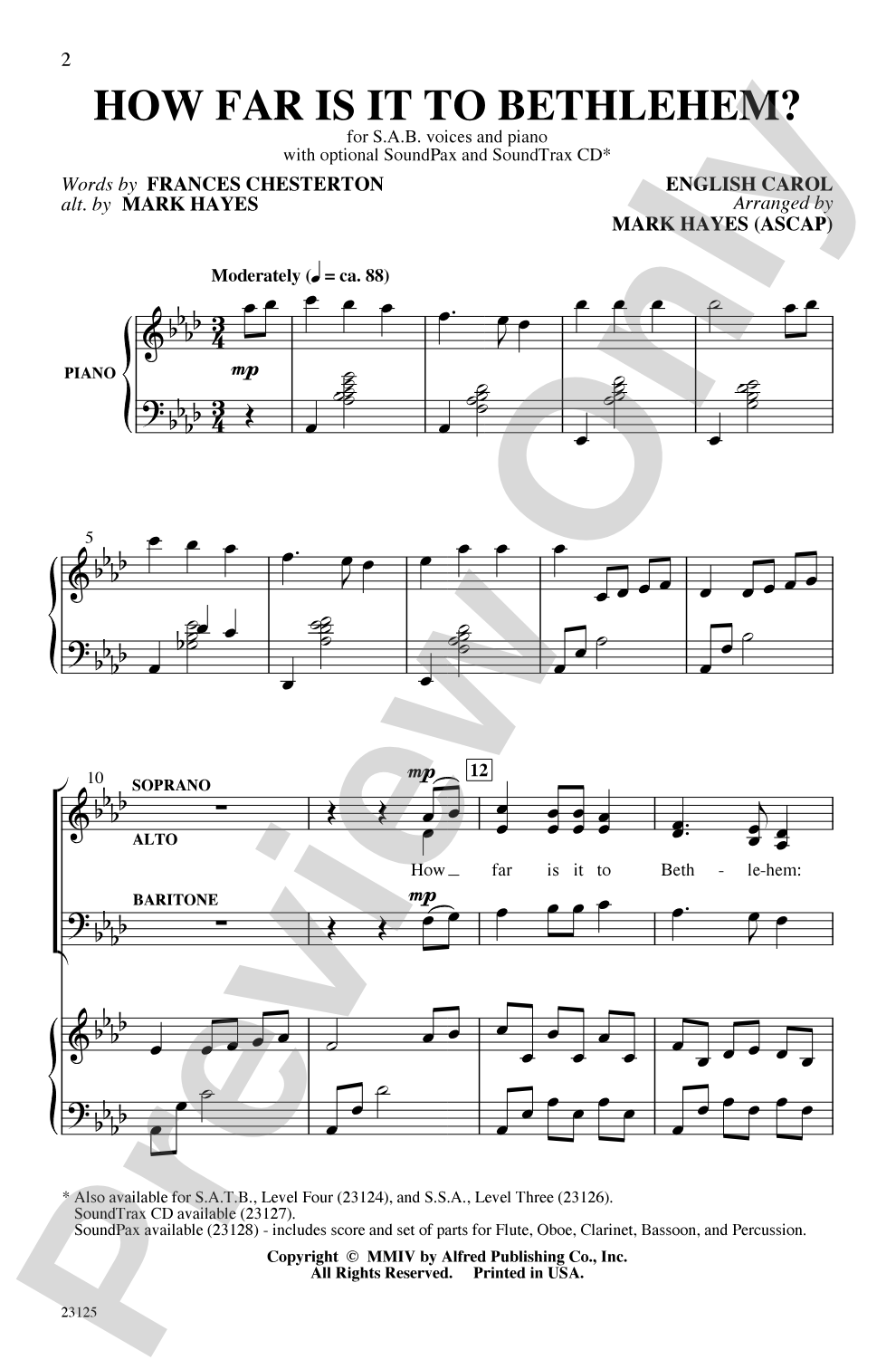
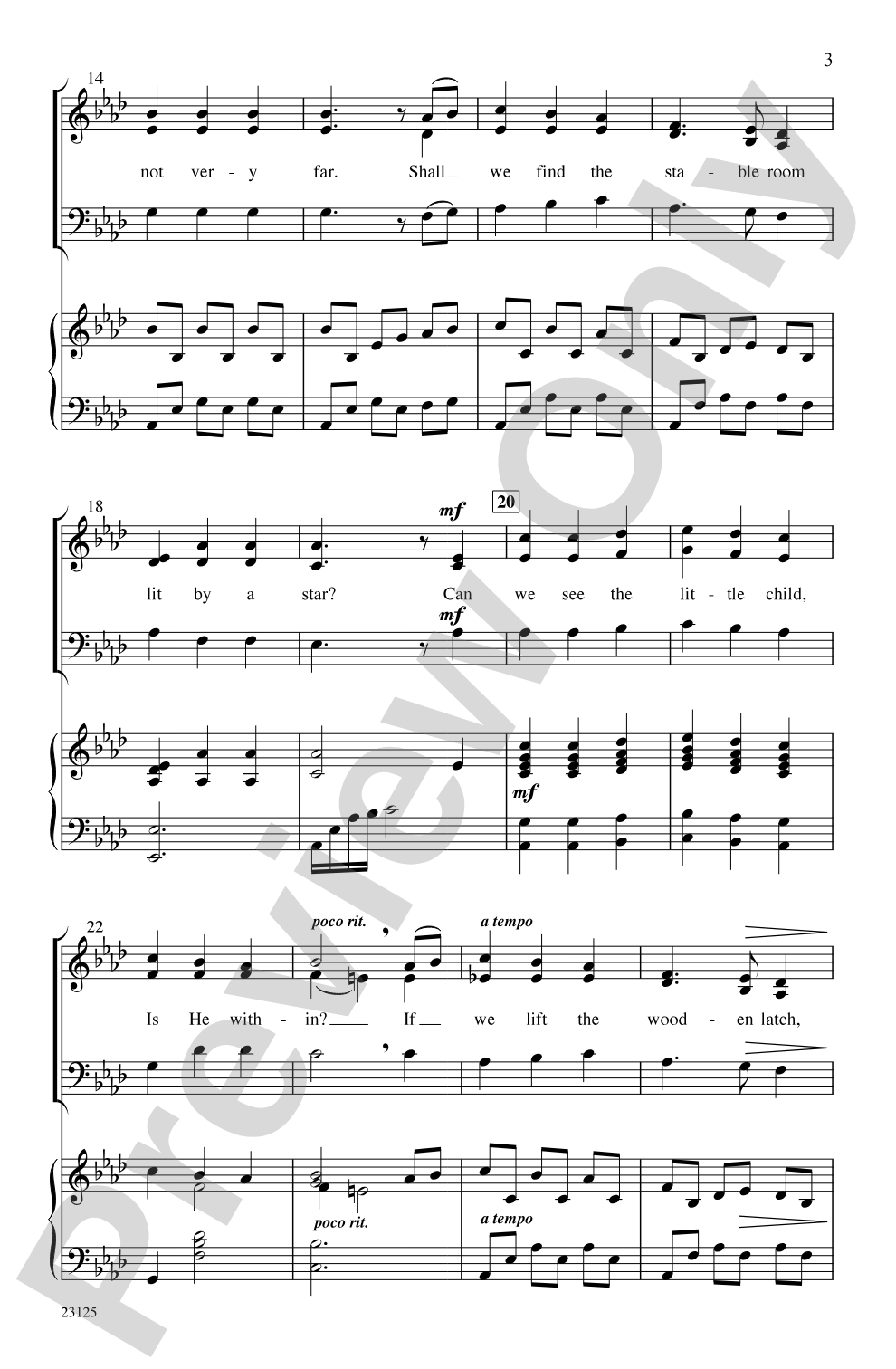

How Far Is It to Bethlehem?: SAB Choral Octavo
Arr. Mark Hayes
Item: 00-PO-0007949
$1.65
Minimum order quantity: 20 copies
Pickup currently not available
Related Items
How Far Is It to Bethlehem?: SATB Choral Octavo |
$1.65
|
View | |
How Far Is It to Bethlehem?: SSA Choral Octavo |
$2.25
|
View | |
How Far Is It to Bethlehem?: Choral SoundPax |
$20.00
|
View | |
How Far Is It to Bethlehem?: SATB Choral Octavo |
$1.65
|
View | |
How Far Is It to Bethlehem?: SAB Choral Octavo |
$1.65
|
View | |
How Far Is It to Bethlehem?: SSA Choral Octavo |
$2.25
|
View | |
How Far Is It to Bethlehem?: Choral Octavo SoundTrax CD |
$26.99
|
View | |
How Far Is It to Bethlehem?: Choral SoundPax |
$20.00
|
View |
Description
Mark Hayes lets the beauty of the melody shine in his arrangement of How Far Is It to Bethlehem. His simple, strophic treatment and sensible harmonies never overshadow the purity of the gentle, inquisitive carol. And yet there is something truly unique and awesome about this setting for the choirs of today. A sweet, accomplishable arrangement for any group.


How Far Is It to Bethlehem?: SAB Choral Octavo isn't in MakeMusic Cloud just yet...but it could be. Let us know you'd like to see it, and you'll help shape what comes next. In the meantime, start a free trial and dive into thousands of interactive titles your students can play along with today.
Request This Title
Tell us you want it.
Start Your Free Trial
Explore everything that's ready to play right now.
Sample Audio
1
Audio File
--:--
0:00
0:00
Sample Video
No sample videos found.
Additional Details
Series:
Alfred Choral Designs
Publisher:
Alfred Music
Page Count:
8
SKU:
00-PO-0007949
More about this title
About the Arranger: Mark Hayes
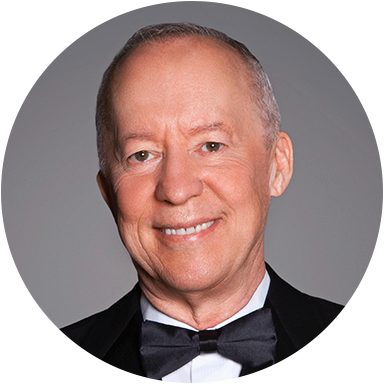
Mark Hayes has composed and arranged over 1,750 published works across every musical genre. His career spans concert halls from Lincoln Center to the Vatican, where he has premiered major choral works including his Requiem. A summa cum laude graduate of Baylor University's Piano Performance program, Hayes earned the 2010 Award for Exemplary Leadership in Christian Music from his alma mater.
Beyond his choral legacy, Hayes maintains prolific output as a pianist and orchestrator. His catalog includes more than 100 piano books ranging from gospel to jazz to classical repertoire, and he has orchestrated musicals and served as guest conductor at Carnegie Hall and the National Cathedral. Based in Kansas City, Hayes continues composing with a mission to create music that serves musicians of all levels.
Why we love this
Hayes's touch here honors the carol's contemplative core without adding unnecessary complexity. He chooses restraint as his tool, letting three parts move with natural clarity while the melody remains the focal point. For directors seeking a Christmas piece that works for developing singers without sacrificing musical substance, this arrangement delivers.
What to expect
The carol unfolds with wonder and quiet curiosity. There is a tenderness in the pacing and voicing that invites contemplation rather than celebration. The harmonies feel honest and accessible, never calling attention to themselves but instead deepening the sense of intimate searching at the heart of the text.
Who it's for
This works beautifully for SAB choirs at any experience level, from developing community or church groups to upper-level high school ensembles looking for a refined holiday selection. Directors can confidently program it knowing the voicing is genuinely singable and the arrangement respects both the singers and the listener.
How to get the most out of it
- Balance the melody prominently in the soprano line while keeping inner voices warm but secondary; this ensures the gentle, questioning character of the tune remains clear throughout.
- Take advantage of the recorded accompaniment to lock in ensemble blend before adding solo parts or featured sections, particularly useful in rehearsals where instrumental reinforcement is limited.
- Shape each strophe with subtle dynamic shaping rather than dramatic shifts; the power of this arrangement lies in its intimate simplicity, so trust the melody and harmonies to carry the emotional weight.
How to use it
Pair this with a more robust Christmas selection to create a program that moves from the reflective to the triumphant. It works especially well as an opening piece in a holiday concert, establishing a meditative mood before building toward brighter carols. This is also ideal for mid-winter services or special performances where atmosphere matters more than spectacle.
Skills your students will build
- Sustaining legit phrasing in three-part writing while tracking independent voice movements
- Balancing chord sonorities across SAB voicing, particularly in maintaining soprano line prominence
- Responding to harmonic context when shaping dynamics and articulation choices
- Sight-reading in connected, flowing style rather than detached syllabic singing