
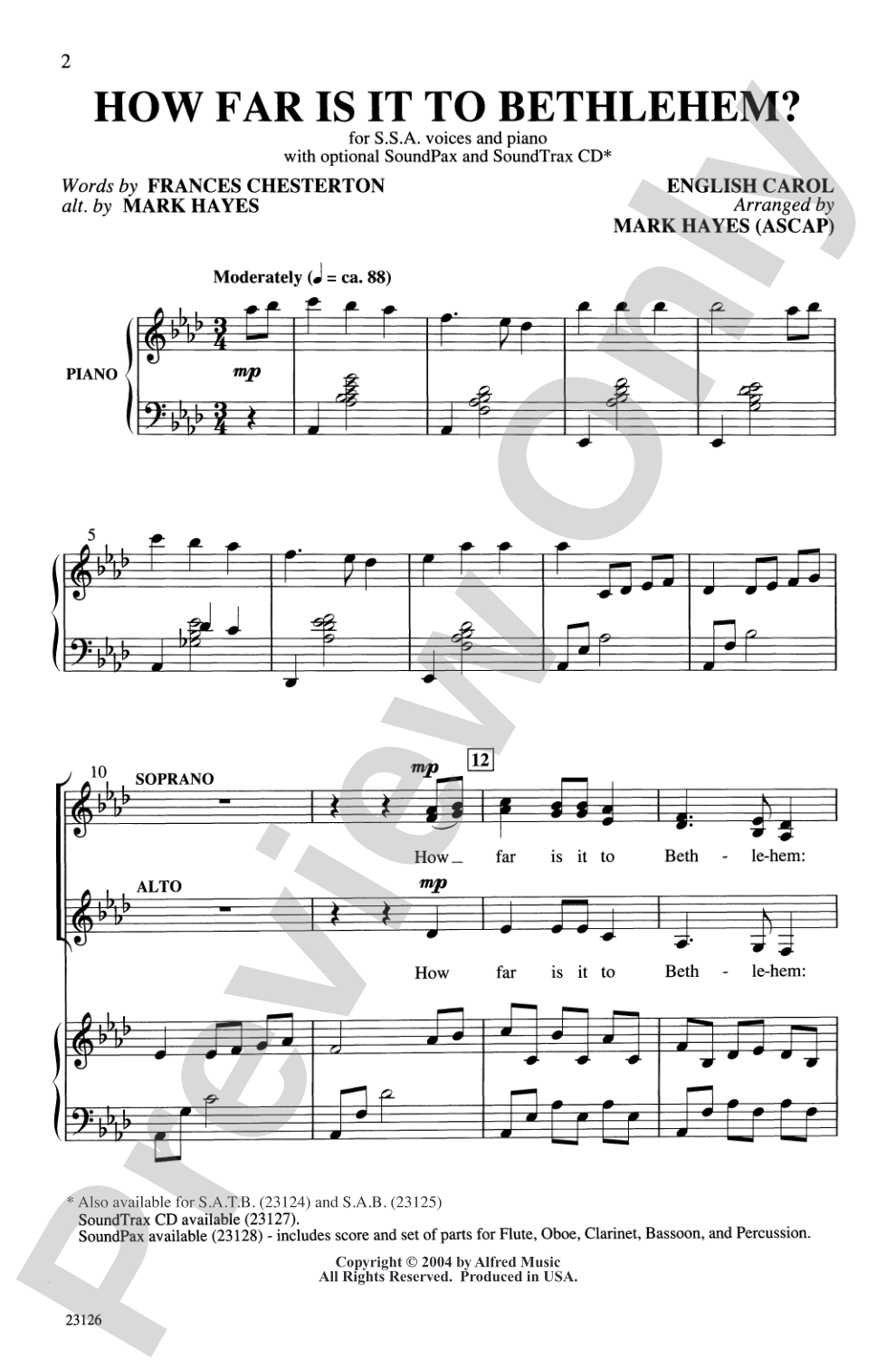
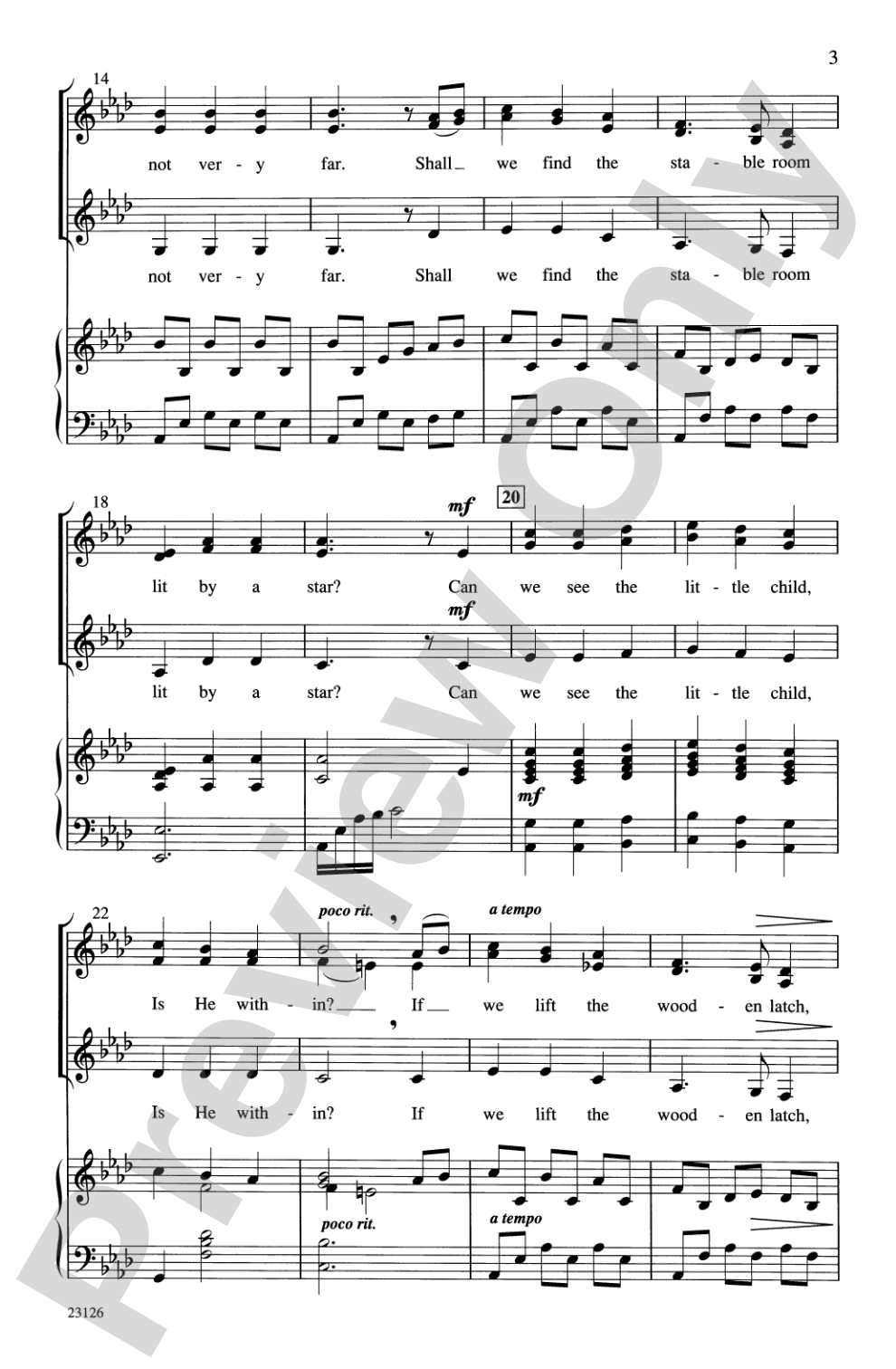

How Far Is It to Bethlehem?: SSA Choral Octavo
Arr. Mark Hayes
Item: 00-PO-0006539
$2.25
Minimum order quantity: 20 copies
Pickup currently not available
Related Items
How Far Is It to Bethlehem?: SATB Choral Octavo |
$1.65
|
View | |
How Far Is It to Bethlehem?: SAB Choral Octavo |
$1.65
|
View | |
How Far Is It to Bethlehem?: Choral SoundPax |
$20.00
|
View | |
How Far Is It to Bethlehem?: SATB Choral Octavo |
$1.65
|
View | |
How Far Is It to Bethlehem?: SAB Choral Octavo |
$1.65
|
View | |
How Far Is It to Bethlehem?: SSA Choral Octavo |
$2.25
|
View | |
How Far Is It to Bethlehem?: Choral Octavo SoundTrax CD |
$26.99
|
View | |
How Far Is It to Bethlehem?: Choral SoundPax |
$20.00
|
View |
Description
Mark Hayes lets the beauty of the melody shine in his arrangement of How Far Is It to Bethlehem. His simple, strophic treatment and sensible harmonies never overshadow the purity of the gentle, inquisitive carol. And yet there is something truly unique and awesome about this setting for the choirs of today. A sweet, accomplishable arrangement for any group.


How Far Is It to Bethlehem?: SSA Choral Octavo isn't in MakeMusic Cloud just yet...but it could be. Let us know you'd like to see it, and you'll help shape what comes next. In the meantime, start a free trial and dive into thousands of interactive titles your students can play along with today.
Request This Title
Tell us you want it.
Start Your Free Trial
Explore everything that's ready to play right now.
Sample Audio
1
Audio File
--:--
0:00
0:00
Sample Video
No sample videos found.
Additional Details
Series:
Alfred Choral Designs
Publisher:
Alfred Music
Page Count:
8
SKU:
00-PO-0006539
More about this title
About the Arranger: Mark Hayes
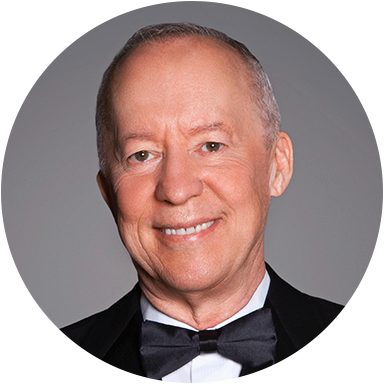
Mark Hayes stands among the most prolific composers and arrangers in sacred and secular music today, with over 1,750 published works spanning concert piano, choral literature, orchestration, and musical theater. A summa cum laude graduate in Piano Performance from Baylor University, Hayes has conducted major ensembles at Lincoln Center, the National Cathedral, and Carnegie Hall, and has premiered significant works including his Requiem at both Lincoln Center and St. Ignatius Basilica in Rome as part of a Vatican-sponsored festival.
Beyond the concert hall, Hayes has demonstrated versatility across multiple genres: he orchestrated the musical Madame Buttermilk, composed the score for Civil War Voices (which won six awards at the Midtown International Theatre Festival), and authored over 100 piano books in styles ranging from gospel and classical to jazz and Broadway. In 2010, Baylor University recognized his contributions with the Award for Exemplary Leadership in Christian Music. His work consistently reflects a commitment to writing music that serves both artistic ambition and practical accessibility for performers.
Why we love this
Hayes captures the essential innocence of this carol without needless elaboration. The strophic design and transparent harmonies allow the melody itself to anchor the piece, making it genuinely achievable for developing choirs while retaining the emotional clarity that makes this carol distinctive. This is the rare arrangement that trusts both the tune and your singers.
What to expect
The piece unfolds with quiet contemplation, inviting rather than imposing. There is something inherently tender in its approach to the question at the heart of the text, and Hayes's harmonies never strain or overwhelm that vulnerability. Singing it feels like sharing something personal rather than delivering a performance.
Who it's for
This arrangement serves directors seeking a Christmas carol that SSA choirs can learn quickly and perform with genuine musicality. It works equally well for church choirs, school ensembles, and community groups looking for a piece that respects the singers' capability while honoring the carol's meditative quality.
How to get the most out of it
- Let the text drive the phrasing; the gentle, questioning nature of the lyrics should feel conversational rather than ceremonial.
- Balance the SSA texture so that the melody (typically in the first soprano line) remains audible without requiring sopranos to oversing.
- Take unhurried tempos that allow the harmonies to settle; there is no need to rush a piece built on such simplicity.
- Consider how instrumental support (if using the available accompaniment parts) reinforces rather than dominates the choral sound.
How to use it
Position this as an intimate moment in a Christmas concert, perhaps paired with a more robust carol to create dynamic contrast. It also serves effectively in services of lessons and carols, church holiday programming, or any context calling for a carol that emphasizes reflection over spectacle.
Skills your students will build
- Sustaining musical line across strophic forms (same melody with repeating text)
- Balancing individual voice parts within a three-part texture
- Singing with text clarity and emotional intention in a transparent harmonic setting
- Reading and interpreting simple but elegant choral voicing