
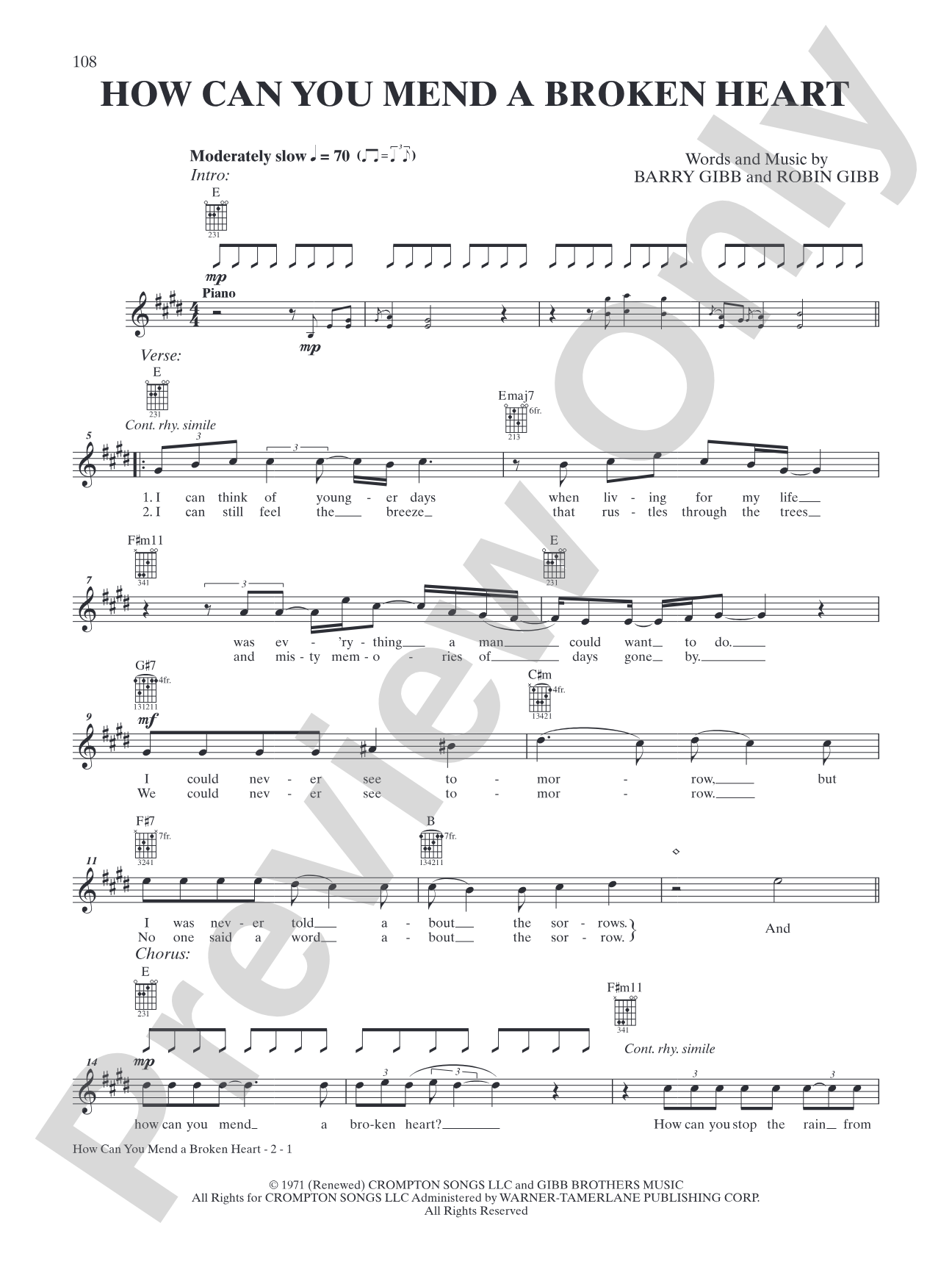

How Can You Mend a Broken Heart: Interm./Easy Guitar TAB
66 Essential Songs of the Era
Item: 00-PS-0011478
$4.99
One moment…
Related Items
Melissa: Interm./Easy Guitar TAB |
$4.99
|
View | |
Whipping Post: Interm./Easy Guitar TAB |
$4.99
|
View | |
Can't Get Enough (of Your Love): Interm./Easy Guitar TAB |
$5.99
|
View | |
96 Tears: Interm./Easy Guitar TAB |
$4.99
|
View | |
You Can't Always Get What You Want: Interm./Easy Guitar TAB |
$5.99
|
View | |
Do You Want to Know a Secret: Interm./Easy Guitar TAB |
$4.99
|
View |
Description
The baby boom generation changed the world, and this music is the soundtrack of that change. This book contains easy guitar TAB arrangements of 66 songs by the greatest artists of the '60s and '70s, including The Rolling Stones, Led Zeppelin, Joni Mitchell, the Grateful Dead, Blind Faith, Harry Chapin, Sly & the Family Stone, The Beatles, Jackson Browne, Buffalo Springfield, Derek and the Dominos, The Kinks, Rod Stewart, The Eagles, Janis Joplin, The Allman Brothers, Cream, Crosby, Stills, Nash & Young, and many more!


How Can You Mend a Broken Heart: Interm./Easy Guitar TAB isn't in MakeMusic Cloud just yet...but it could be. Let us know you'd like to see it, and you'll help shape what comes next. In the meantime, start a free trial and dive into thousands of interactive titles your students can play along with today.
Request This Title
Tell us you want it.
Start Your Free Trial
Explore everything that's ready to play right now.
Sample Audio
No sample audio found.
Sample Video
No sample videos found.
Additional Details
Series:
The Boomer's Book
Publisher:
Alfred Music
Page Count:
264
SKU:
00-PS-0011478
More about this title
About the Composer: Barry Gibb
Barry Gibb is a British-Australian singer, songwriter, and producer who co-founded the Bee Gees with his brothers Robin and Maurice. Born in 1946, he emerged as one of the most significant songwriters of the late 20th century, crafting some of the era's most enduring pop and rock hits. His melodic gift and production sensibility shaped the sound of multiple decades, from soft rock ballads to the disco phenomenon of the 1970s.
As a composer, Gibb's work spans intimate acoustic songs to expansive orchestral arrangements. His ability to write memorable hooks and emotionally resonant lyrics made him a favorite among guitarists and singers seeking accessible yet sophisticated material. Many of his compositions have become standards in music education settings, valued for their clear melodic lines and straightforward harmonic structures.
Why we love this
This book pairs a genuinely singable melody with guitar TAB that intermediate players can actually execute without frustration. The Bee Gees' catalog sits perfectly at the intersection of musicality and accessibility, giving students a chance to play songs they and their audiences recognize while building real technique.
What to expect
Wistful and reflective, with an underlying emotional depth that belies its accessibility. The melody carries a yearning quality typical of early Bee Gees work, supported by warm, consonant chords that invite the listener into an intimate moment.
Who it's for
Intermediate guitarists who want to expand beyond power chord rock into the softer, more nuanced territory of '60s and '70s pop-rock. This arrangement works well for students developing fingerstyle and open chord voicing skills, and for anyone seeking contemporary material that's neither overly simple nor gratuitously difficult.
How to get the most out of it
- Work through the chord changes slowly before adding the TAB passages; this song relies on smooth voicing transitions between major and minor tonalities.
- Balance the fingerpicking patterns with the vocal rhythm if you're playing and singing simultaneously, using a metronome to lock the two elements together.
- Pay attention to dynamics within the arrangement; the original recording builds intensity gradually, so consider how volume and articulation can create that narrative arc.
How to use it
Feature this as a student recital selection or coffee house performance piece where the song's melodic strength can shine without needing full band arrangement. It also serves well in a casual classroom context to introduce students to the broader Boomer catalog while keeping technical demands reasonable.
Skills your students will build
- Fingerstyle patterns and open position chord voicings
- Reading and executing TAB notation fluently
- Balancing melody and accompaniment in a single-instrument arrangement
- Phrasing and dynamics to support lyrical content