
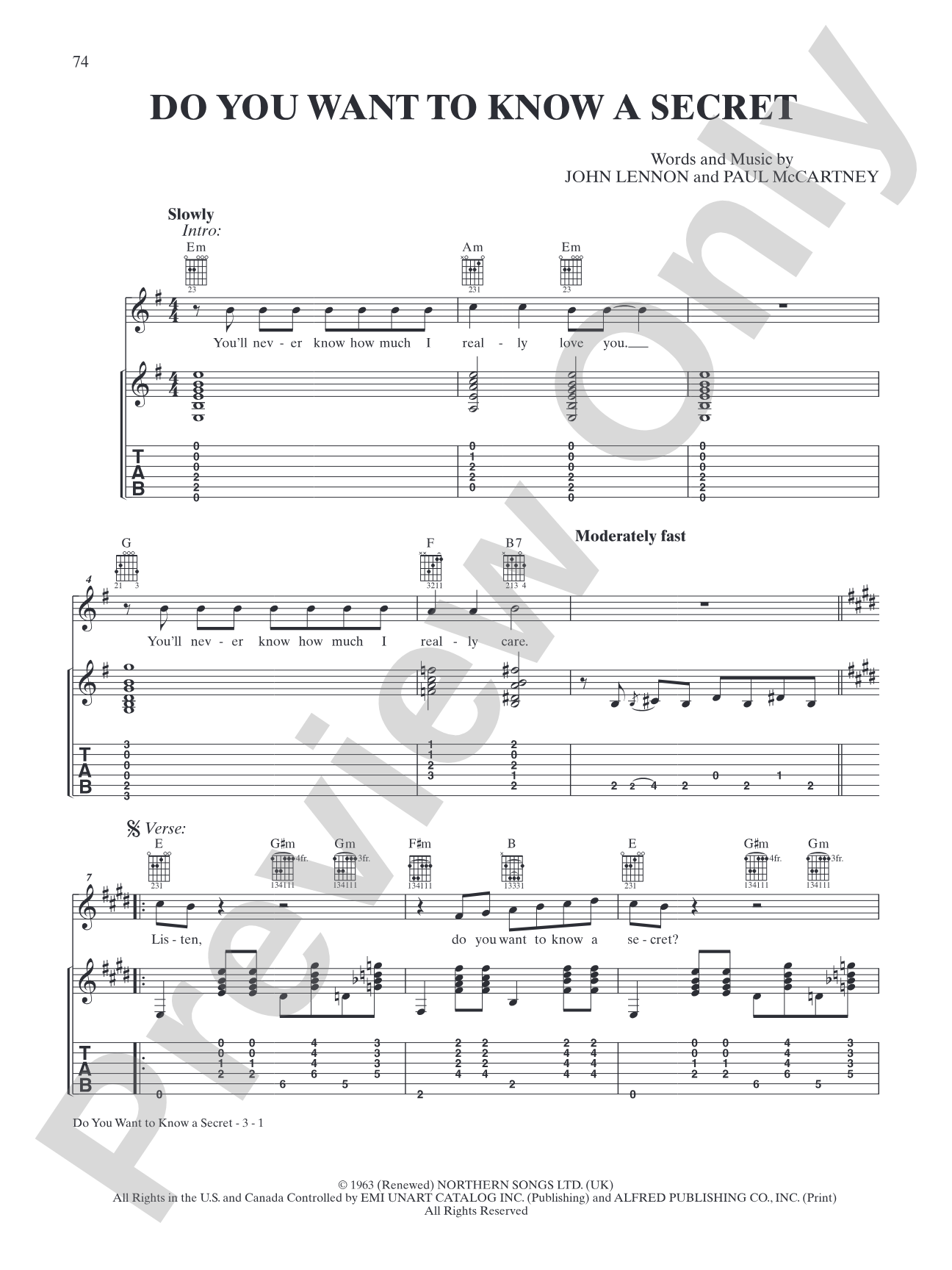

Do You Want to Know a Secret: Interm./Easy Guitar TAB
66 Essential Songs of the Era
Item: 00-PS-0011472
$4.99
One moment…
Related Items
Melissa: Interm./Easy Guitar TAB |
$4.99
|
View | |
Whipping Post: Interm./Easy Guitar TAB |
$4.99
|
View | |
Can't Get Enough (of Your Love): Interm./Easy Guitar TAB |
$5.99
|
View | |
96 Tears: Interm./Easy Guitar TAB |
$4.99
|
View | |
You Can't Always Get What You Want: Interm./Easy Guitar TAB |
$5.99
|
View | |
How Can You Mend a Broken Heart: Interm./Easy Guitar TAB |
$4.99
|
View |
Description
The baby boom generation changed the world, and this music is the soundtrack of that change. This book contains easy guitar TAB arrangements of 66 songs by the greatest artists of the '60s and '70s, including The Rolling Stones, Led Zeppelin, Joni Mitchell, the Grateful Dead, Blind Faith, Harry Chapin, Sly & the Family Stone, The Beatles, Jackson Browne, Buffalo Springfield, Derek and the Dominos, The Kinks, Rod Stewart, The Eagles, Janis Joplin, The Allman Brothers, Cream, Crosby, Stills, Nash & Young, and many more!


Do You Want to Know a Secret: Interm./Easy Guitar TAB isn't in MakeMusic Cloud just yet...but it could be. Let us know you'd like to see it, and you'll help shape what comes next. In the meantime, start a free trial and dive into thousands of interactive titles your students can play along with today.
Request This Title
Tell us you want it.
Start Your Free Trial
Explore everything that's ready to play right now.
Sample Audio
No sample audio found.
Sample Video
No sample videos found.
Additional Details
Series:
The Boomer's Book
Publisher:
Alfred Music
Page Count:
264
SKU:
00-PS-0011472
More about this title
About the Composer: John Lennon
John Lennon (1940-1980) was a guitarist, vocalist, and songwriter who reshaped popular music as a founding member of The Beatles. His compositions ranged from introspective ballads to experimental rock songs, and his guitar work influenced generations of players across every genre. Lennon's impact on music education extends beyond his recordings; his songwriting demonstrates how melody, harmony, and rhythm can be combined to create memorable, singable music that resonates across decades.
Why we love this
This folio captures "Do You Want to Know a Secret" alongside 65 other classics from rock's golden age, giving intermediate and early-intermediate guitarists immediate access to the songs that defined a generation. The TAB format removes barriers to entry while the song selection spans multiple artists and styles, so students encounter varied techniques and approaches within a single collection. Programming these pieces opens conversations about cultural history while building confidence on familiar material.
What to expect
These arrangements capture the energy and emotional directness of classic rock and singer-songwriter traditions. Whether playing a delicate acoustic passage or driving rock rhythms, the music carries the confidence and authenticity of songs written to move people, not impress musicians. Each piece invites you into the world of its original artist while remaining genuinely playable at your level.
Who it's for
Intermediate and early-intermediate guitarists who want to build repertoire with recognizable, well-loved songs from rock history. Students preparing for recitals, jam sessions, or informal performances will find immediate material that motivates practice. Teachers looking to connect guitar lessons to music history and cultural context will appreciate the breadth of artists and eras represented.
How to get the most out of it
- Listen to the original recording before diving into the TAB. Hearing the guitar part in context helps you understand the tone, dynamics, and groove that make the arrangement work.
- Pay attention to any notated strumming patterns or rhythmic notation above the TAB. These details shape the character of the song more than the fret numbers alone.
- When TAB includes multiple guitar parts, decide which voice fits your skill level and musical goals, then learn it thoroughly rather than jumping between parts.
- Work through sections slowly enough to read the TAB without stopping. Speed develops naturally once your eyes and fingers coordinate with the written material.
How to use it
Build a "Classic Rock" recital showcasing three or four pieces from different artists and eras, helping students hear how guitar styles evolved across the '60s and '70s. Assign individual songs as supplementary repertoire throughout the year, connecting lessons on fingerstyle technique to one ballad, alternate tunings to another, and rhythm guitar to a third. Use the collection to create a thematic concert exploring a particular artist or movement (protest folk, British rock, Southern rock), tying musical learning to historical context.
Skills your students will build
- Reading TAB notation fluently and coordinating it with standard notation
- Playing fingerstyle patterns used in folk and rock contexts
- Executing rhythm guitar techniques including strumming patterns and muting
- Adapting arrangements to match tempos and feels from recorded originals
- Building muscle memory for chord changes and transitions common to classic rock songs