

Hope Is the Thing with Feathers: 2-Part Choral Octavo
Words by Emily Dickinson, music by Penny Rodriguez
Item: 00-PO-0007019
$2.05
Minimum order quantity: 20 copies
Pickup currently not available
Description
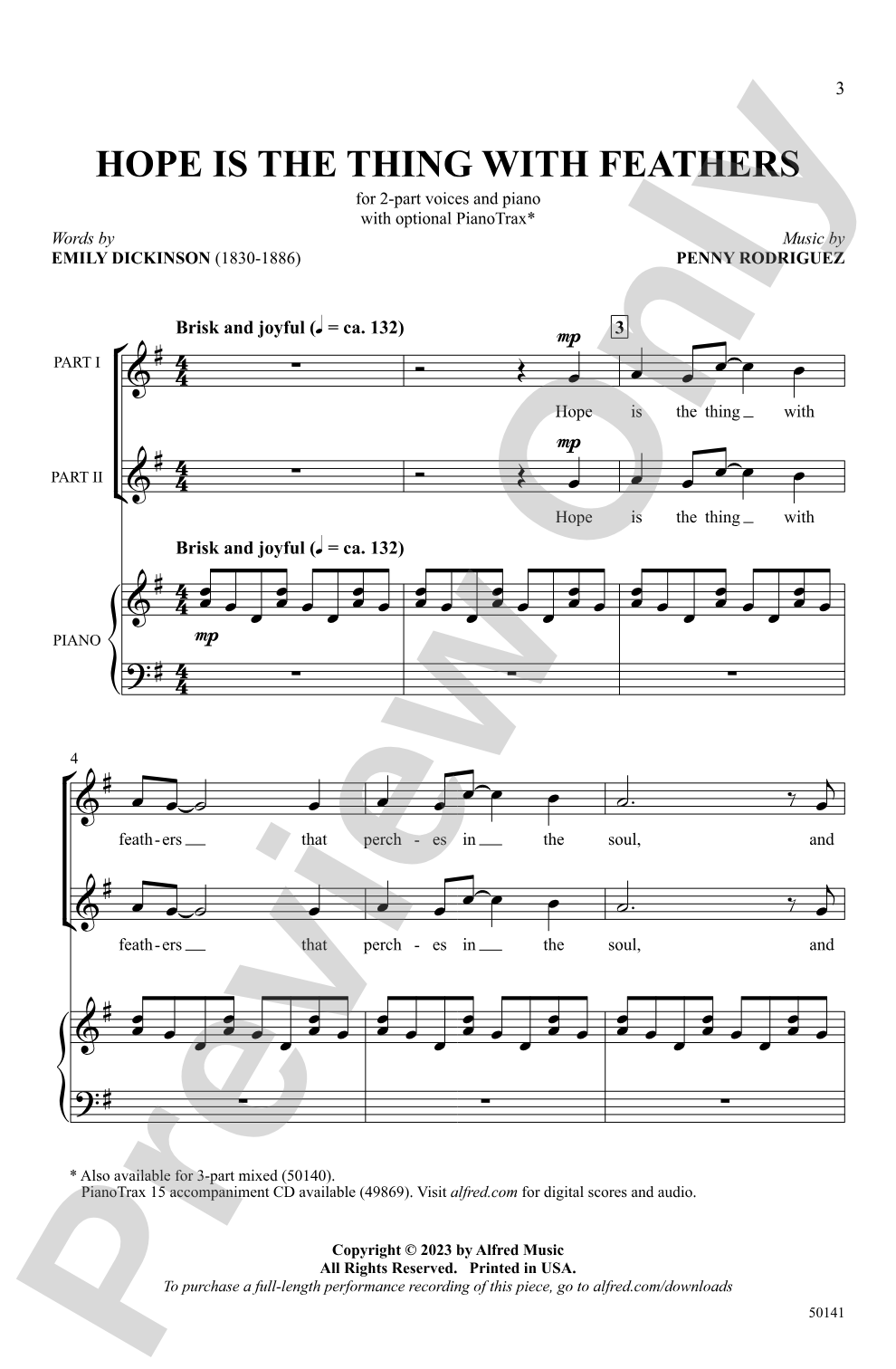
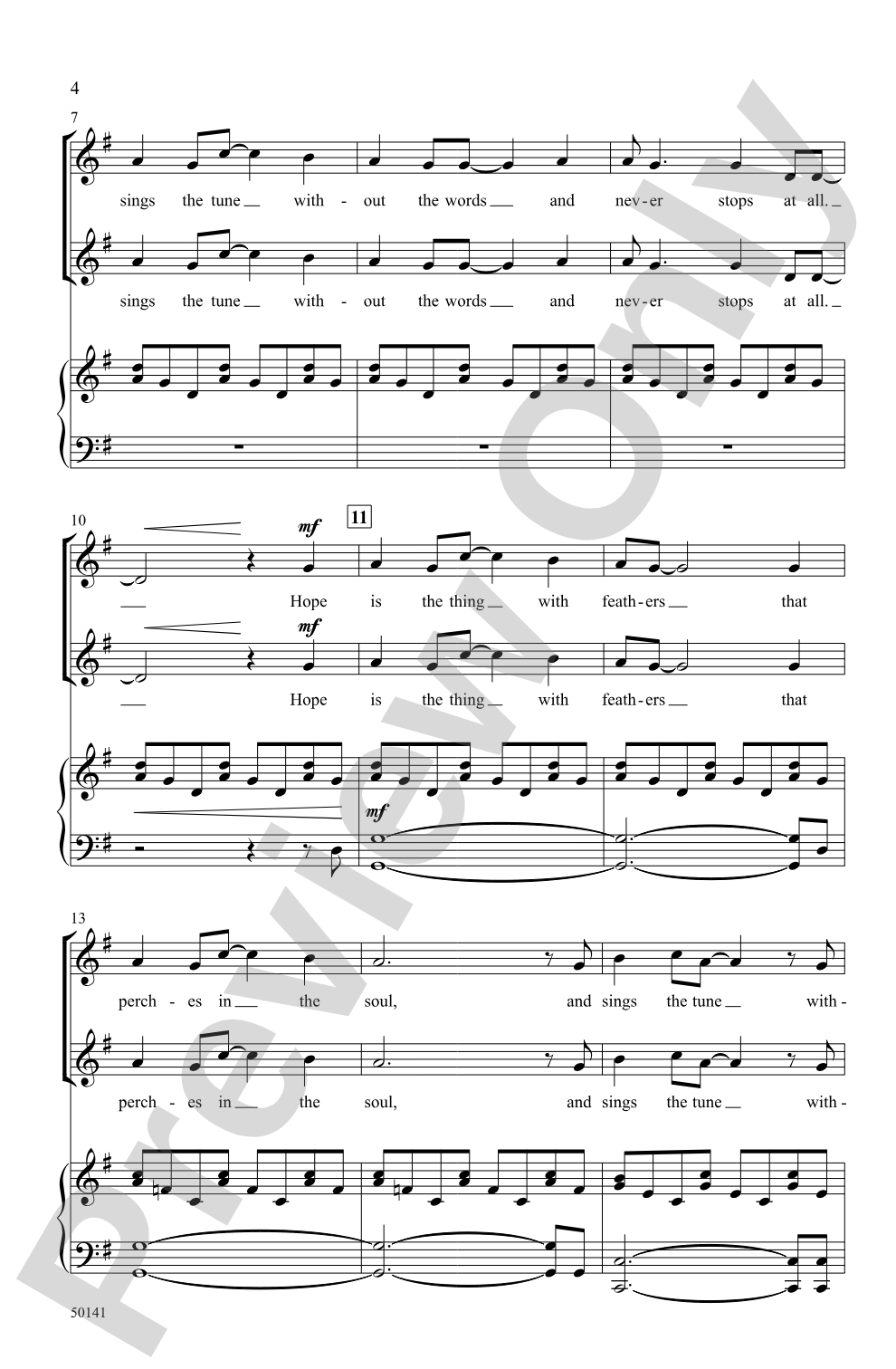
This charming setting of the famous Emily Dickinson poem reminds us that hope "never stops at all." A memorable melody is first sung in unison before layering into a buoyant two-part canon. From the brisk opening piano motive to the exuberant full-voiced ending, it's a stellar selection overflowing with joy. Careful and conservative part writing ensures success for developing choirs.


Discover MakeMusic Cloud: thousands of interactive titles your students can play along with today.
Sample Audio
1
Audio File
--:--
0:00
0:00
Sample Video
Additional Details
Series:
Alfred Choral Designs
Publisher:
Alfred Music
Page Count:
12
SKU:
00-PO-0007019
More about this title
About the Composer: Penny Rodriguez

Penny Rodriguez began her musical journey at age 6, studying piano in Peru where her family was involved in missionary work. She completed formal training in piano performance at Moody/American Conservatory of Music and has spent decades balancing composition with performance, releasing 11 recorded albums and publishing numerous piano works and choral pieces.
In recent years, Rodriguez has concentrated her creative energy on art songs for solo voice and piano, pairing her compositions with carefully selected poetry. She lives near Indianapolis with her husband, Dave, and finds deep fulfillment in time spent with their grandchildren.
Why we love this
Rodriguez writes for young choirs with genuine understanding of what developing singers can achieve. The progression from unison melody to two-part canon feels inevitable rather than imposed, and the brisk piano motive gives rehearsals an immediate sense of forward momentum that keeps energy high across the rehearsal room.
What to expect
There's a brightness here that feels earned rather than imposed. The unison opening grounds singers in the poem's central image before the canon introduces playfulness and motion. From the first piano gesture to the full-voiced close, the piece maintains an infectious sense of forward momentum that leaves both singers and audience uplifted.
Who it's for
This setting belongs in any developing choir program looking for literature that connects text to craft without sacrificing musicality. The conservative voicing means singers at various technical levels can succeed together, while the poetic choice of Dickinson adds literary substance to a concert or festival appearance.
How to get the most out of it
- Treat the opening piano motive as the emotional anchor of the piece. Have pianists lock into that rhythmic gesture early so singers can latch onto its buoyancy from the first phrase.
- Shape the transition into the two-part canon carefully. Even though part writing is conservative, clarity between the voices matters. Isolate each part in separate rehearsals before combining them.
- Let the final section build organically. Resist over-pushing the dynamics early; the exuberance comes from confident execution and rhythmic precision, not forced volume.
How to use it
Program this as a contrast piece alongside heavier or more complex selections. It works equally well opening a concert (its optimism sets a welcoming tone) or appearing midway through (a chance to reset energy and showcase the developing choir's ability to balance unison singing with contrapuntal work). The Dickinson text makes it a natural pairing with other poetry-based literature on a thematic concert.
Skills your students will build
- Reading and sustaining a unison melodic line with consistent phrasing
- Following an independent vocal line within a two-part canon
- Coordinating with piano accompaniment and responding to its rhythmic motive
- Balancing ensemble sound when voices move in parallel motion