

Hope Is the Thing with Feathers: 3-Part Mixed Choral Octavo
Words by Emily Dickinson, music by Penny Rodriguez
Item: 00-PO-0007018
$2.05
Minimum order quantity: 10 copies
Please note: Under U.S. copyright law, you must purchase the exact number of copies needed for your ensemble. Printing, duplicating or sharing additional copies is strictly prohibited.
Pickup currently not available
Description
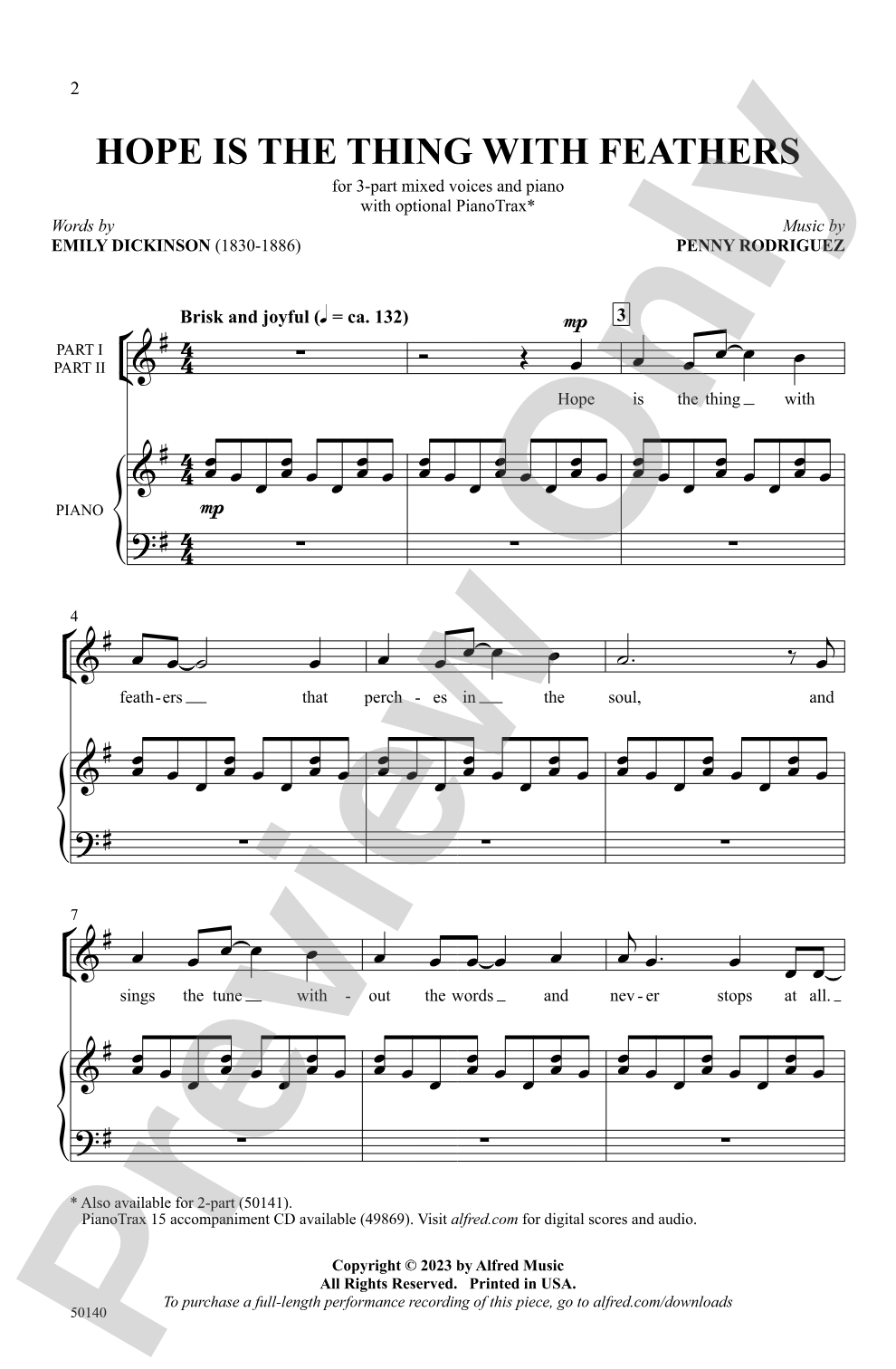
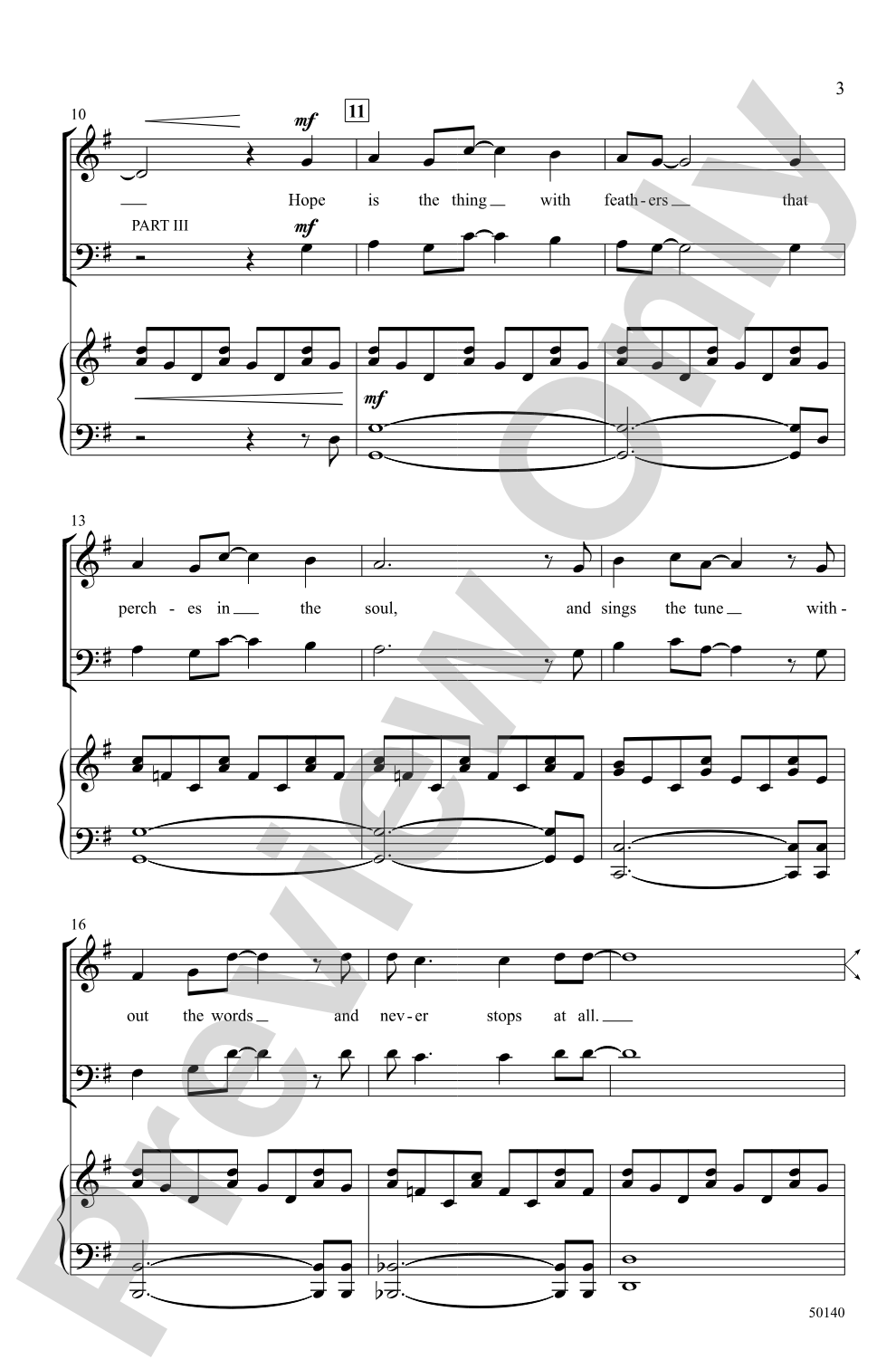
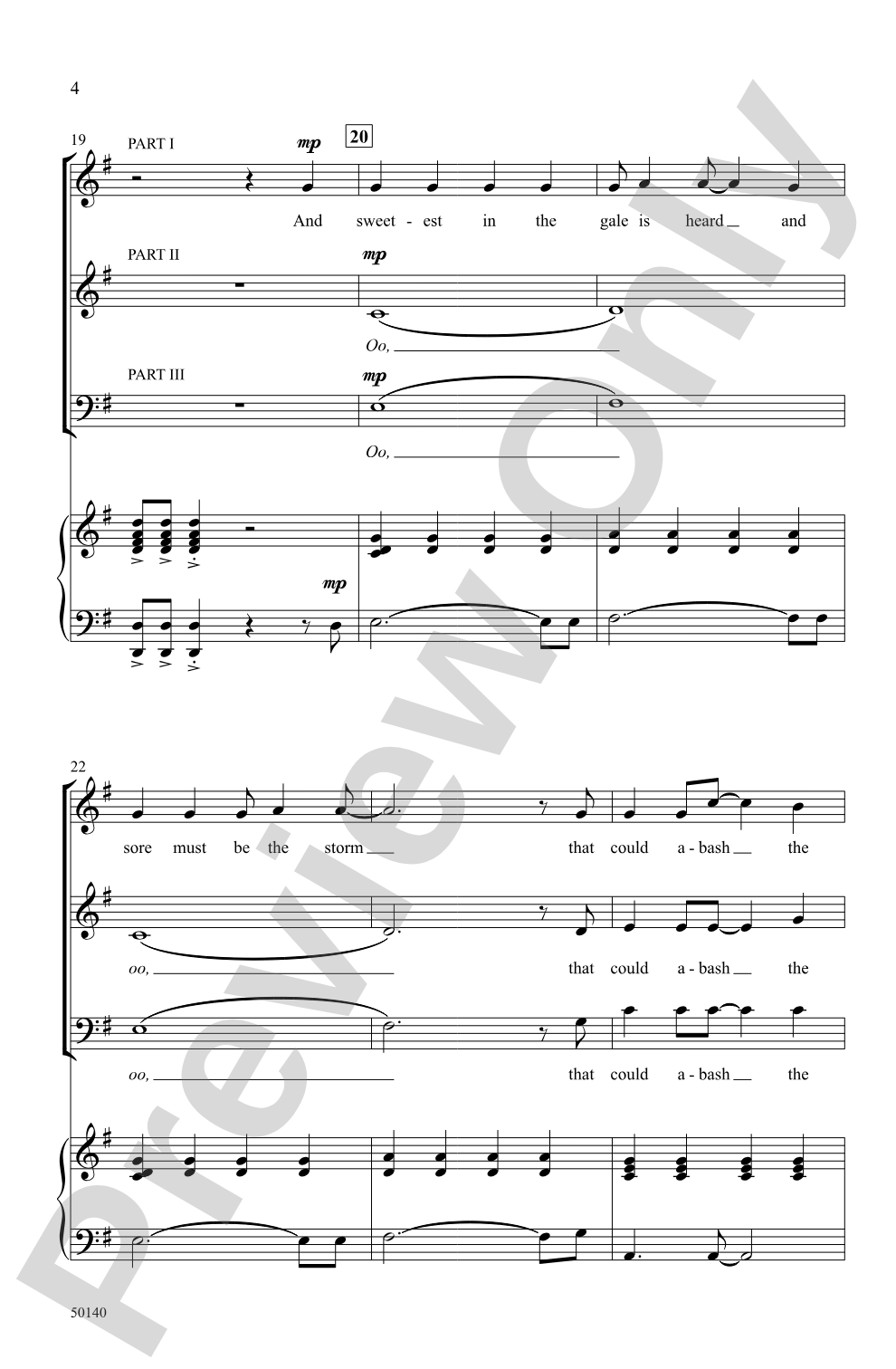
This charming setting of the famous Emily Dickinson poem reminds us that hope "never stops at all." A memorable melody is first sung in unison before layering into a buoyant two-part canon. From the brisk opening piano motive to the exuberant full-voiced ending, it's a stellar selection overflowing with joy. Careful and conservative part writing ensures success for developing choirs.


Discover MakeMusic Cloud: thousands of interactive titles your students can play along with today.
Sample Audio
1
Audio File
--:--
0:00
0:00
Sample Video
Additional Details
Series:
Alfred Choral Designs
Publisher:
Alfred Music
Page Count:
12
SKU:
00-PO-0007018
More about this title
About the Composer: Penny Rodriguez

Penny Rodriguez began her musical journey at age six in Peru, where she developed her foundation as a pianist while her parents worked as missionaries. She pursued formal training at Moody/American Conservatory of Music, earning a degree in piano performance, and has since established herself as a composer, pianist, and recording artist with eleven albums to her name.
In recent years, Rodriguez has concentrated her compositional energy on art songs for solo voice and piano, drawing on celebrated poetry to shape her lyrical writing. She brings this sensitivity to text to her choral works as well. Based in the Indianapolis area, she finds creative fulfillment in the intersection of literary language and musical expression.
Why we love this
Rodriguez's setting captures the essence of Dickinson's poem without over-complicating the vocal lines, making it genuinely singable for developing choirs while remaining musically sophisticated. The structural arc from unison to canon to full texture gives conductors a clear dramatic progression, and the careful part writing means your singers can focus on the poetry and the joy rather than wrestling with ranges or awkward voice leading.
What to expect
From the first piano gesture, this setting radiates warmth and quiet confidence. The unison melody feels intimate and direct, like sharing something true; when the canon enters, the texture opens up without losing that sense of intimacy, building toward a glowing, full-voiced statement that feels earned rather than rushed.
Who it's for
This piece works for middle school through adult community choirs with modest vocal ranges and flexible part distributions. The three-part mixed voicing and conservative scoring make it accessible to singers still developing their independence and blending skills, while the literary text and polished arrangement appeal to choirs ready to program something with substance.
How to get the most out of it
- Shape the opening unison melody to let its simplicity shine; resist the urge to over-conduct it. This is where the poem's message lands most clearly.
- Balance the two-part canon carefully so neither voice overwhelms the other. Ask your singers to listen actively across parts rather than just singing their own line.
- Let the piano motive drive the tempo from the beginning. It sets the buoyant character that defines the whole piece.
- Build energy gradually into the full-voiced ending without sacrificing diction on the text. The joy should come through the words as much as the harmony.
How to use it
Pair this with other contemporary settings of classical American poetry for a thematic concert, or use it as an uplifting closer that sends audiences out feeling genuinely hopeful rather than sentimentally treated. Its moderate difficulty and concert appeal also make it a strong choice for festival programming or a spring concert where you want to showcase what your developing choir can accomplish.
Skills your students will build
- Singing in unison with clear diction and unified phrasing
- Tracking a melodic line while singing against a different canon part
- Balancing three independent vocal lines with appropriate blend
- Interpreting literary text and connecting it to musical choices
- Following a conductor through a structured harmonic progression