

Hodie Fanfare: SATB Choral Octavo
Music by Sally K. Albrecht
Item: 00-PO-0006920

$2.05
Minimum order quantity: 20 copies
Pickup currently not available
Description
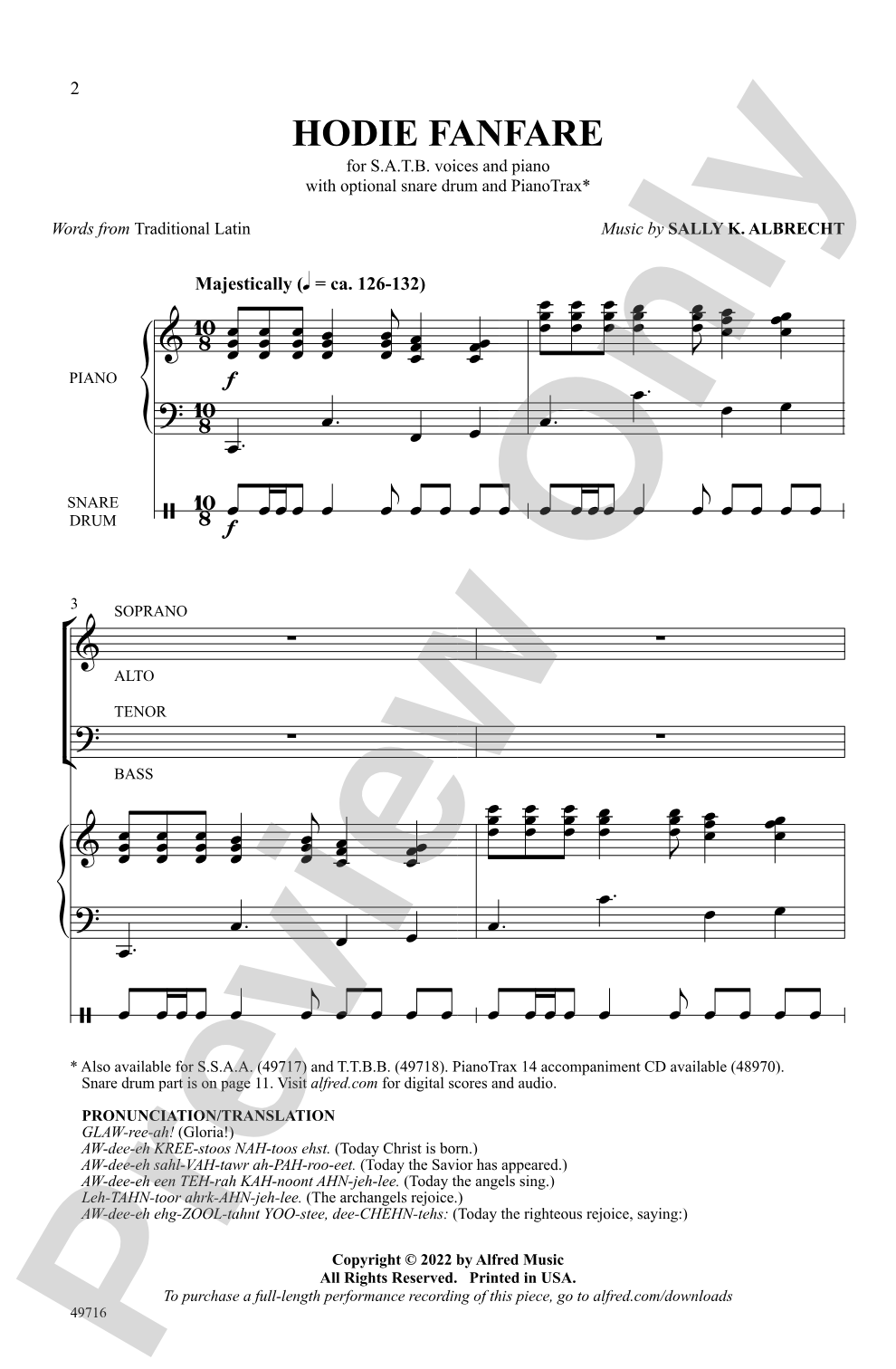
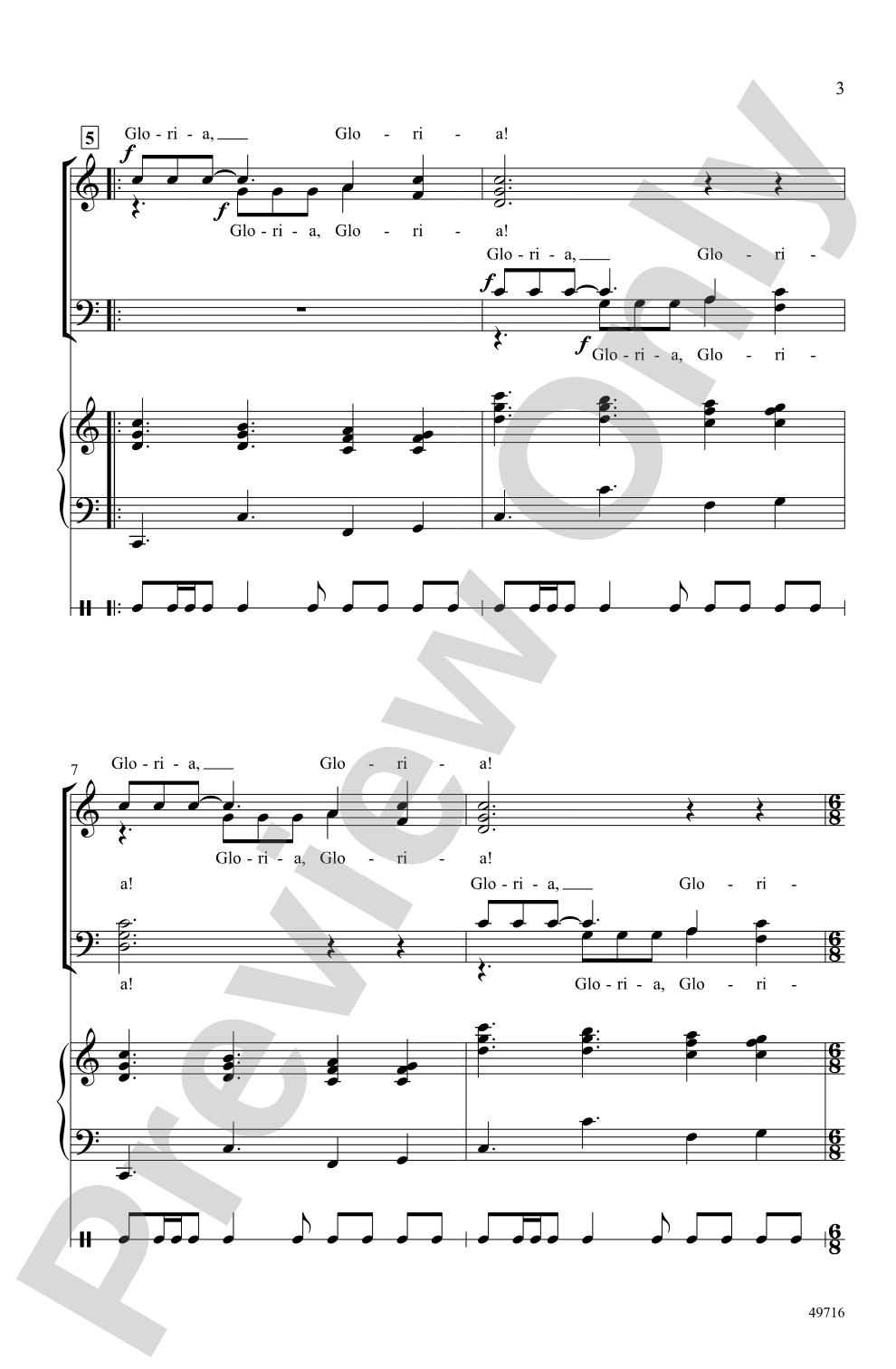
Changing meters of 10/8 and 6/8 are sure to grab your attention in this contemporary Christmas choral. Rhythmic four-part voices sing mostly in Latin (with occasional "joy to the world" interjections) and with various choral textures. Staggered "Glorias" kick it off with exuberance and joyfully return before the final flourish. It's an inspired surprise when the addition of a descant cleverly combines themes we've heard before. Invite a snare drum player to join (part included) to reinforce the triumphant tone.


Don't just read it, hear it, play along with it, and watch your students grow with it. In MakeMusic Cloud, Hodie Fanfare: SATB Choral Octavo comes alive with professional accompaniment, adjustable tempo, and built-in practice tools that turn solo practice into real progress.
Open in the Player
Jump straight in and assign it today.
Start Your Free Trial
Open this title and explore the full library in minutes.
Sample Audio
1
Audio File
--:--
0:00
0:00
Sample Video
1 / 2
Additional Details
Series:
Alfred Choral Designs
Publisher:
Alfred Music
Page Count:
12
SKU:
00-PO-0006920
More about this title
About the Composer: Sally K. Albrecht

Sally K. Albrecht has shaped American choral music for over four decades through her prolific compositions and her leadership in music education publishing. Since 1987, she has received annual ASCAP Special Music Awards and maintains over 600 choral works in active publication, alongside 75 larger musicals and songbooks. Her conducting experience spans prestigious venues including Lincoln Center, Carnegie Hall, and The Kennedy Center, where she has led honor choirs and festival ensembles nationwide.
Albrecht's academic background bridges music and theatre: she earned a B.A. from Rollins College in 1976, followed by an M.A. in Drama and an M.M. in Accompanying from the University of Miami. She served as Director of School Choral, Vocal, and Elementary Publications at Alfred Music and has held faculty positions at Oakland University, Jersey City State College, and Meredith College. Beyond her compositional work, she has chaired the Board of Trustees for Omicron Delta Kappa National Leadership Honor Society and received the Distinguished Alumna Award from both the University of Miami Frost School of Music and Rollins College.
Why we love this
Albrecht crafts a contemporary Christmas piece that refuses predictability through its shifting meters and rhythmic drive, anchoring familiar carol fragments ("joy to the world") within Latin text and propulsive choral writing. The descant entrance rewards careful preparation with a moment of genuine surprise, layering melodic themes in a way that excites both singers and audiences. The optional snare drum part elevates the piece beyond typical holiday fare, giving directors a tool to inject theatrical flair and energy without cluttering the texture.
What to expect
The shifting meters give this piece an almost dance-like propulsion, urgent yet celebratory. The Latin phrases layered with English fragments create a sense of tradition colliding with contemporary energy, while the descant entrance delivers a moment of transcendent brightness that feels earned rather than inevitable.
Who it's for
Intermediate to advanced SATB choirs seeking a contemporary holiday piece with rhythmic and textural sophistication. Directors who want to move beyond traditional carols and can commit time to meter work and ensemble balance will find a piece that rewards meticulous preparation with genuine musical impact.
How to get the most out of it
- Lock the changing meters (10/8 and 6/8) early in rehearsal by conducting against the grain; have singers tap their foot on a steady subdivision and practice transitions between meters independently before blending parts.
- Articulate the staggered "Glorias" with precision and unanimous breath support to maximize their impact; this rhythmic unison is your leverage for excitement.
- Coordinate carefully with the snare drum player on dynamics and articulation so the percussion reinforces rather than overwhelms the Latin text and choral textures.
- Mark the descant entrance clearly in all parts and rehearse it separately with those singers; the moment lands strongest when the other three parts anchor the harmonic foundation without wavering.
How to use it
Program this as a concert opener or closing piece during holiday performances to establish a modern, energetic tone alongside traditional carols. The optional snare drum part makes it equally effective in secular holiday programs or interfaith celebrations where the instrumental color adds visual and sonic intrigue without relying on exclusively religious imagery.
Skills your students will build
- Reading and maintaining 10/8 and 6/8 meters with secure transitions between them
- Singing in Latin with clear articulation within rhythmic contexts
- Blending multiple choral textures including homophony and independent parts
- Coordination with instrumental percussion while maintaining choral balance
- Part independence when a descant overlays existing harmonic material