
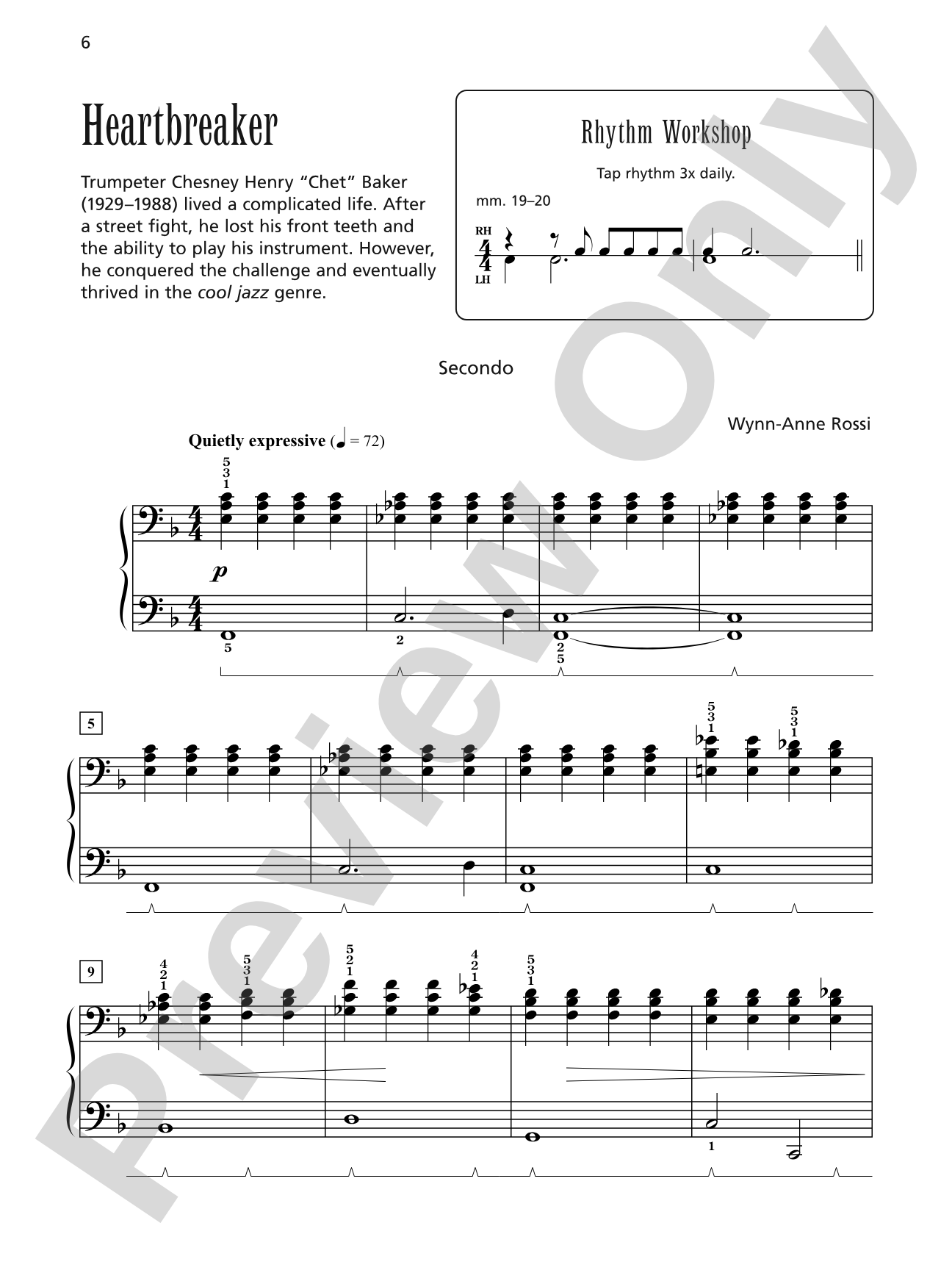

Heartbreaker - Piano Duet (1 Piano, 4 Hands): Piano Duet (1 Piano, 4 Hands)
5 Early Intermediate to Intermediate Piano Duets That Celebrate American Jazz
By Wynn-Anne Rossi
Level: Early Intermediate / Intermediate
Item: 00-PS-0017638
$4.99
Pickup currently not available
Related Items
Buddy Boobop - Piano Duet (1 Piano, 4 Hands): Piano Duet (1 Piano, 4 Hands) |
$4.99
|
View | |
Southpaw Spirit - Piano Duet (1 Piano, 4 Hands): Piano Duet (1 Piano, 4 Hands) |
$4.99
|
View | |
Struttin' Down Frenchmen Street - Piano Duet (1 Piano, 4 Hands): Piano Duet (1 Piano, 4 Hands) |
$7.99
|
View | |
Waltz for Sarah - Piano Duet (1 Piano, 4 Hands): Piano Duet (1 Piano, 4 Hands) |
$5.99
|
View | |
Jazzin' Americana for Two, Book 2: Piano Duet (1 Piano, 4 Hands) Book |
$7.99
|
View |
Description
Wynn-Anne Rossi's Jazzin' Americana for Two series is a journey through the jazz genre, honoring the history, the diverse styles, and the fabulous musicians who made this music great. Students will become familiar with the names of famous musicians such as Chet Baker, McCoy Tyner, and Sarah Vaughan while learning different jazz styles, from blues and bebop to boogie and rock. Each duet (for one piano, four hands) is enhanced with interesting facts that will awaken curiosity and strengthen the musical experience. Titles: Buddy Boobop * Heartbreaker * Southpaw Spirit * Struttin' Down Frenchmen Street * Waltz for Sarah. A Federation Festivals 2024-2028 selection.


Discover MakeMusic Cloud: thousands of interactive titles your students can play along with today.
Sample Audio
No sample audio found.
Sample Video
No sample videos found.
Additional Details
Series:
Jazzin' Americana
Publisher:
Alfred Music
Page Count:
24
SKU:
00-PS-0017638
More about this title
About the Composer: Wynn-Anne Rossi
Wynn-Anne Rossi is a composer and educator whose work brings jazz history and contemporary idioms into the studio and classroom. She writes with a deep understanding of how students learn instrumental music, crafting pieces that balance technical accessibility with genuine stylistic authenticity.
Why we love this
Rossi's duet writing gives intermediate pianists a real reason to collaborate, with both primo and secondo parts equally engaged in the jazz vocabulary rather than one hand simply accompanying the other. The series itself is a masterclass in cultural awareness; students don't just play jazz styles, they learn the musicians who invented them, building repertoire knowledge alongside technique.
What to expect
Swinging, conversational, and infused with the character of American jazz standards. The piece balances the accessibility of early intermediate technique with genuine jazz idioms, creating music that sounds sophisticated and colorful without requiring advanced facility.
Who it's for
Early intermediate to intermediate pianists ready to explore jazz style in a duet setting. This works beautifully for studio teachers introducing students to ensemble playing and for classroom pianists preparing for festivals or concerts.
How to get the most out of it
- Listen to recordings of the featured jazz artist before your first rehearsal together. Hearing Chet Baker's sound or Sarah Vaughan's phrasing will inform the tone and articulation you both bring to the piece.
- Work out rhythmic precision in the swing sections separately before combining parts. Jazz phrasing lives in the pocket between the beat, and both players need to feel the same pulse.
- Balance the dynamic levels carefully in each section so that the melody and harmonic conversation both register clearly without either duet partner overpowering the other.
- Experiment with rubato in the slower passages, but establish it together first. Both players must shape the time in the same direction.
How to use it
Feature this as a duet performance at a student recital or jazz-themed concert. It also works well in a pedagogy setting where you're teaching a unit on jazz history; students can perform the piece immediately after learning about the featured musician, cementing both the music and the context.
Skills your students will build
- Swing rhythm and jazz articulation (legato/detached phrasing within the jazz idiom)
- Ensemble listening and balance between primo and secondo parts
- Comping and harmonic awareness through the accompaniment part
- Left-hand independence and rhythmic precision in jazz contexts
- Connecting musical style to historical musicians and cultural knowledge