
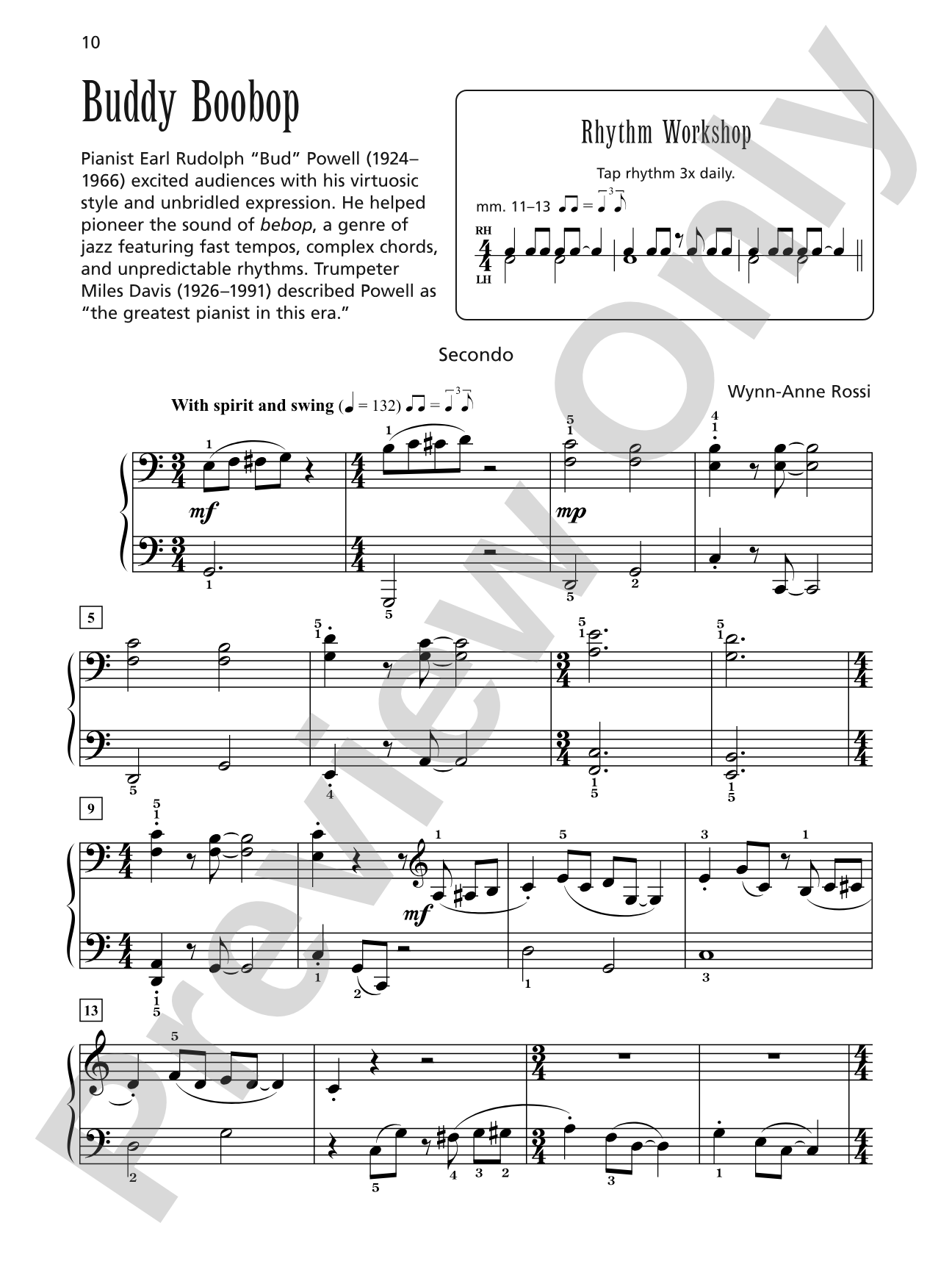

Buddy Boobop - Piano Duet (1 Piano, 4 Hands): Piano Duet (1 Piano, 4 Hands)
5 Early Intermediate to Intermediate Piano Duets That Celebrate American Jazz
By Wynn-Anne Rossi
Level: Early Intermediate / Intermediate
Item: 00-PS-0017637
$4.99
Pickup currently not available
Related Items
Heartbreaker - Piano Duet (1 Piano, 4 Hands): Piano Duet (1 Piano, 4 Hands) |
$4.99
|
View | |
Southpaw Spirit - Piano Duet (1 Piano, 4 Hands): Piano Duet (1 Piano, 4 Hands) |
$4.99
|
View | |
Struttin' Down Frenchmen Street - Piano Duet (1 Piano, 4 Hands): Piano Duet (1 Piano, 4 Hands) |
$7.99
|
View | |
Waltz for Sarah - Piano Duet (1 Piano, 4 Hands): Piano Duet (1 Piano, 4 Hands) |
$5.99
|
View | |
Jazzin' Americana for Two, Book 2: Piano Duet (1 Piano, 4 Hands) Book |
$7.99
|
View |
Description
Wynn-Anne Rossi's Jazzin' Americana for Two series is a journey through the jazz genre, honoring the history, the diverse styles, and the fabulous musicians who made this music great. Students will become familiar with the names of famous musicians such as Chet Baker, McCoy Tyner, and Sarah Vaughan while learning different jazz styles, from blues and bebop to boogie and rock. Each duet (for one piano, four hands) is enhanced with interesting facts that will awaken curiosity and strengthen the musical experience. Titles: Buddy Boobop * Heartbreaker * Southpaw Spirit * Struttin' Down Frenchmen Street * Waltz for Sarah. A Federation Festivals 2024-2028 selection.


Discover MakeMusic Cloud: thousands of interactive titles your students can play along with today.
Sample Audio
No sample audio found.
Sample Video
No sample videos found.
Additional Details
Series:
Jazzin' Americana
Publisher:
Alfred Music
Page Count:
24
SKU:
00-PS-0017637
More about this title
About the Composer: Wynn-Anne Rossi
Wynn-Anne Rossi is a composer and educator whose work spans jazz, contemporary classical, and pedagogical repertoire. Her teaching experience informs every piece she writes; she understands what students need to grow as musicians and what teachers need in the rehearsal room.
Rossi has built a substantial catalog of educational compositions that serve ensemble and solo contexts across multiple instruments. Her Jazzin' Americana series reflects her commitment to making music history tangible and engaging for young musicians by pairing solid composition with genuine cultural knowledge.
Why we love this
This duet gives two pianists a genuine reason to sit at the same bench together. The writing is musically idiomatic to jazz without requiring either player to have prior improvisational experience; both parts are notated and equally engaging. The pairing of repertoire with historical context about the musicians who inspired each piece turns practice into discovery.
What to expect
These pieces swing with the lean, purposeful energy of bebop and blues without demanding virtuosity. Each duet has a distinct personality; 'Buddy Boobop' captures the wit and conversational tone of bebop, while the collection as a whole moves between the sophistication of Sarah Vaughan, the harmonic daring of McCoy Tyner, and the coolness of Chet Baker. Playing these pieces feels like being handed a piece of jazz history and invited to make it your own.
Who it's for
This duet works for students who read at an early intermediate to intermediate level and are curious about jazz styles beyond what they might encounter in their other lessons. It's ideal for studio teachers looking to expand a student's musical vocabulary or for ensemble directors seeking duo repertoire that teaches history alongside technique.
How to get the most out of it
- Balance the Primo and Secondo parts by listening from the audience position; the Primo often carries the melody, but the Secondo's rhythmic foundation and harmonic support must remain audible and propulsive.
- Work on rhythmic independence between the two players before worrying about dynamic nuance. Jazz phrasing requires each hand to land with confidence on its own part.
- Sit close enough that you can hear each other without turning your head; use peripheral vision to stay coordinated during rhythm-based passages.
How to use it
Feature this duet in a jazz recital or a concert celebrating American music traditions. You might program it alongside solo jazz standards or follow it with a brief presentation about the featured musician to deepen the audience's engagement. It also serves well as a culminating piece in a semester-long exploration of jazz history.
Skills your students will build
- Reading swing rhythms and jazz articulation (swung eighths, stabs, ghost notes)
- Coordinating two independent melodic and rhythmic lines at the same instrument
- Understanding jazz harmonic language and voicing
- Developing ensemble listening and response within a duet context
- Building familiarity with jazz history and the musicians who shaped the genre