
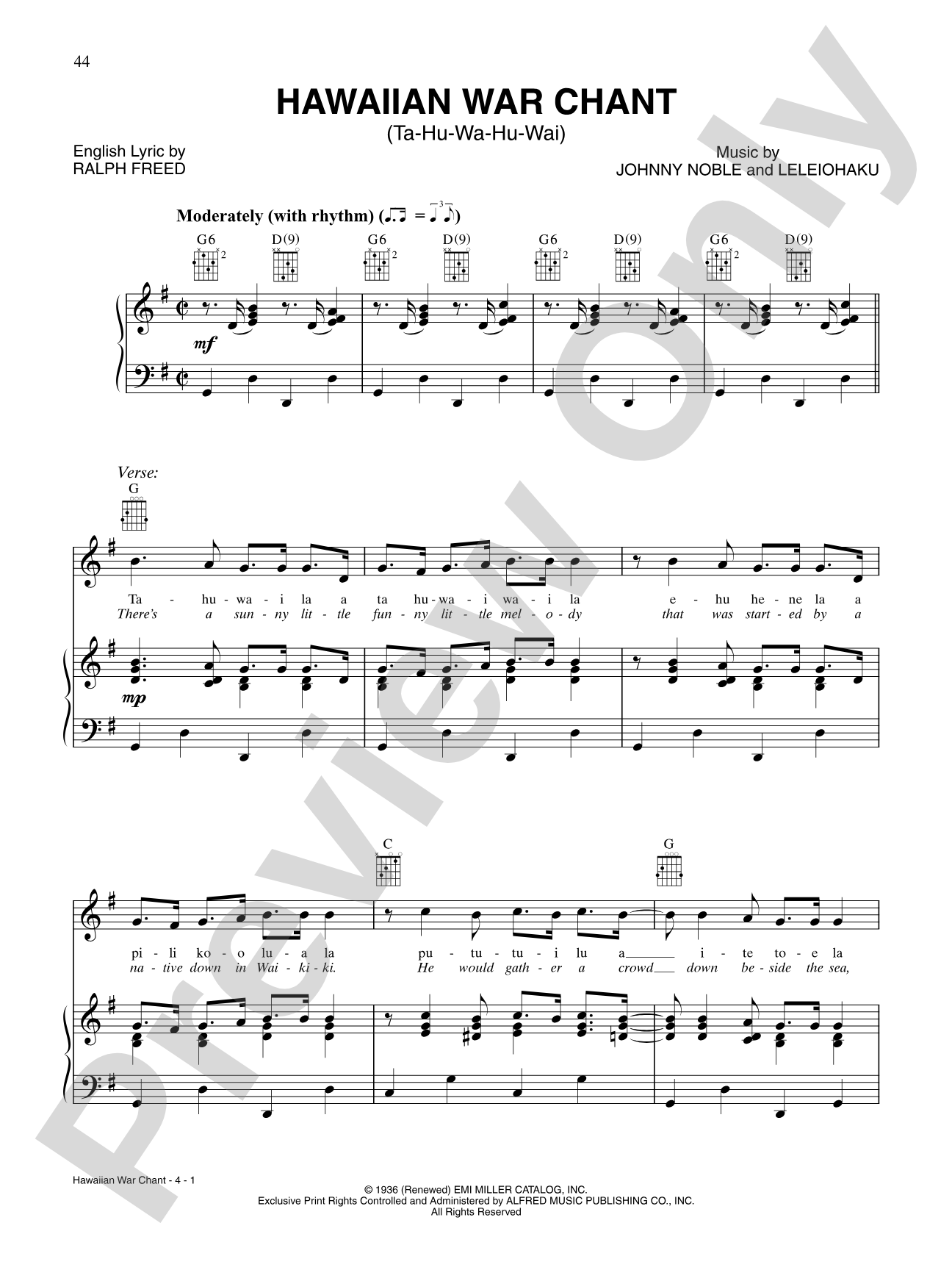

Hawaiian War Chant (Ta-Hu-Wa-Hu-Wai): Piano/Vocal/Chords
27 Popular and Traditional Favorites
Item: 00-PS-0015590
$4.99
One moment…
Related Items
Love Song of Kalua: Piano/Vocal/Chords |
$4.99
|
View | |
Caravan: Piano/Vocal/Chords |
$4.99
|
View | |
Hawai‘i ’78: Piano/Vocal/Chords |
$5.99
|
View | |
White Sandy Beach: Piano/Vocal/Chords |
$4.99
|
View | |
Henehene Kou 'Aka: Piano/Vocal/Chords |
$5.99
|
View | |
Panini Puakea: Piano/Vocal/Chords |
$5.99
|
View | |
‘Ama ‘Ama: Piano/Vocal/Chords |
$5.99
|
View | |
Ka Huila Wai: Piano/Vocal/Chords |
$5.99
|
View | |
‘Ulili E: Piano/Vocal/Chords |
$5.99
|
View | |
A Hawaiian Like Me: Piano/Vocal/Chords |
$4.99
|
View | |
Misirlou: Piano |
$4.99
|
View | |
Top-Requested Hawaiian Sheet Music: Piano/Vocal/Guitar Book |
$14.99
|
View |
Description
Create a tropical soundscape by playing everybody's favorite Hawaiian traditional songs, island-themed standards, popular hits, and "retro" exotica novelties This practical songbook focuses on the songs and styles that today's audiences associate with Hawai'i, so they're guaranteed to entertain! The arrangements are for piano and voice, with basic chord fingering grids included for optional guitar accompaniment. Titles: 'Ama 'Ama (Israel "Iz" Kamakawiwo'ole) * 'Ulili E (Israel "IZ" Kamakawiwo'ole) * Aloha 'Oe (Farewell to Thee) (Elvis Presley) * Better Together (Jack Johnson) * Caravan (Arthur Lyman) * E Ku'u Morning Dew (Israel "Iz" Kamakawiwo'ole) * Hawai'i '78 (Israel "Iz" Kamakawiwo'ole) * A Hawaiian Like Me (Israel "Iz" Kamakawiwo'ole) * Hawaiian Roller Coaster Ride (Walt Disney's Lilo & Stitch) * Hawaiian War Chant (Ta-Hu-Wa-Hu-Wai) (Bob Wills and His Texas Playboys) * The Hawaiian Wedding Song (Ke Kali Nei Au) (Elvis Presley, Andy Williams) * Henehene Kou 'Aka (Israel "Iz" Kamakawiwo'ole) * Ka Huila Wai (Israel "Iz" Kamakawiwo'ole) * Live a Little (Hawaiian Style) * Love Song of Kalua (The Brothers Cazimero) * Lovely Hula Hands (Don Ho) * Mele Kalikimaka (Bing Crosby) * Miserlou (Arthur Lyman) * My Little Grass Shack in Kealakekua, Hawai'i (Annette Funicello) * Over The Rainbow (Israel "Iz" Kamakawiwo'ole) * Panini Puakea (Israel "Iz" Kamakawiwo'ole) * Pearly Shells (Pupu A O 'Ewa) (Don Ho) * Pua Lane (Brother Noland) * Sweet Leilani (Bing Crosby) * Tiny Bubbles (Hua Li'i) (Don Ho) * What a Wonderful World (Israel "Iz" Kamakawiwo'ole) * White Sandy Beach (Israel "Iz" Kamakawiwo'ole).


Hawaiian War Chant (Ta-Hu-Wa-Hu-Wai): Piano/Vocal/Chords isn't in MakeMusic Cloud just yet...but it could be. Let us know you'd like to see it, and you'll help shape what comes next. In the meantime, start a free trial and dive into thousands of interactive titles your students can play along with today.
Request This Title
Tell us you want it.
Start Your Free Trial
Explore everything that's ready to play right now.
Sample Audio
No sample audio found.
Sample Video
No sample videos found.
Additional Details
Series:
Top-Requested Sheet Music
Publisher:
Alfred Music
Page Count:
132
SKU:
00-PS-0015590
More about this title
About the Composer: Johnny Noble
Johnny Noble was a prolific Hawaiian composer and bandleader who helped define the sound of Hawaiian music in the early twentieth century. His compositions and arrangements became foundational to how mainland audiences understood and experienced Hawaiian musical traditions, blending traditional Hawaiian melodies with Western harmonic structures and orchestration.
Why we love this
This collection gives pianists and singers immediate access to the repertoire that actually resonates with audiences when they hear "Hawaiian music." The mix of traditional songs, Disney standards, and modern artists like Jack Johnson and Israel Kamakawiwo'ole means you can program something that feels authentic rather than clichéd, and the chord grids make it genuinely flexible for ensembles with guitarists.
What to expect
Warm, unhurried, and evocative of island landscapes. The arrangements balance nostalgic charm with genuine musicality, moving gracefully between traditional Hawaiian melodies and accessible popular songs that feel natural in a piano and voice setting.
Who it's for
Pianists and singers preparing recitals, cabaret performances, or educational concerts centered on Hawaiian or tropical themes. Music teachers looking for engaging vocal repertoire that connects to cultural traditions and contemporary artists students recognize.
How to get the most out of it
- Lean into the rhythm section. These arrangements thrive on steady, unhurried accompaniment; the piano provides both harmonic support and rhythmic foundation, so lock in a groove rather than rushing the tempo.
- Balance the vocal line with the accompaniment so the melody breathes. Many of these songs benefit from space around longer notes, which lets the emotional content land without overplaying the chords.
- Use the chord grids to invite optional guitar doubling or substitution. A ukulele or classical guitar playing the voicings in parallel can deepen the tropical atmosphere without requiring a full rearrangement.
- Adapt dynamics to the room and audience size. These pieces work equally well in an intimate setting with softer playing and in a larger venue where fuller piano sound carries the melody further.
How to use it
Build a concert around Hawaiian traditions and contemporary retellings by pairing Johnny Noble standards with the Israel Kamakawiwo'ole arrangements included here. This collection also works beautifully as a thematic recital program or as individual selections to fill out a variety show that celebrates world music and cultural connection.
Skills your students will build
- Singing melodic lines over jazz and pop-influenced chord progressions
- Reading chord symbols and understanding chord grid notation for guitar
- Accompanying vocalists with rhythmic awareness and harmonic sensitivity
- Interpreting cultural and historical context in musical performance
- Balancing multiple musical roles (soloist, accompanist, ensemble member)