
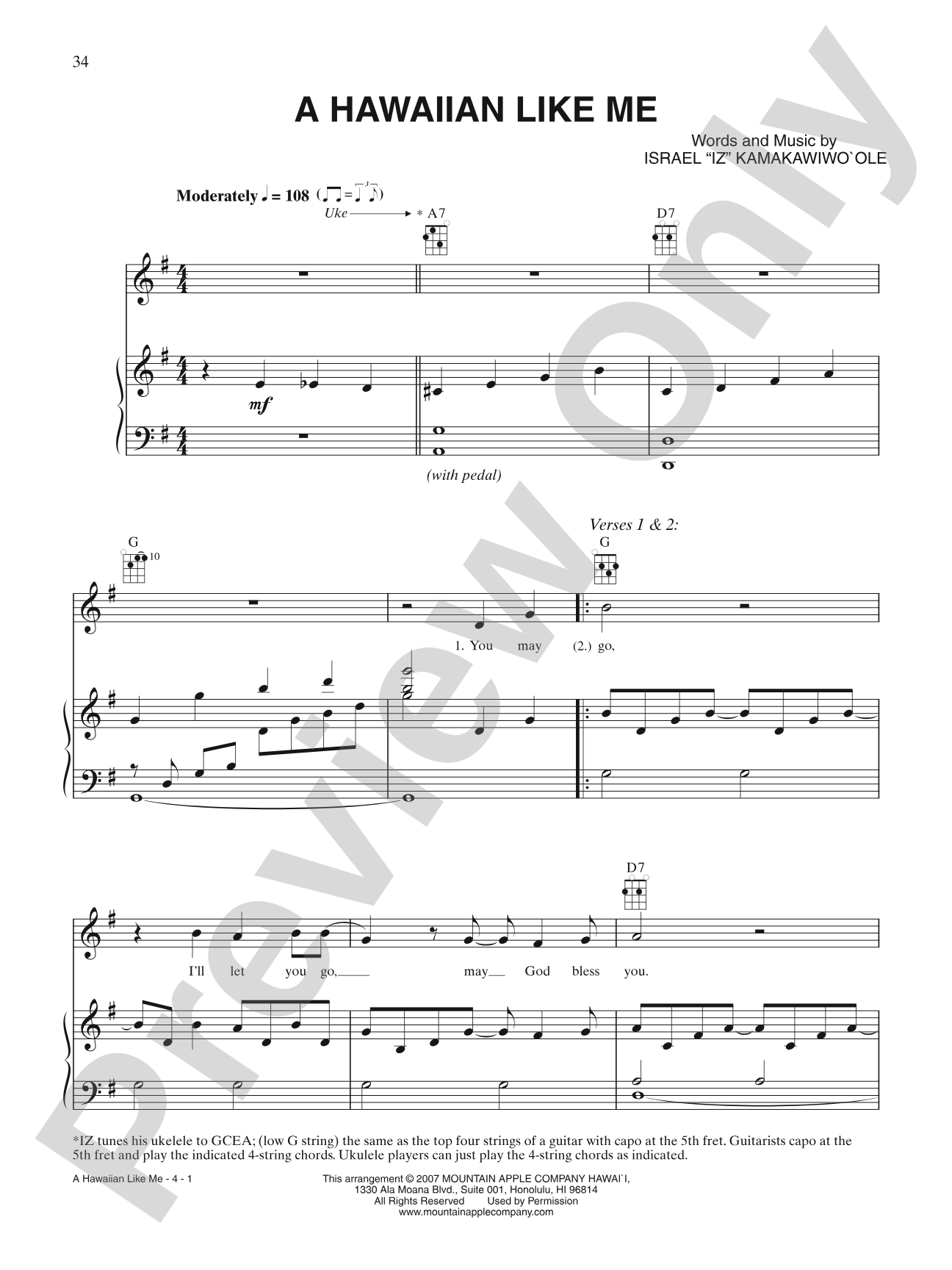

A Hawaiian Like Me: Piano/Vocal/Chords
27 Popular and Traditional Favorites
Item: 00-PS-0015599
$4.99
Pickup currently not available
Related Items
Love Song of Kalua: Piano/Vocal/Chords |
$4.99
|
View | |
Hawaiian War Chant (Ta-Hu-Wa-Hu-Wai): Piano/Vocal/Chords |
$4.99
|
View | |
Caravan: Piano/Vocal/Chords |
$4.99
|
View | |
Hawai‘i ’78: Piano/Vocal/Chords |
$5.99
|
View | |
White Sandy Beach: Piano/Vocal/Chords |
$4.99
|
View | |
Henehene Kou 'Aka: Piano/Vocal/Chords |
$5.99
|
View | |
Panini Puakea: Piano/Vocal/Chords |
$5.99
|
View | |
‘Ama ‘Ama: Piano/Vocal/Chords |
$5.99
|
View | |
Ka Huila Wai: Piano/Vocal/Chords |
$5.99
|
View | |
‘Ulili E: Piano/Vocal/Chords |
$5.99
|
View | |
Misirlou: Piano |
$4.99
|
View | |
Top-Requested Hawaiian Sheet Music: Piano/Vocal/Guitar Book |
$14.99
|
View |
Description
Create a tropical soundscape by playing everybody's favorite Hawaiian traditional songs, island-themed standards, popular hits, and "retro" exotica novelties This practical songbook focuses on the songs and styles that today's audiences associate with Hawai'i, so they're guaranteed to entertain! The arrangements are for piano and voice, with basic chord fingering grids included for optional guitar accompaniment. Titles: 'Ama 'Ama (Israel "Iz" Kamakawiwo'ole) * 'Ulili E (Israel "IZ" Kamakawiwo'ole) * Aloha 'Oe (Farewell to Thee) (Elvis Presley) * Better Together (Jack Johnson) * Caravan (Arthur Lyman) * E Ku'u Morning Dew (Israel "Iz" Kamakawiwo'ole) * Hawai'i '78 (Israel "Iz" Kamakawiwo'ole) * A Hawaiian Like Me (Israel "Iz" Kamakawiwo'ole) * Hawaiian Roller Coaster Ride (Walt Disney's Lilo & Stitch) * Hawaiian War Chant (Ta-Hu-Wa-Hu-Wai) (Bob Wills and His Texas Playboys) * The Hawaiian Wedding Song (Ke Kali Nei Au) (Elvis Presley, Andy Williams) * Henehene Kou 'Aka (Israel "Iz" Kamakawiwo'ole) * Ka Huila Wai (Israel "Iz" Kamakawiwo'ole) * Live a Little (Hawaiian Style) * Love Song of Kalua (The Brothers Cazimero) * Lovely Hula Hands (Don Ho) * Mele Kalikimaka (Bing Crosby) * Miserlou (Arthur Lyman) * My Little Grass Shack in Kealakekua, Hawai'i (Annette Funicello) * Over The Rainbow (Israel "Iz" Kamakawiwo'ole) * Panini Puakea (Israel "Iz" Kamakawiwo'ole) * Pearly Shells (Pupu A O 'Ewa) (Don Ho) * Pua Lane (Brother Noland) * Sweet Leilani (Bing Crosby) * Tiny Bubbles (Hua Li'i) (Don Ho) * What a Wonderful World (Israel "Iz" Kamakawiwo'ole) * White Sandy Beach (Israel "Iz" Kamakawiwo'ole).


A Hawaiian Like Me: Piano/Vocal/Chords isn't in MakeMusic Cloud just yet...but it could be. Let us know you'd like to see it, and you'll help shape what comes next. In the meantime, start a free trial and dive into thousands of interactive titles your students can play along with today.
Request This Title
Tell us you want it.
Start Your Free Trial
Explore everything that's ready to play right now.
Sample Audio
No sample audio found.
Sample Video
No sample videos found.
Additional Details
Series:
Top-Requested Sheet Music
Publisher:
Alfred Music
Page Count:
132
SKU:
00-PS-0015599
More about this title
About the Composer: Israel "IZ" Kamakawiwo'ole
Israel Kamakawiwo'ole (1959-1997) was a Hawaiian singer, musician, and composer who became an international ambassador for Hawaiian music and culture. His distinctive ukulele-driven arrangements and warm baritone voice brought traditional and contemporary Hawaiian songs to global audiences, earning him recognition far beyond the islands. His medley of "Over the Rainbow" and "What a Wonderful World" remains one of the most streamed recordings in history, introducing millions of listeners to Hawaiian musical expression.
Kamakawiwo'ole's gift was making Hawaiian music accessible without diluting its authenticity. He drew from traditional chants, island standards, and contemporary compositions, weaving them into arrangements that honored their origins while speaking to modern listeners. His work demonstrates how deeply rooted cultural music can reach across language and geography, making him an essential figure in music education focused on world music traditions and cultural representation.
Why we love this
This collection captures the genuine magic of Hawaiian music without relying on stereotypes or thin exotica novelties. The mix of traditional songs, beloved standards, and Kamakawiwo'ole's own compositions gives singers and pianists material that audiences genuinely want to hear, creating natural performance energy that transcends typical novelty or special-concert programming.
What to expect
These arrangements invite you into warm, sun-soaked soundscapes where melody takes precedence and harmonic movement feels natural rather than complex. Whether playing a rollicking novelty number like "Tiny Bubbles" or the introspective beauty of "Over the Rainbow," the music maintains a conversational quality that feels intimate even in larger performance spaces.
Who it's for
This book serves singers preparing material for recitals, benefit concerts, or relaxed performance settings, as well as pianists building a repertoire of accessible, audience-friendly arrangements. It also works for intermediate musicians seeking to develop cultural knowledge through playing, or anyone designing a Hawaiian-themed concert, community event, or special presentation.
How to get the most out of it
- Pay attention to the ukulele voicings embedded in the piano arrangements; they carry the harmonic and rhythmic character of Hawaiian music. Let those figures breathe and don't rush the attack on chords.
- Use the chord grids not just for guitarists but as a reference for understanding the harmonic color. Many of these songs sit beautifully in voicings that prioritize open strings and extensions, which should inform your touch and pedaling at the keyboard.
- Approach tempos with relaxation rather than precision. Hawaiian music thrives on a gentle, unhurried quality. Singers and pianists should lock into a shared sense of ease rather than mechanically hitting a metronomic pulse.
- The lyrics carry cultural and emotional weight, especially in songs like "Hawai'i '78" and traditional chants. Connect to the meaning and let that inform your phrasing, dynamics, and interpretive choices rather than treating text as decoration.
How to use it
Build an entire Hawaiian-themed concert around this collection, or weave individual selections into summer pops series, community celebrations, or benefit concerts where accessible, feel-good repertoire serves the occasion. The range of styles within the book (from traditional chants to contemporary hits) makes it easy to program a cohesive set that holds audience attention without requiring extensive supporting context.
Skills your students will build
- Singing or playing Hawaiian melodic contours and ornamentation patterns
- Navigating chord changes across a wide harmonic range (major, minor, extended, and altered chord voicings)
- Coordinating voice and piano parts with independence of line
- Interpreting rhythm and phrasing in non-metered or loosely metered passages
- Reading chord symbols and applying them to keyboard and optional guitar accompaniment