
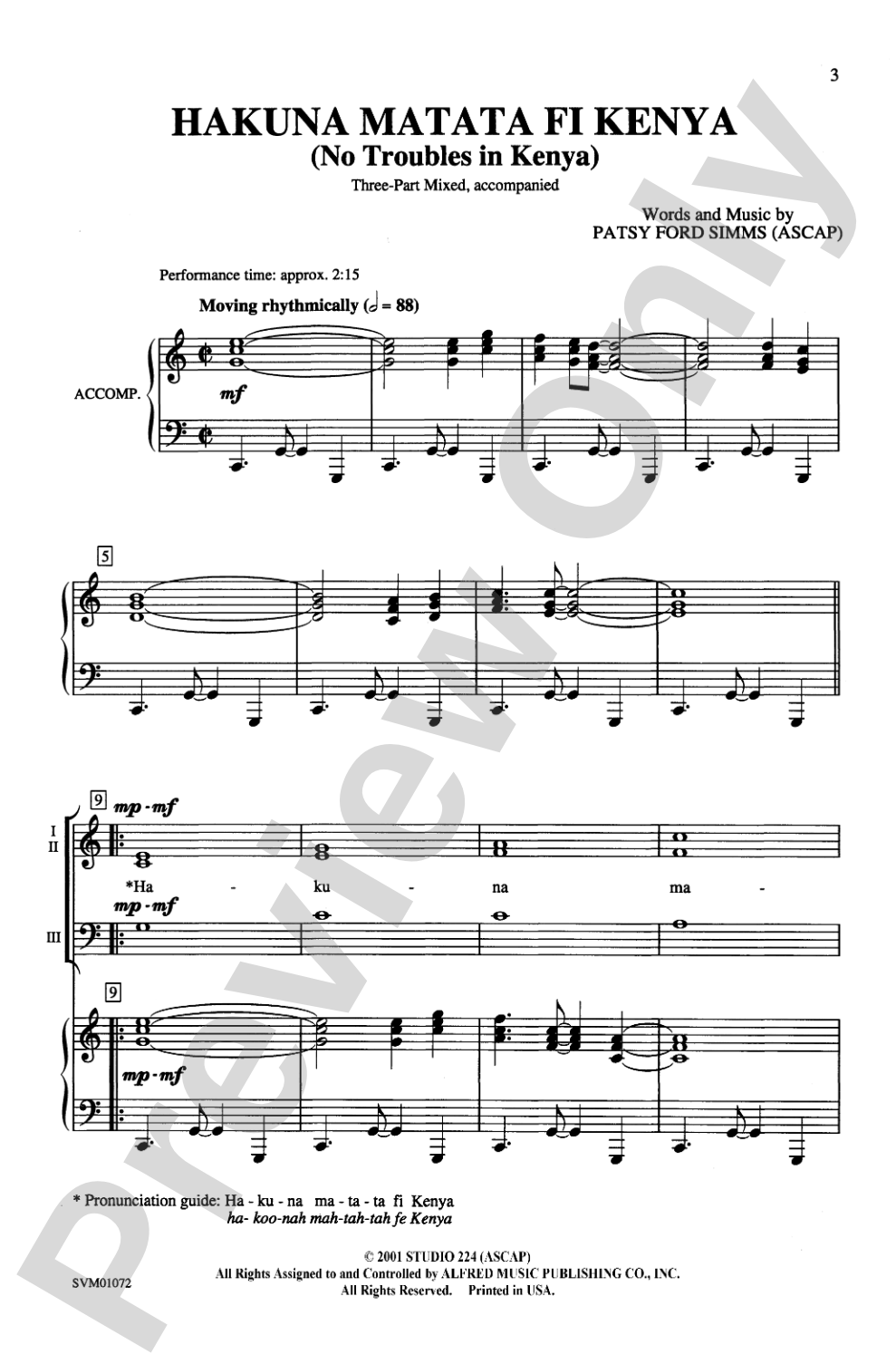

Hakuna Matata Fi Kenya (No Troubles in Kenya): 3-Part Mixed Choral Octavo
(No Troubles in Kenya)
Words and music by Patsy Ford Simms
Level: Moderate
Item: 00-PO-0005346
$2.25
Minimum order quantity: 20 copies
Pickup currently not available
Description
Patsy Ford Simms brings us another exquisite original African style work that carries a wonderful message, a memorable melody and lots of African percussion. This is a must have!


Hakuna Matata Fi Kenya (No Troubles in Kenya): 3-Part Mixed Choral Octavo isn't in MakeMusic Cloud just yet...but it could be. Let us know you'd like to see it, and you'll help shape what comes next. In the meantime, start a free trial and dive into thousands of interactive titles your students can play along with today.
Request This Title
Tell us you want it.
Start Your Free Trial
Explore everything that's ready to play right now.
Sample Audio
No sample audio found.
Sample Video
No sample videos found.
Additional Details
Series:
Alfred Archive Edition: Studio PR Catalog
Publisher:
Alfred Music
Page Count:
8
SKU:
00-PO-0005346
More about this title
About the Composer: Patsy Ford Simms
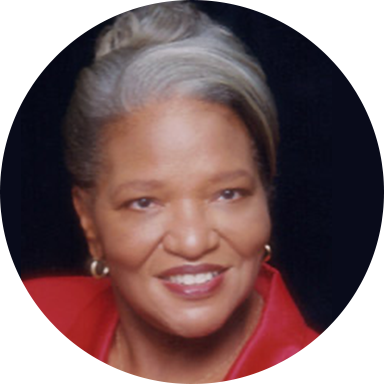
Patsy Ford Simms began her composing and arranging career in response to a genuine classroom need: the scarcity of quality choral literature written specifically for junior high and middle school singers. Since her first publication in 1981, she has created over 300 pieces for educational and church settings across multiple major publishing houses. Her formal training includes a Bachelor of Science in Music Education from Knoxville College, a Master of Education from the University of Louisville, and a doctorate in Music Education from Columbia Pacific University.
Ford Simms spent 30 years teaching music in grades K-12 and at the Youth Performing Arts School before retiring from full-time classroom work. She has established herself as an arranger, composer, and clinician with an international reputation, having presented her work in Italy and Africa. Her compositions include commissioned pieces and short musicals centered on African American history. Two of her works were selected for MENC's World's Largest Concerts, and she has received numerous ASCAP Special Music Awards for her contributions to music education.
Why we love this
Ford Simms writes for real choirs singing at real skill levels, and it shows. The melody sits naturally in the SAB range, the part writing doesn't force anyone into an uncomfortable register, and the rhythm patterns feel singable rather than academic. Programming African percussion alongside three-part harmony creates a sound that engages both your singers and your audience.
What to expect
Optimistic and rhythmically alive. The melody moves with natural ease, and the African percussion elements create a celebratory energy that lifts the message of the text. Your singers will feel the joy in this piece from the first read.
Who it's for
Middle school and junior high choirs looking for accessible, engaging material that doesn't compromise on musical substance. This works equally well for community and church choirs seeking contemporary repertoire with an uplifting message and strong rhythmic drive.
How to get the most out of it
- Involve your rhythm section early. The African percussion isn't decorative; it anchors the groove and gives your singers something visceral to lock into rhythmically.
- Emphasize the melodic contour in the soprano line so the main theme stays front and center even when the other parts are moving.
- Balance the three parts so the middle and lower voices support rather than compete. This piece works best when the harmonies feel unified.
- If using the recorded accompaniment, have singers listen to it multiple times before rehearsal to internalize the percussion colors and rhythmic feel.
How to use it
Use this as a concert brightener that connects with younger audiences and shifts the emotional tone of a set. It programs well alongside other contemporary secular works or as part of a themed concert exploring world music and cultural expression.
Skills your students will build
- Singing in a SAB voicing with independent parts
- Maintaining rhythmic independence while coordinating with percussion
- Blending three distinct vocal lines into unified harmony
- Responding to rhythmic and cultural elements from African musical traditions