

Godfrey Gordon Gustavus Gore: 2-Part Choral Octavo
Words by William Brighty Rands, music by Janet Gardner
Item: 00-PO-0000468
$1.75
Minimum order quantity: 20 copies
Pickup currently not available
Description
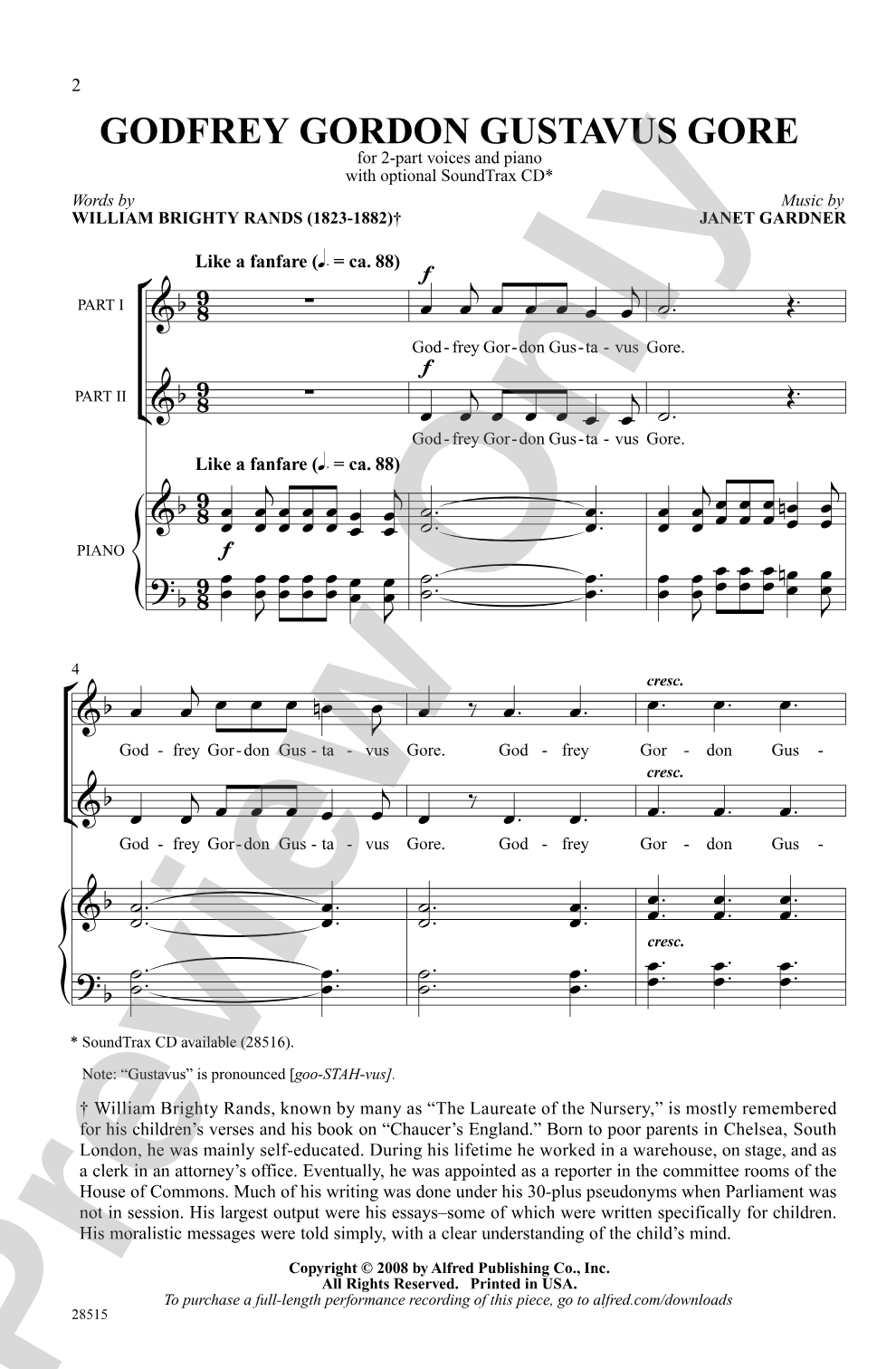
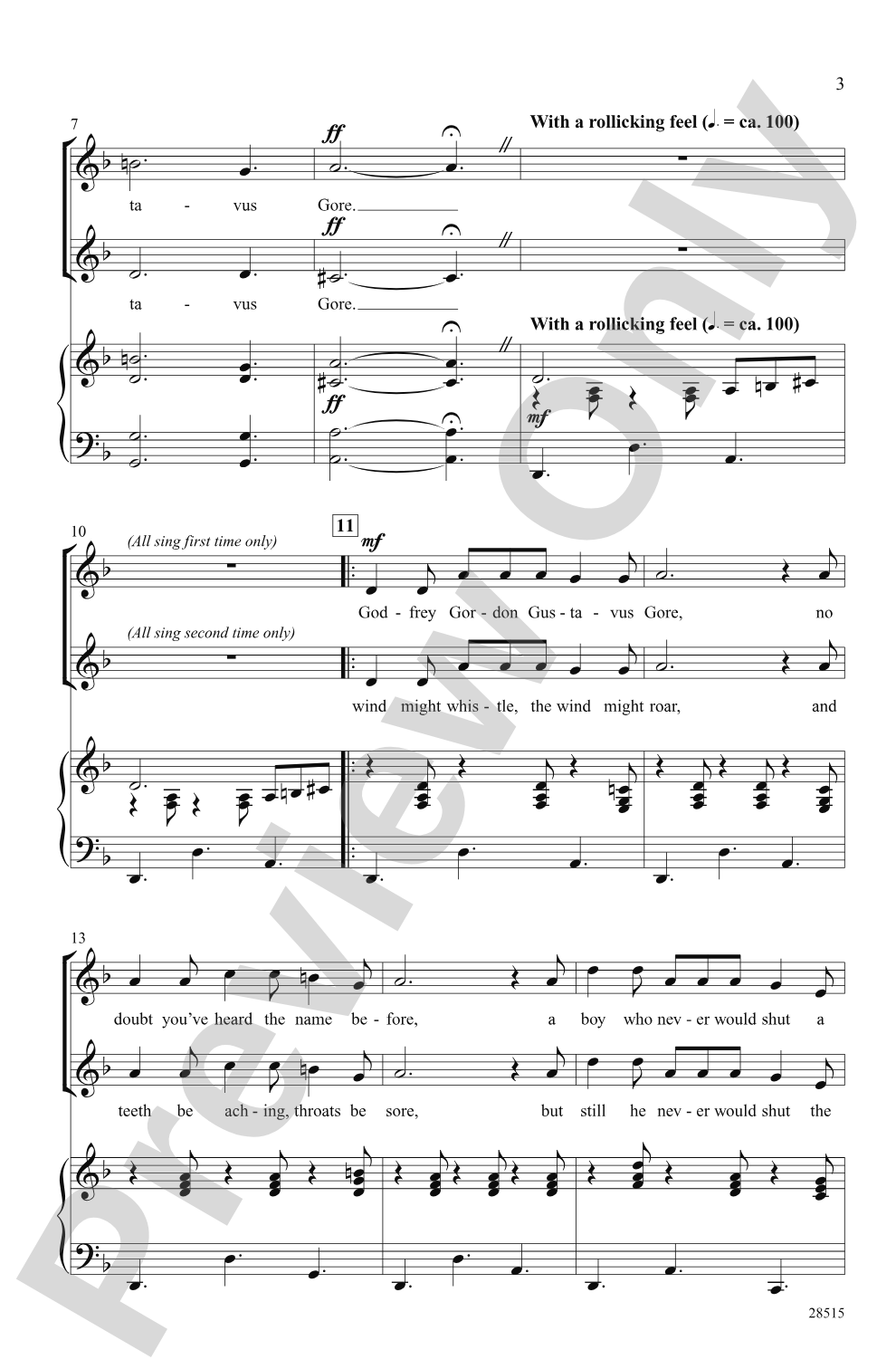
2-part choirs will love singing this story of "Godfrey Gordon Gustavus Gore, a boy who never would shut the door." Janet Gardner's modal melody and rollicking compound meters give this slightly silly text an irresistible charm. Rhymes are abundant . . . "door, implore, ignore, Singapore" . . . and more!


Godfrey Gordon Gustavus Gore: 2-Part Choral Octavo isn't in MakeMusic Cloud just yet...but it could be. Let us know you'd like to see it, and you'll help shape what comes next. In the meantime, start a free trial and dive into thousands of interactive titles your students can play along with today.
Request This Title
Tell us you want it.
Start Your Free Trial
Explore everything that's ready to play right now.
Sample Audio
1
Audio File
--:--
0:00
0:00
Sample Video
No sample videos found.
Additional Details
Series:
Alfred Choral Designs
Publisher:
Alfred Music
Page Count:
12
SKU:
00-PO-0000468
More about this title
About the Composer: Janet Gardner

Janet Gardner studied music education at Concordia College in Moorhead, Minnesota, and spent 33 years teaching elementary general music in Montevideo. She became known regionally as a clinician and composer, presenting workshops at state universities and music conventions across the United States and Canada. In 1995, she received the Minnesota Music Classroom Teacher of the Year award and later chaired the Minnesota Elementary Composition Contest for six years.
Gardner has composed numerous musicals for Alfred Music, among them Bones!, Broadway Santa, The Granny Awards, and The Phantom of the Music Room. Her choral catalog includes several octavos that balance pedagogical soundness with genuine musical charm. She has earned annual ASCAP awards for her compositions. Since retiring from classroom teaching in 2006, Gardner continues composing in Montevideo, where she also serves as a church musician and directs an ecumenical contemporary music ensemble.
Why we love this
Gardner's setting captures the absurd energy of the original poem while giving your singers a genuinely fun experience. The compound meters and modal melody work together to create something that feels playful without becoming gimmicky, and the rhyme scheme practically sings itself. Young singers thrive on material this engaging, and the 12 pages move quickly enough to keep rehearsal momentum strong.
What to expect
Lighthearted and rhythmically infectious, with a storyteller's charm that keeps listeners smiling. The modal melody gives the setting a slightly quirky character that matches the absurdity of the text perfectly, while the compound meters add a rollicking swing that makes this feel contemporary and bright.
Who it's for
Middle school and elementary choirs, particularly groups ready for two-part writing but not yet tackling complex harmonic language. This octavo works wonderfully for singers who respond to humor and narrative in text, and for directors looking to program something with genuine appeal to young performers and their audiences.
How to get the most out of it
- Lean into the rhythmic bounce of the compound meter; the lilting quality makes this piece come alive when singers feel the lilt rather than counting in straight divisions.
- Use the recorded accompaniment during early rehearsals to lock the harmonic foundation while singers are learning their parts.
- Highlight the rhymes through clear articulation and slight emphasis on the end-rhyme words (door, implore, ignore, Singapore). This helps the audience follow the storytelling.
- Keep the overall tempo buoyant without rushing; Gardner's modal melody needs room to breathe even when the rhythm is playful.
How to use it
Program this as a concert closer or mid-concert pick-me-up, especially in spring concerts when audiences appreciate lighter repertoire. It pairs well alongside other story songs or novelty pieces, and works beautifully as a finale to a program of choral literature across multiple styles.
Skills your students will build
- Reading and performing in compound meter
- Singing modal melodies with accurate intonation
- Two-part harmony and voice independence
- Text clarity and articulation for storytelling
- Phrasing in non-traditional harmonic contexts