
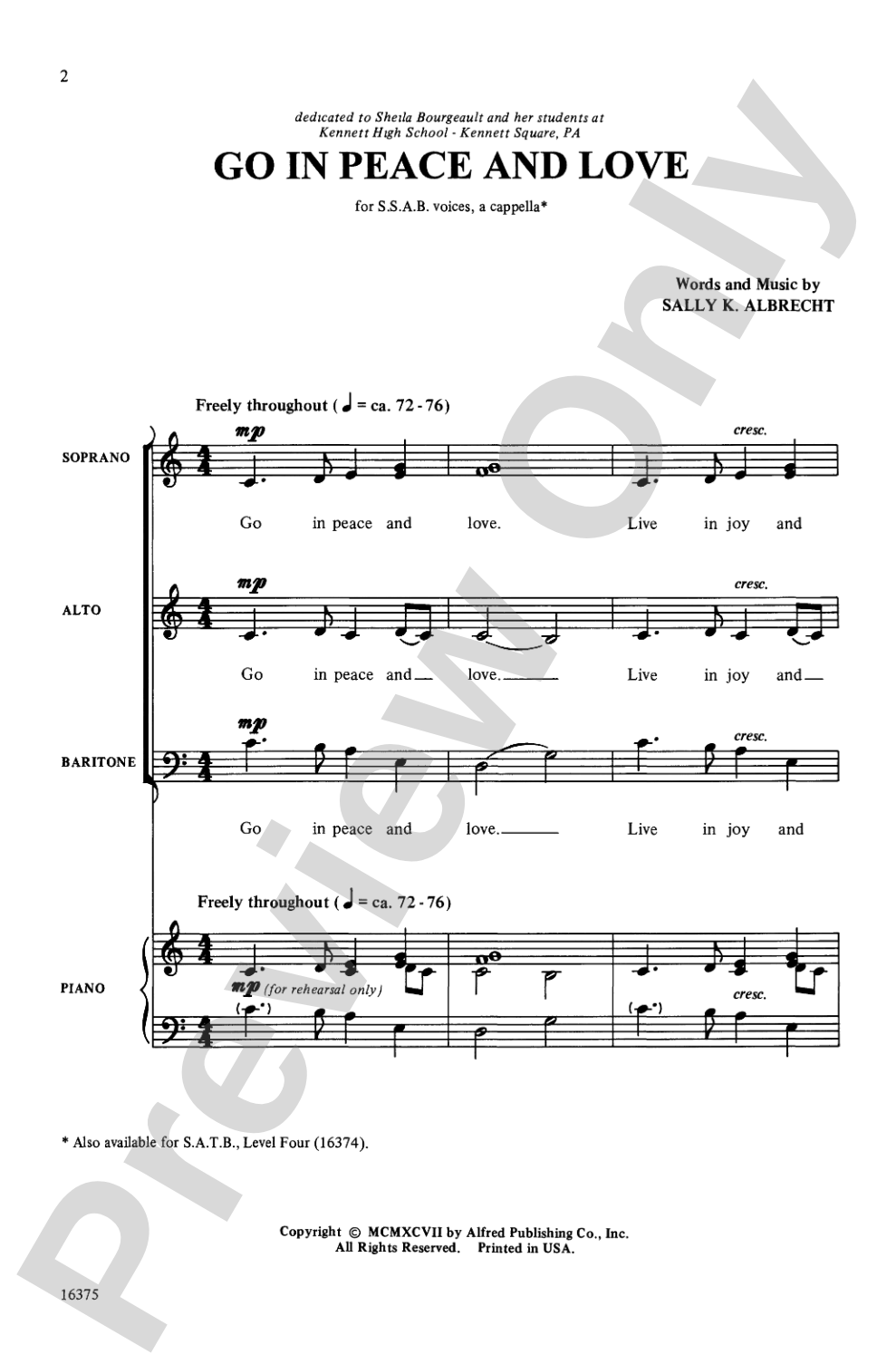
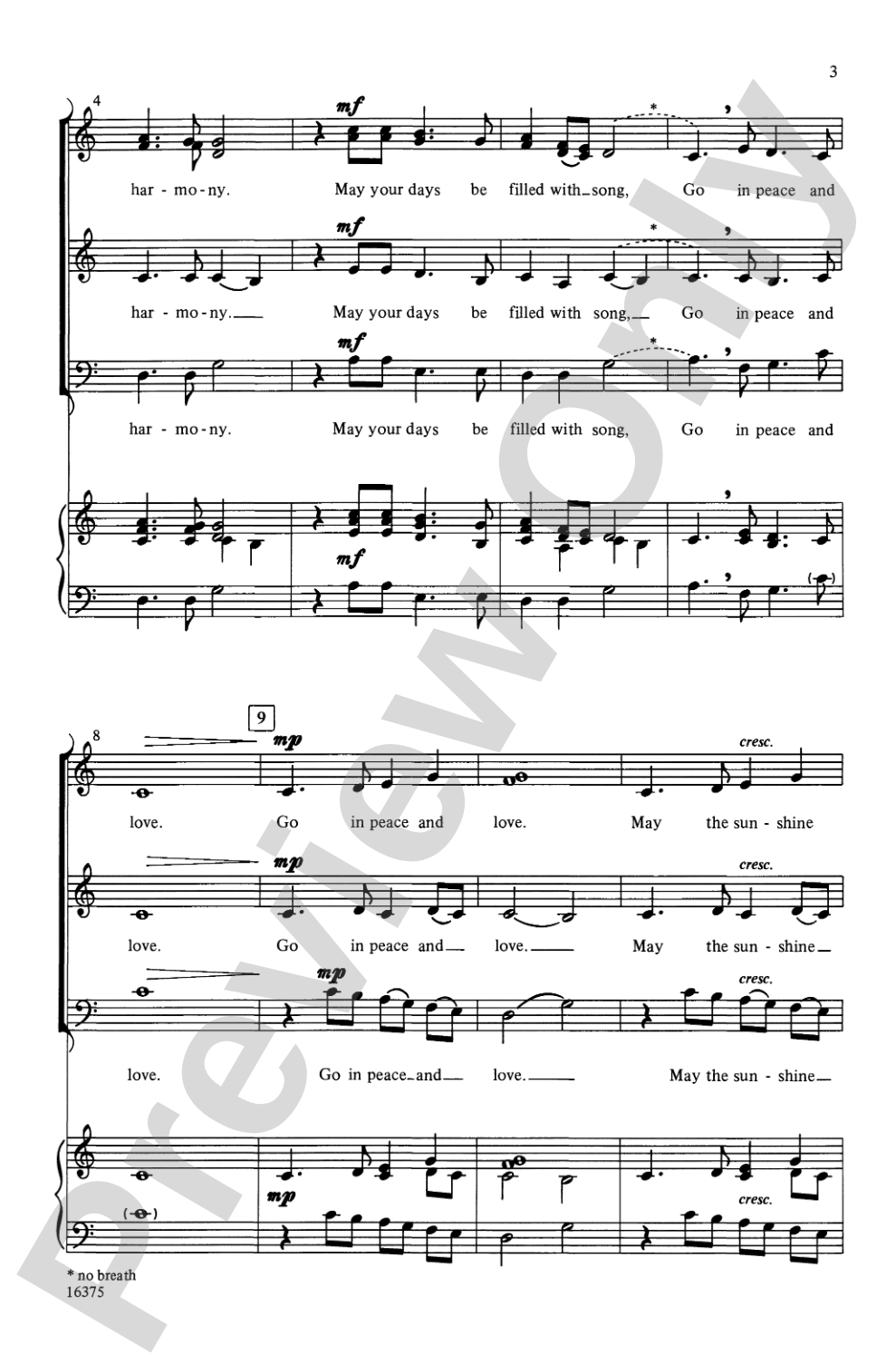

Go in Peace and Love: SSAB, a cappella Choral Octavo
Music by Sally K. Albrecht
Item: 00-PO-0003982
$2.25
Minimum order quantity: 20 copies
Pickup currently not available
Description
A thoughtful song of parting, benediction-like, in the style of an Irish blessing. Basic choral writing throughout with much opportunity for rubato phrasing. Moderate ranges in all voice parts in both editions.


Go in Peace and Love: SSAB, a cappella Choral Octavo isn't in MakeMusic Cloud just yet...but it could be. Let us know you'd like to see it, and you'll help shape what comes next. In the meantime, start a free trial and dive into thousands of interactive titles your students can play along with today.
Request This Title
Tell us you want it.
Start Your Free Trial
Explore everything that's ready to play right now.
Sample Audio
No sample audio found.
Sample Video
No sample videos found.
Additional Details
Series:
Alfred Archive Edition: Alfred Choral Designs
Publisher:
Alfred Music
Page Count:
8
SKU:
00-PO-0003982
More about this title
About the Composer: Sally K. Albrecht

Sally K. Albrecht has shaped choral music education for over three decades, beginning as Director of School Choral, Vocal, and Elementary Publications at Alfred Music, where she oversaw the development of hundreds of titles for student singers. A prolific composer with more than 600 published works and 75 larger collections to her credit, she has been recognized annually by ASCAP since 1987 for her contributions to music. She has conducted honor choirs at prestigious venues including Lincoln Center, Carnegie Hall, and The Kennedy Center, bringing her signature approach to choral expression and movement across the country.
Albrecht earned her B.A. from Rollins College in Music and Theater (1976), followed by an M.A. in Drama and an M.M. in Accompanying from the University of Miami. She has taught in the music departments at Oakland University, Jersey City State College, and Meredith College. Beyond her compositional work, she has served as Chair of the Board of Trustees for the Omicron Delta Kappa National Leadership Honor Society and received the organization's "Pillar of Leadership" award. In 2021, both the University of Miami Frost School of Music and Rollins College honored her with Distinguished Alumna Awards. She lives in North Carolina with her husband, composer and arranger Jay Althouse.
Why we love this
Albrecht's gift for writing accessible yet genuinely moving benedictions makes this piece feel natural for a closing moment without requiring technical virtuosity from singers. The rubato phrasing opportunities invite your choir to discover their own interpretive voice rather than locking into a fixed tempo, and that freedom tends to produce more authentic performances. Paired with the moderate ranges and straightforward voice-leading, this creates a piece that feels ceremonial and intentional without demanding extra rehearsal time.
What to expect
A gentle, meditative blessing that unfolds like an Irish benediction spoken over a gathered community. The writing breathes with openness and warmth, never pushing dramatically forward but instead inviting singers and listeners into a moment of peace and reflection, supported by the intimacy of a cappella sound.
Who it's for
This piece suits intermediate to advanced high school and college choirs, as well as adult community ensembles seeking meaningful repertoire for closer moments. The SSAB voicing works equally well for mixed ensembles with strong soprano sections or treble-focused groups, and the moderate ranges make it accessible without requiring soloistic singers.
How to get the most out of it
- Shape the phrase endings with slight ritardandos to honor the blessing quality; the Irish tradition here benefits from breath and space rather than driving through to the next phrase.
- Let your singers experiment with the rubato in sectionals first. Once each voice part understands where it naturally wants to breathe and linger, bring those discoveries into full rehearsal so the rubato feels organic rather than imposed.
- Balance the SSAB texture by ensuring both soprano lines blend as a unified top without one dominating; this requires careful listening in rehearsal but prevents a thin or lopsided sound.
- Consider how much vibrato serves this piece. A cappella voicings can benefit from subtle vibrato that enriches tone, but excessive vibrato can blur the simplicity Albrecht intended.
How to use it
Reserve this for graduation ceremonies, peace-focused concerts, or services where a benedictory moment will resonate. It works as a concert closer or as the final piece in a program themed around community and transition, and its moderate length and simple technical demands mean it won't overshadow the occasion.
Skills your students will build
- Phrasing with rubato and flexible tempo in an a cappella context
- SSAB voice leading and blend in mixed ensemble textures
- Expressivity through restraint and minimal text
- Sustained a cappella intonation across moderate ranges