
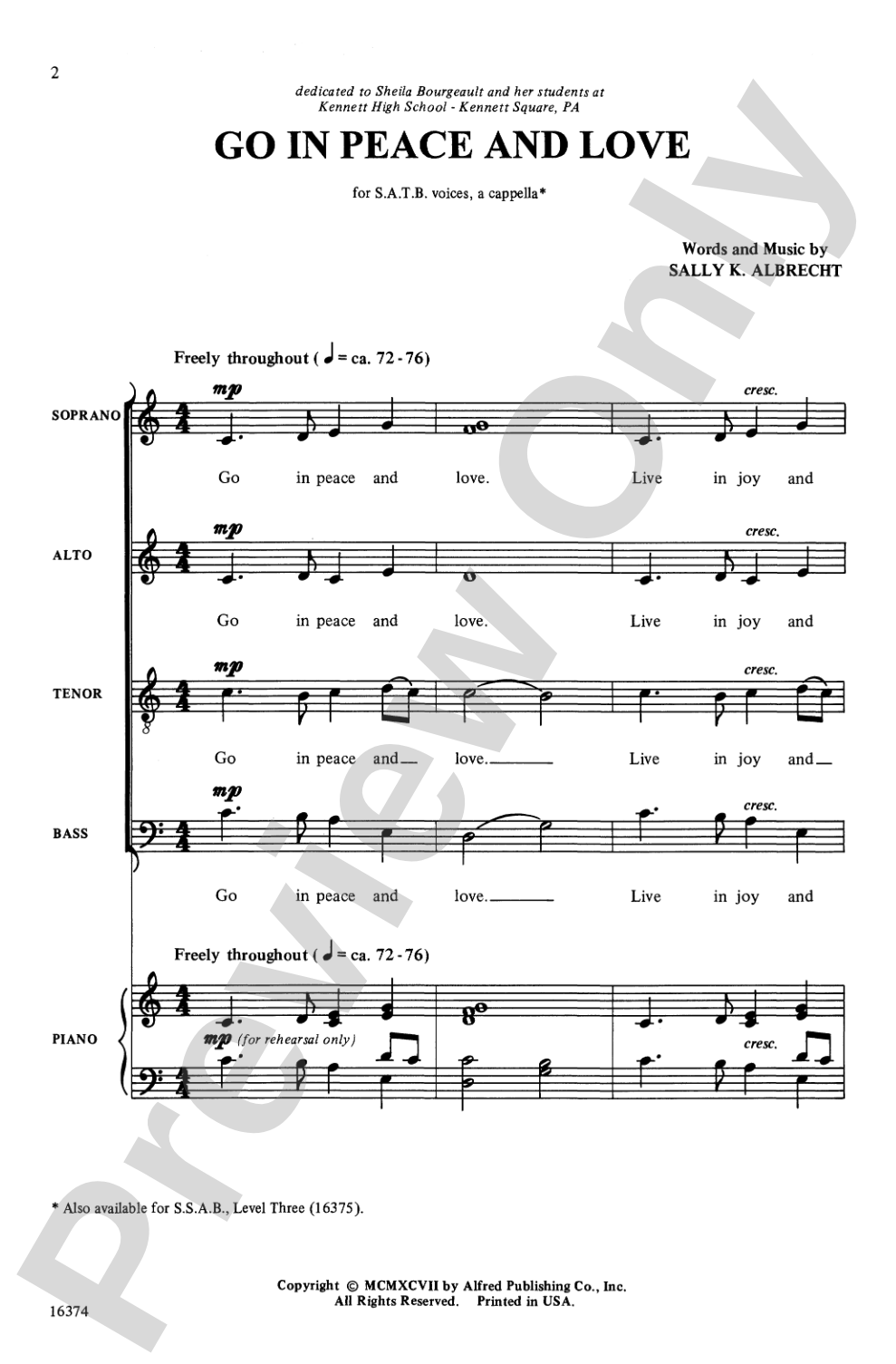
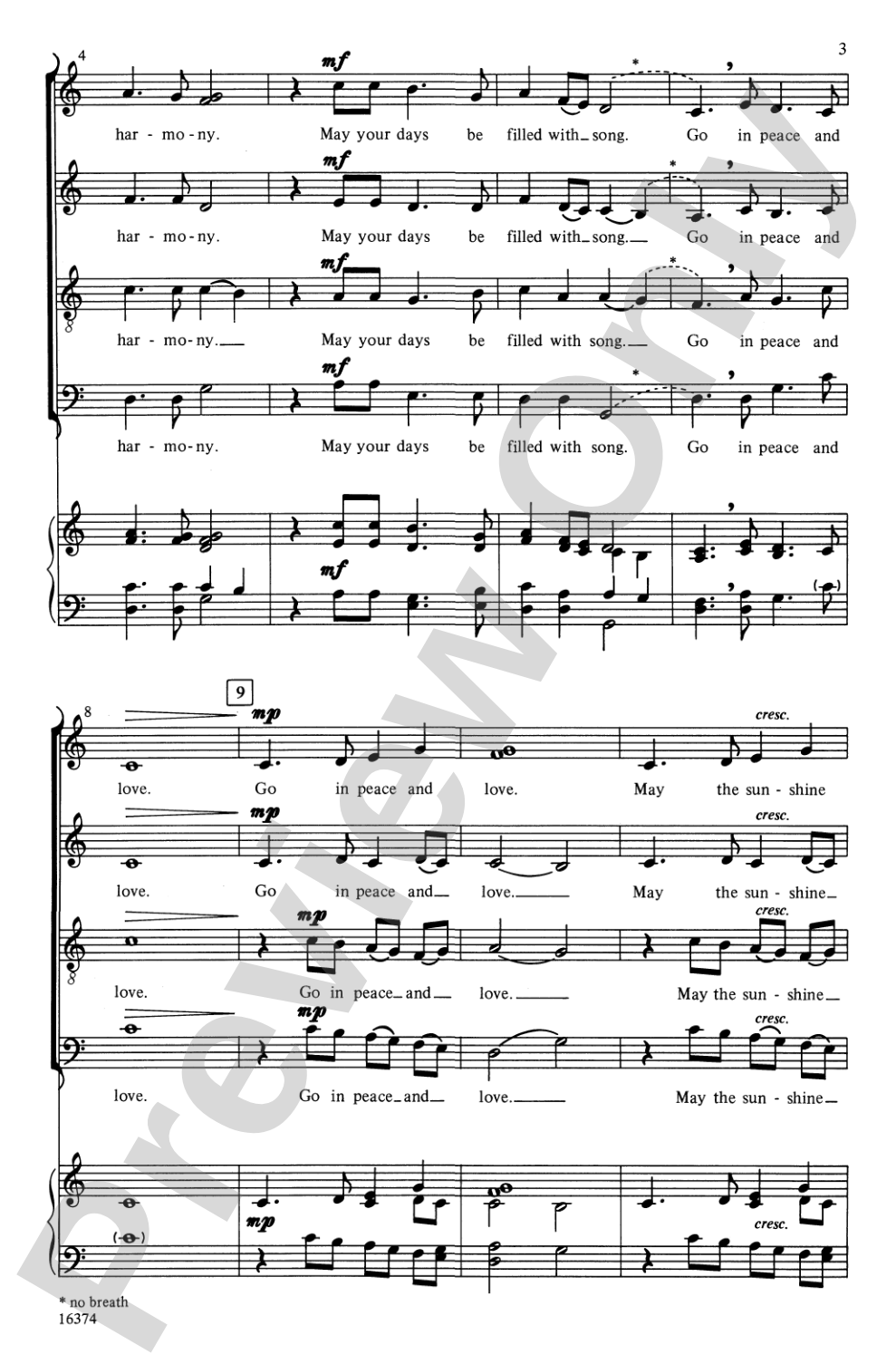

Go in Peace and Love: SATB, a cappella Choral Octavo
Music by Sally K. Albrecht
Item: 00-PO-0003981
$2.25
Minimum order quantity: 20 copies
Pickup currently not available
Description
A thoughtful song of parting, benediction-like, in the style of an Irish blessing. Basic choral writing throughout with much opportunity for rubato phrasing. Moderate ranges in all voice parts in both editions.


Go in Peace and Love: SATB, a cappella Choral Octavo isn't in MakeMusic Cloud just yet...but it could be. Let us know you'd like to see it, and you'll help shape what comes next. In the meantime, start a free trial and dive into thousands of interactive titles your students can play along with today.
Request This Title
Tell us you want it.
Start Your Free Trial
Explore everything that's ready to play right now.
Sample Audio
No sample audio found.
Sample Video
No sample videos found.
Additional Details
Series:
Alfred Archive Edition: Alfred Choral Designs
Publisher:
Alfred Music
Page Count:
8
SKU:
00-PO-0003981
More about this title
About the Composer: Sally K. Albrecht

Sally K. Albrecht has shaped American choral music for over three decades, first as Director of School Choral, Vocal, and Elementary Publications at Alfred Music, and throughout her career as a prolific composer with more than 600 published works. Her contributions to the field have earned consistent recognition, including annual ASCAP Special Music Awards since 1987 and the Distinguished Alumna Award from both the University of Miami Frost School of Music and Rollins College. She holds degrees from Rollins College (B.A., 1976) and the University of Miami (M.A. in Drama, 1977; M.M. in Accompanying, 1979).
Beyond her publishing legacy, Albrecht has conducted honor choirs and festival events at Lincoln Center, Carnegie Hall, and The Kennedy Center, establishing herself as both a clinician and advocate for choral artistry. Her particular expertise in choral movement and accessible yet musically substantive writing has made her works essential to choir libraries across the country. She resides in Wake Forest, North Carolina, with her husband, composer and arranger Jay Althouse.
Why we love this
Albrecht crafts this benediction with genuine warmth and restraint, trusting simple four-part harmony and rubato phrasing to carry emotional weight rather than technical complexity. The Irish blessing style grounds the piece in a timeless tradition while keeping voice parts moderate and accessible, making it feasible for developing ensembles without sacrificing sincerity. Directors will appreciate the built-in flexibility for expressive nuance while working with singers who need room to breathe and find their voices.
What to expect
The piece settles into you like a spoken blessing, warm and unhurried. With moderate ranges across all parts and an Irish folk sensibility, it feels both intimate and timeless, inviting singers to linger on harmonies and listeners to hear genuine care in every phrase.
Who it's for
Choirs at the intermediate level and above will find this piece manageable and musically rewarding. It suits groups with moderate ensemble size and singers comfortable with four-part a cappella singing, whether in school choirs, community ensembles, or church settings.
How to get the most out of it
- Shape phrases through breath, not the printed measures; the rubato markings invite you to stretch and compress time naturally, especially at cadences where singers need space to express the benediction's sentiment
- Balance the texture by listening for the soprano line while anchoring with the bass; this a cappella setting depends entirely on intonation, so tune vertically first and adjust horizontal line-singing second
- Consider light divisi in the middle voices if your ensemble size allows; opening up moments of harmonic thickness can enhance the blessing's resonance without adding complexity
How to use it
This is an ideal closer for a graduation concert, benediction ceremony, or any program centered on peace and community. It pairs naturally with other sacred a cappella works and provides a memorable, heartfelt ending that allows the audience to leave reflective rather than energized.
Skills your students will build
- Sustaining pure intonation in a cappella ensemble singing
- Phrasing with rubato and flexibility within a predetermined harmonic framework
- Balancing SATB texture through listening and blend adjustment
- Interpreting a cappella works with attention to breath and natural speech rhythm