

Gloria in Excelsis Deo: SATB Choral Octavo
By Jay Althouse
Item: 00-PO-0006288
$2.05
Minimum order quantity: 20 copies
Pickup currently not available
Description
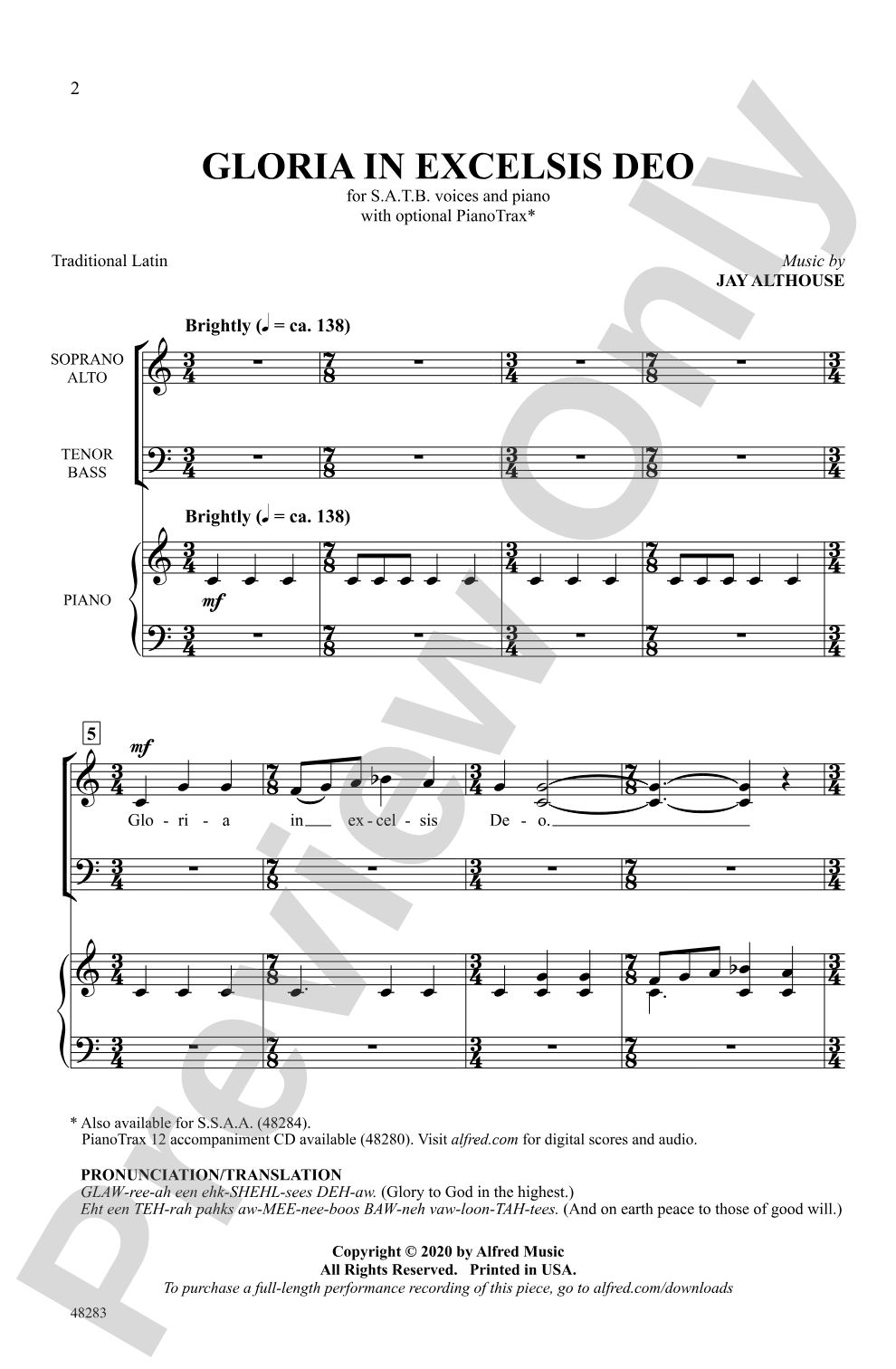
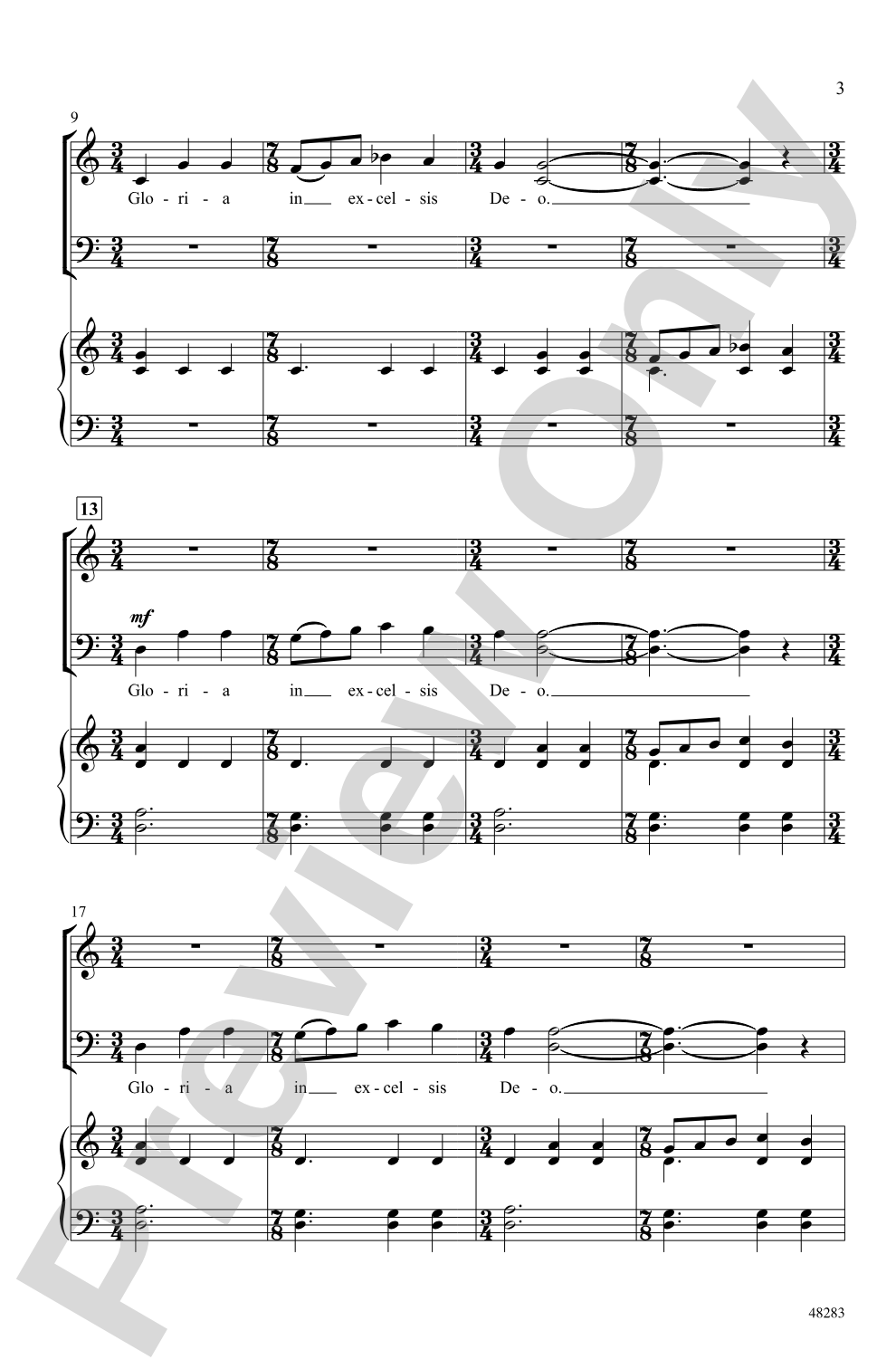
An achievable thriller on a familiar Latin text! Jay Althouse's compelling mixed meter theme develops into a shimmering array of contemporary harmonies in this exciting, angular work. A reflective adagio section in the middle offers contrast before returning to the rhythmic opening.


Gloria in Excelsis Deo: SATB Choral Octavo isn't in MakeMusic Cloud just yet...but it could be. Let us know you'd like to see it, and you'll help shape what comes next. In the meantime, start a free trial and dive into thousands of interactive titles your students can play along with today.
Request This Title
Tell us you want it.
Start Your Free Trial
Explore everything that's ready to play right now.
Sample Audio
1
Audio File
--:--
0:00
0:00
Sample Video
Additional Details
Series:
Alfred Choral Designs
Publisher:
Alfred Music
Page Count:
8
SKU:
00-PO-0006288
More about this title
About the Composer: Jay Althouse

Jay Althouse holds degrees in Music Education and Music from Indiana University of Pennsylvania, where he was honored with the Distinguished Alumni award. His career spans both publishing and composition; he spent eight years managing rights and licenses for a major educational music publisher and served on the Executive Board of the Music Publishers Association of America. As a composer, he has published more than 800 choral works performed regularly across the English-speaking world and maintains membership in ASCAP, where he is a frequent recipient of the Special Award.
Beyond composition, Althouse has shaped music education through multiple channels. He co-wrote children's musicals with his wife Sally K. Albrecht, compiled respected vocal solo collections including Folk Songs for Solo Singers, and authored influential classroom resources such as Ready to Read Music and Sixty Music Quizzes. His collaborative work I Hear America Singing was performed by the San Francisco Girls and Boys Choirs at President Obama's 2009 Inauguration. He serves on the National Advisory Board of the Folk Art Society of America and resides in Wake Forest, North Carolina.
Why we love this
Althouse delivers a piece that excels at concert and festival programming without sacrificing musical substance. The mixed meter foundation gives the piece its distinctive character, while the contemporary harmonic language and strategic shift to adagio create genuine architectural interest that audiences feel, even if they can't name it. This is the kind of work that reminds singers why they chose this repertoire.
What to expect
The piece opens with angular, syncopated energy that feels modern despite its sacred text. The shimmering harmonic passages create luminosity and shimmer, then the middle adagio offers genuine reprieve and reflection before the rhythmic opening returns with earned impact. It's thrilling without being bombastic, sophisticated without being inaccessible.
Who it's for
This octavo suits intermediate to advanced choirs ready for contemporary harmonic language and rhythmic complexity. Singers need confidence with mixed meter and the ability to hear their line within a complex harmonic texture, making it ideal for high school advanced choirs, college choirs, and community ensembles with regular rehearsal time.
How to get the most out of it
- Establish the mixed meter theme clearly in rehearsal before layering harmonies; use a metronome to anchor the rhythmic displacement rather than fighting it.
- Shape the contemporary harmonies by emphasizing voice independence in the faster sections; resist blending that smooths out the angular quality.
- Balance dynamic contrast between the opening theme, the shimmering harmonic section, and the reflective adagio to maximize the architecture Althouse has built.
- If using the recorded accompaniment, rehearse with it early and often so singers internalize the harmonic rhythm and independence from the accompanist's choices.
How to use it
Pair this as a concert or festival centerpiece for a program exploring sacred music across styles, or use it to demonstrate how contemporary harmonic writing can serve liturgical texts. The contrasting adagio section makes it particularly effective as a program closer where you want to leave audiences with both intellectual engagement and emotional resonance.
Skills your students will build
- Reading and performing mixed meter (developing independence across meter changes)
- Voice independence within contemporary harmonic textures
- Dynamic shaping and phrasing across contrasting sections
- Intonation in complex, non-traditional harmonic contexts
- Rhythmic precision in syncopated material