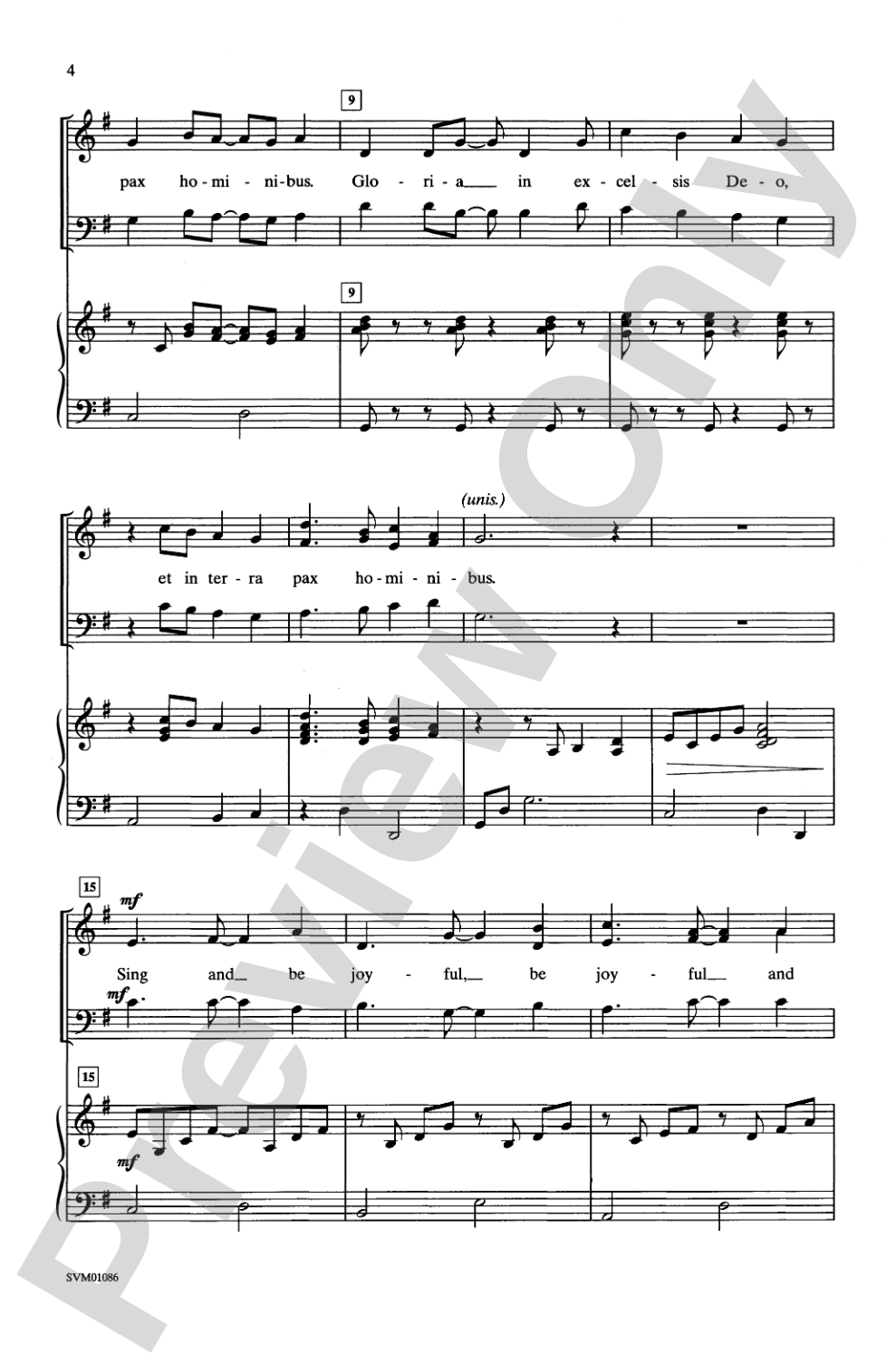
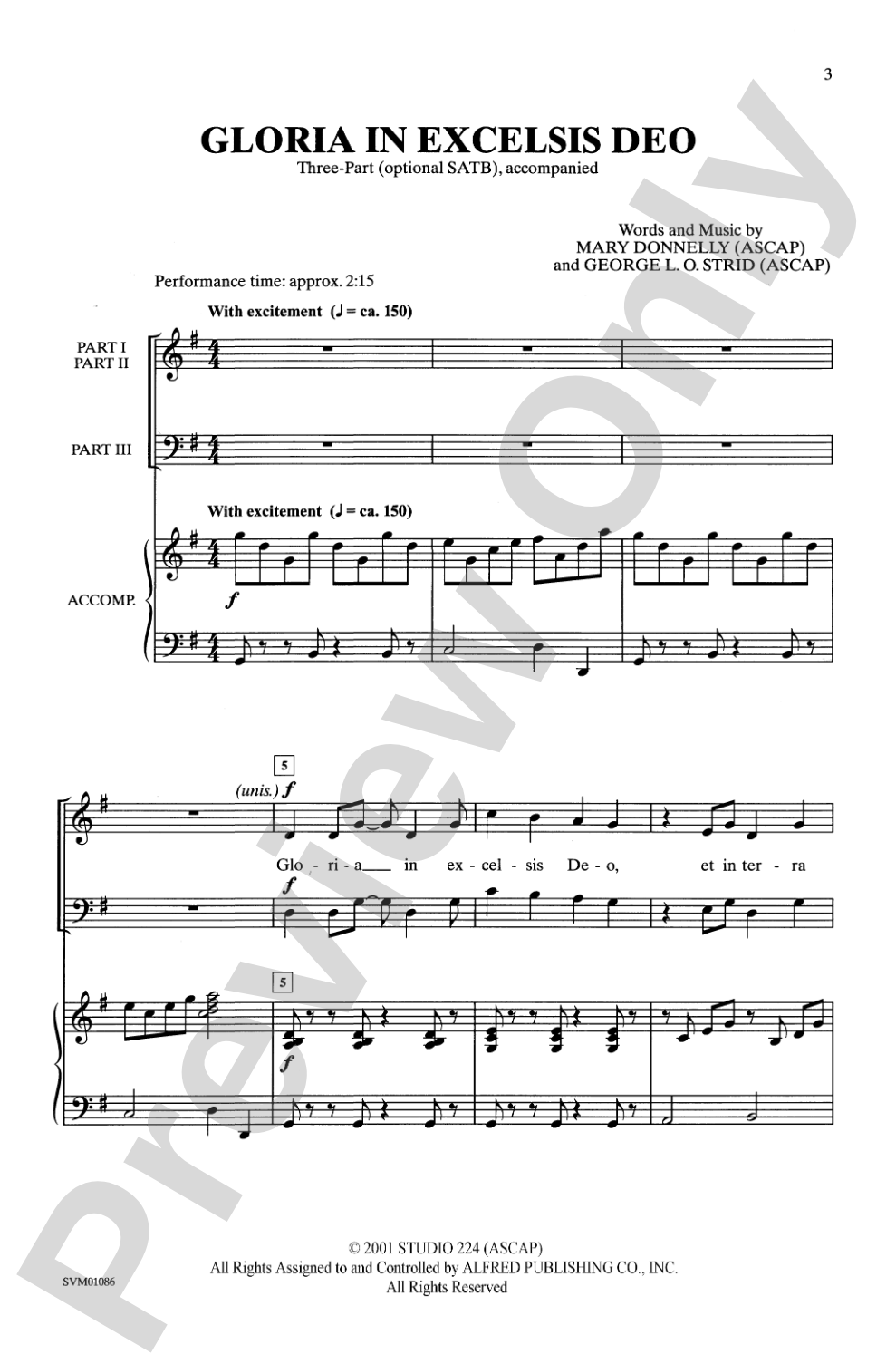
Gloria In Excelsis Deo Sheet Music Preview

Gloria In Excelsis Deo: 3-Part (Opt. SATB) Choral Octavo

Words and music by Mary Donnelly and George L. O. Strid

Level: Moderate

Item: 00-PO-0005348

Digital Download
$2.25

Minimum order quantity: 20 copies

Description
This very strong concert/festival work comes from the writing team that has brought us successful choral works for over a decade. It's easy to sing yet substantial enough that any choir would love to perform.

Gloria In Excelsis Deo: 3-Part (Opt. SATB) Choral Octavo isn't in MakeMusic Cloud just yet...but it could be. Let us know you'd like to see it, and you'll help shape what comes next. In the meantime, start a free trial and dive into thousands of interactive titles your students can play along with today.

Sample Audio
No sample audio found.
Sample Video
Additional Details
Series: Alfred Archive Edition: Studio PR Catalog
Publisher: Alfred Music
Page Count: 12
SKU: 00-PO-0005348

More about this title

About the Composer: Mary Donnelly

Mary Donnelly

Mary Donnelly grew up in Reno, Nevada, and studied English and French at the University of Nevada before discovering her passion for music education. She pursued formal training in music pedagogy at Lesley College in Cambridge, Massachusetts, where she focused on integrating the arts across the curriculum. Over three decades, she taught general music and choir in elementary and middle schools throughout Washoe County, Nevada, while remaining active in ACDA, NEA, and ASCAP.

In 1985, Donnelly began collaborating with George L. O. Strid when they co-taught a sixth grade general music class. Their first joint project, a musical for Reading Week called The Million Dollar Mystery, launched a partnership that has produced over two hundred songs and twenty-five musicals. The two continue to create accessible, singable works grounded in Donnelly's classroom experience and deep understanding of what young singers need.

Why we love this

Donnelly and Strid write from genuine classroom experience, and it shows. This piece balances immediate accessibility with enough musical substance to satisfy both singers and audiences, making it equally at home in a spring concert or competitive festival without feeling thin or compromised.

What to expect

Gloria in Excelsis Deo carries the warmth and clarity of a processional hymn without the stiffness. Donnelly and Strid craft lines that feel natural to sing, and the harmonic language supports rather than constrains the voices, creating a sense of lifted, genuine praise.

Who it's for

This octavo suits developing choirs in grades 3-5, middle school ensembles still building blend and independence, and community or church choirs seeking repertoire that doesn't demand extensive vocal technique. The flexible voicing (3-part with optional SATB) lets you choose the arrangement that fits your singers without sacrificing the piece's musical integrity.

How to get the most out of it

  • Attend to the text projection in the 3-part sections; the divisi creates opportunities for clarity if each voice part commits to its phrase.
  • If performing the optional SATB expansion, use rehearsal time to build independence in the second soprano and second alto parts before combining all voices.
  • Balance the piece's reverent quality by resisting the urge to slow tempos; this music breathes naturally at a moderate pace and maintains its energy when kept moving.
  • Secure unison passages first, as they anchor the choir's togetherness before the harmonic texture thickens.

How to use it

Program this as the centerpiece of a sacred or seasonal concert, where its moderate demands allow you to pair it with works at different difficulty levels. Its festival-ready quality also makes it ideal for adjudicated events or as a showpiece when you need repertoire that impresses both singers and listeners without requiring extensive rehearsal time.

Skills your students will build

  • Singing in three-part mixed voicing with secure harmonic independence
  • Sustaining and shaping longer musical phrases with consistent breath support
  • Navigating optional SATB divisi to understand voice part flexibility
  • Text clarity and projection in a reverent, sacred context
  • Maintaining musical line when part voicing changes within a section

You May Also Like