
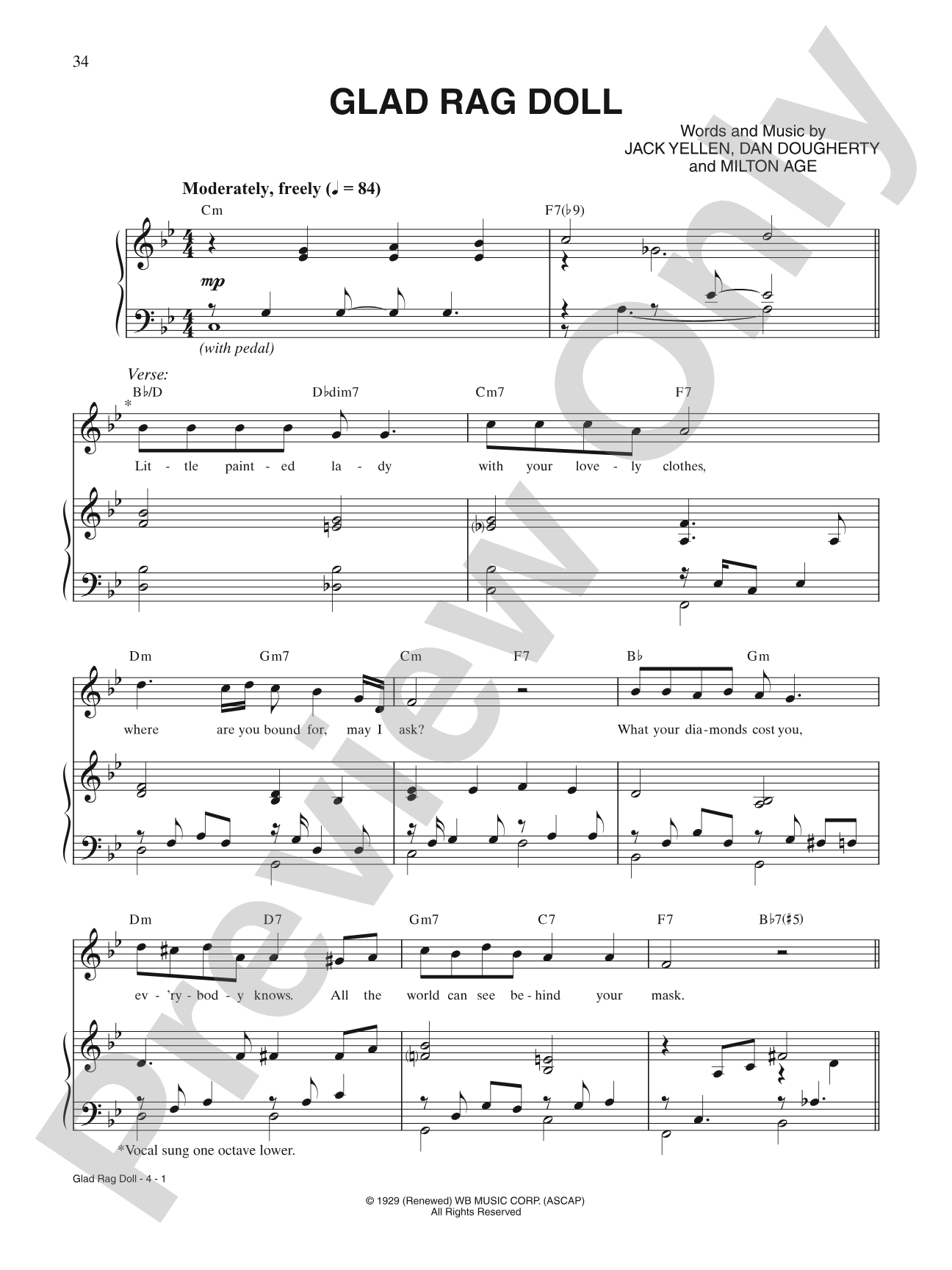

Glad Rag Doll: Piano/Vocal/Chords
Diana Krall
Item: 00-PS-0015534
$4.99
One moment…
Description
This official piano sheet music companion folio to Diana Krall's 11th studio album will delight any pianist who loves jazz and blues. The melodic 1920s- and '30s-era songs are naturally enjoyable at the keys, as are the songs from later eras, like "Lonely Avenue" and "Wide River to Cross." Vocal melodies, complete lyrics, and chords are included. Titles: We Just Couldn't Say Goodbye * There Ain't No Sweet Man That's Worth the Salt of My Tears * Just Like a Butterfly That's Caught in the Rain * You KnowF--I Know Ev'rything's Made for Love * Glad Rag Doll * I'm a Little Mixed Up * Prairie Lullaby * Here Lies Love * I Used to Love You but It's All Over Now * Let It Rain * Lonely Avenue * Wide River to Cross * When the Curtain Comes Down.


Glad Rag Doll: Piano/Vocal/Chords isn't in MakeMusic Cloud just yet...but it could be. Let us know you'd like to see it, and you'll help shape what comes next. In the meantime, start a free trial and dive into thousands of interactive titles your students can play along with today.
Request This Title
Tell us you want it.
Start Your Free Trial
Explore everything that's ready to play right now.
Sample Audio
No sample audio found.
Sample Video
No sample videos found.
Additional Details
Publisher:
Alfred Music
Page Count:
84
SKU:
00-PS-0015534
More about this title
About the Composer: Jack Yellen
Jack Yellen (1892-1991) was a prolific lyricist and songwriter who shaped popular music across five decades. His collaborations with composers like Milton Ager and Dan Dougherty produced standards that defined the jazz and blues repertoire of the 1920s and 1930s, earning him a lasting place in American popular song.
Yellen's gift for conversational, emotionally direct lyrics made his songs natural fits for vocalists and musicians seeking material with genuine character. His work remains a cornerstone of jazz standards pedagogy and performance.
Why we love this
Diana Krall's arrangement of this repertoire pairs authentic 1920s-30s blues and jazz standards with later compositions, giving pianists access to material that feels both historically grounded and musically vital. The folio balances well-loved standards with less frequently performed gems, making it an excellent choice for pianists building a jazz-standards toolkit beyond the most obvious choices.
What to expect
These songs breathe with the warmth and sincerity of jazz's golden age, blending playful swing with genuine emotional depth. Whether navigating the wry humor of "There Ain't No Sweet Man" or the aching vulnerability of "Lonely Avenue," you'll find yourself drawn into narratives that feel immediate and human, even a century after they were written.
Who it's for
Pianists with intermediate to advanced jazz skills who want to expand their standards repertoire and explore the interplay between melody, lyric, and harmony. This folio serves vocalists seeking quality backing arrangements and guitarists who want to comp or comping independently alongside a vocalist.
How to get the most out of it
- Study the original recordings alongside Krall's interpretations to understand the harmonic liberties and rhythmic flexibility that jazz pianists use with this material; her voicings offer a contemporary but respectful approach to these standards.
- Pay attention to the lyrical phrasing marked in the vocal line; these melodies are singable even for instrumentalists, and understanding the text's emotional arc will shape your harmonic choices and tempo flexibility.
- Treat the chord symbols as a starting point rather than a blueprint. The piano voicings suggested in the score show how to support the melody and lyrics, but exploring your own comping patterns will deepen your connection to the material.
- Work through these songs at a slower tempo first, especially the ballads. Getting the melody and harmony under your fingers before adding rhythmic interpretation will help you navigate the syncopation and chromatic movement typical of this era.
How to use it
Feature individual selections in jazz recitals or casual concert settings where intimate, conversational performance is valued over spectacle. The mix of tempos and moods makes this folio ideal for creating a cohesive set that showcases both your technical control and interpretive maturity.
Skills your students will build
- Jazz chord voicing and substitution in authentic blues and swing contexts
- Sight-reading lead-sheet notation with vocal melody, lyrics, and jazz chord symbols
- Rhythmic flexibility and syncopation typical of 1920s-30s jazz idiom
- Lyric integration and phrasing as guides to harmonic and melodic interpretation
- Bass-line reading and comping patterns for jazz standards