
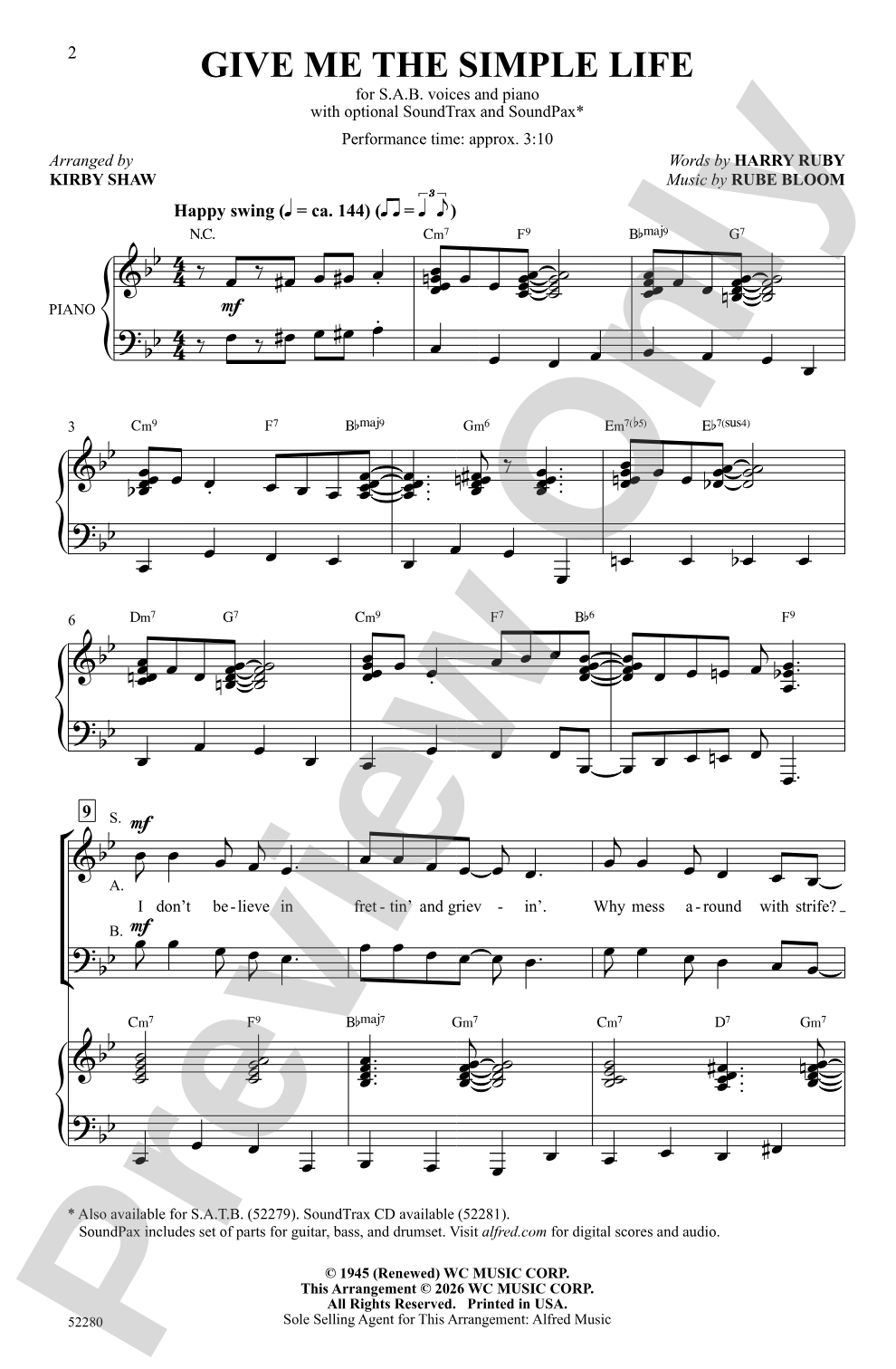
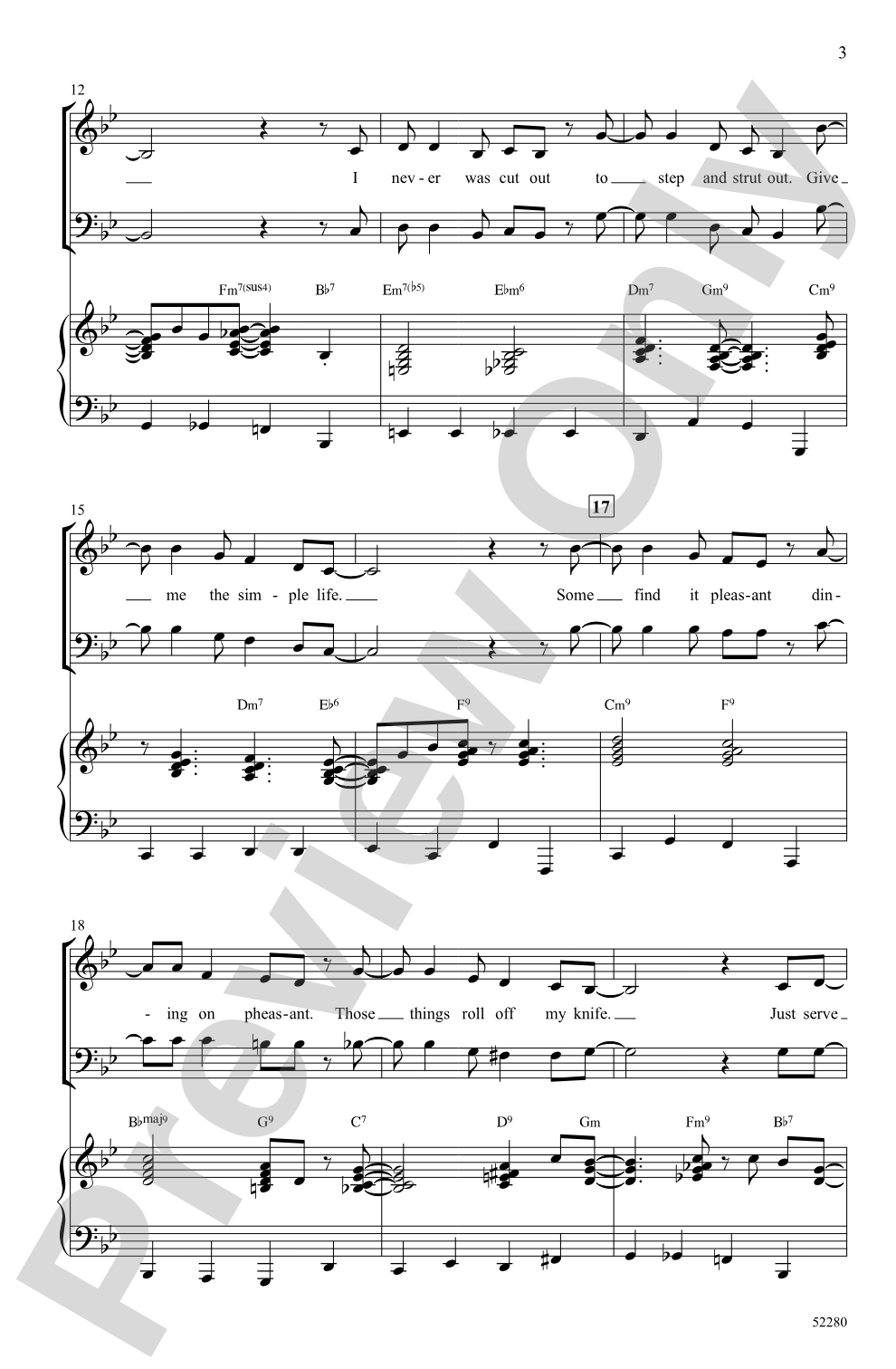

Give Me the Simple Life: SAB Choral Octavo
Words by Harry Ruby, music by Rube Bloom / arr. Kirby Shaw
Item: 00-PO-0007852
$2.55
Minimum order quantity: 20 copies
Pickup currently not available
Related Items
Give Me the Simple Life: SATB Choral Octavo |
$2.55
|
View | |
Give Me the Simple Life: Choral SoundPax Digital Download |
$15.00
|
View | |
Give Me the Simple Life: SATB Choral Octavo |
$2.55
|
View | |
Give Me the Simple Life: SAB Choral Octavo |
$2.55
|
View | |
Give Me the Simple Life: Choral Octavo SoundTrax CD |
$29.99
|
View |
Description
Experience the quintessential charm of the Great American Songbook with this mid-century jazz standard, recorded by modern-day crooner, Seth MacFarlane. His 2025 recording Lush Life debuts long-lost arrangements intended for Frank Sinatra. This kickin' arrangement features tight harmonies, swingin' rhythms that sit right in the pocket, and playful lyrics about finding contentment in life's modest pleasures. Kirby includes the kind of sleek stylizations that vocal jazzers crave, plus a smokin' scat section.


Give Me the Simple Life: SAB Choral Octavo isn't in MakeMusic Cloud just yet...but it could be. Let us know you'd like to see it, and you'll help shape what comes next. In the meantime, start a free trial and dive into thousands of interactive titles your students can play along with today.
Request This Title
Tell us you want it.
Start Your Free Trial
Explore everything that's ready to play right now.
Sample Audio
1
Audio File
--:--
0:00
0:00
Sample Video
Additional Details
Series:
Alfred Pop Choral Series
Publisher:
Alfred Music
Page Count:
8
SKU:
00-PO-0007852
More about this title
About the Composer: Rube Bloom
Rube Bloom (1908-1976) was a composer and pianist who helped shape the Great American Songbook during the 1930s and 1940s. He collaborated with lyricists including Ted Fiorito and wrote standards that became fixtures of jazz and popular vocal repertoire, crafting melodies with the kind of elegant simplicity that makes a song memorable across decades.
Bloom's work demonstrates the craft of mid-century songwriting: conversational lyrics paired with singable lines and harmonic sophistication. His compositions have been recorded by countless artists and remain essential material for choral and vocal jazz programs.
Why we love this
Kirby Shaw's arrangement captures the playful irreverence of vintage jazz without overcomplicating the voicing, making this accessible to choirs that aren't primarily jazz specialists. The scat section and rhythmic grooves give singers genuine improvisation territory while the SAB voicing keeps the part-writing lean and performance-ready. Programming a piece this charming alongside more serious repertoire reminds audiences what jazz standards are really about: pleasure and lightness.
What to expect
Breezy and optimistic, with a wink in the eye. The lyrics celebrate finding joy in simplicity, and Kirby's arrangement mirrors that philosophy with straightforward harmonic motion and rhythmic pocket-playing that lets the melody and groove do the heavy lifting. There's an undeniable warmth here—the kind of feeling you get hearing a classic jazz vocal on a Sunday morning.
Who it's for
Choirs exploring jazz and American songbook standards, especially programs looking to develop their ensemble's rhythmic flexibility and swing sensibility. SAB voicing makes this work for treble and mixed choirs at intermediate levels who have steady rhythm readers but don't yet need the complexity of SATB jazz writing.
How to get the most out of it
- Focus on the swing feel first. Straight eighths will kill the groove; work with your rhythm section or recorded accompaniment to lock the triplet feel that makes the phrasing breathe.
- Balance the scat section carefully so soloists can shine without overwhelming the harmonic backdrop from the choir. Clear communication between your soloist and ensemble pays off here.
- Shape the lyrical moments with the same care you'd give to a ballad, even in a mid-tempo swing arrangement. The best jazz singing is always about phrasing and storytelling, not just nailing the rhythm.
How to use it
This sits perfectly in a concert that balances classical or contemporary choral works with a set of American songbook standards, or as a palate-cleansing piece between heavier selections. The recorded accompaniment makes it a solid candidate for smaller programs short on jazz musicians, while the optional instrumental parts open doors for collaboration with your jazz ensemble.
Skills your students will build
- Swing feel and triplet-based rhythmic precision
- Jazz phrasing and lyrical storytelling
- Reading scat syllables and improvisation notation
- Blending and balance in a groove-based texture
- Responsiveness to recorded accompaniment cues