
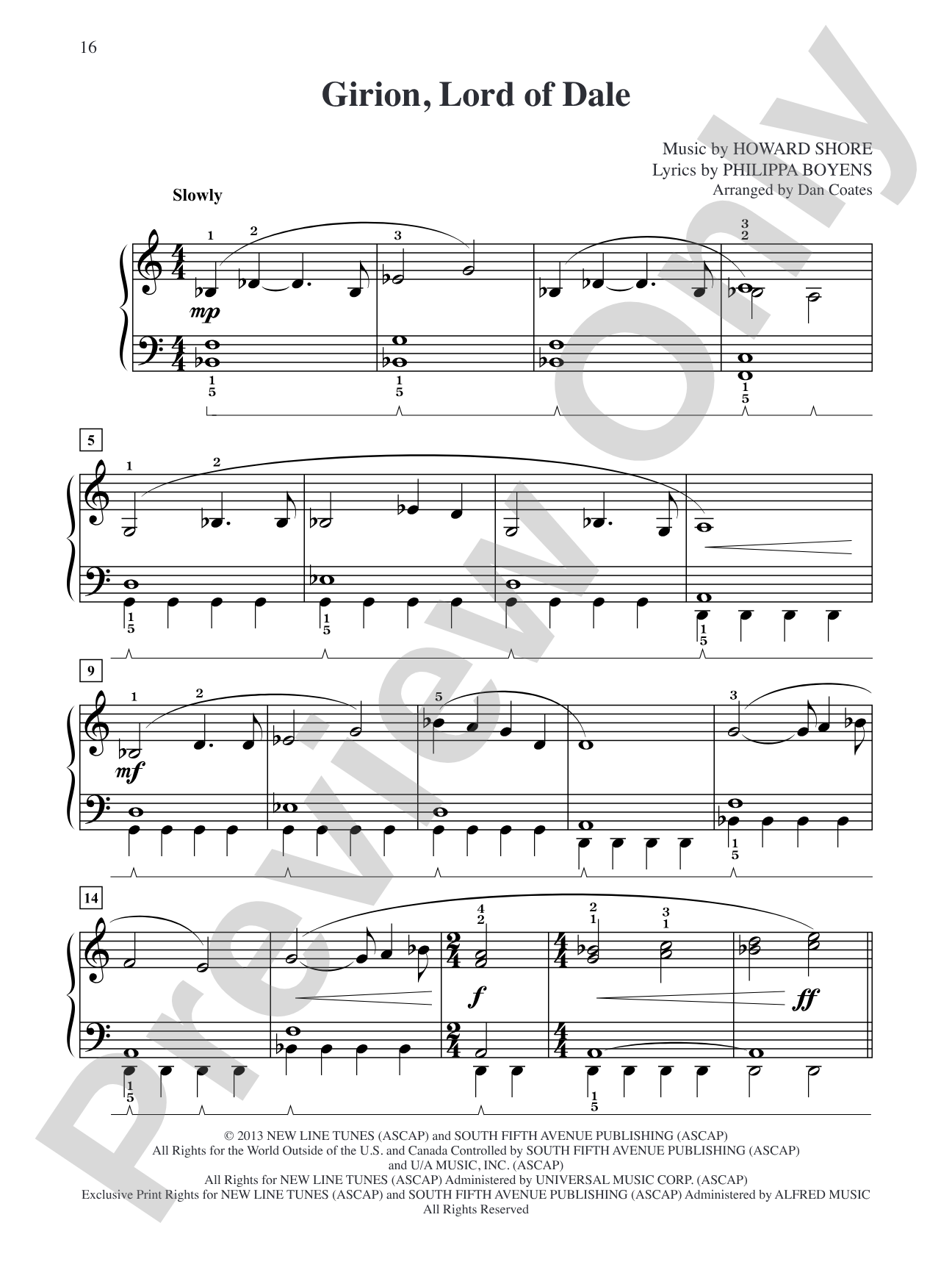

Girion Lord of Dale (from The Hobbit: The Desolation of Smaug): Easy Piano
Easy Piano Selections from the Original Motion Picture Soundtrack
By Howard Shore / arr. Dan Coates
Level: Easy Piano
Item: 00-PS-0015934
$4.99
Pickup currently not available
Related Items
Beyond the Forest (from The Hobbit: The Desolation of Smaug): Easy Piano |
$4.99
|
View | |
Erebor (from The Hobbit: The Desolation of Smaug): Easy Piano |
$5.99
|
View | |
Bree (from The Hobbit: The Desolation of Smaug): Easy Piano |
$4.99
|
View | |
Beorn (from The Hobbit: The Desolation of Smaug): Easy Piano |
$4.99
|
View | |
Bard A Man of Lake-town (from The Hobbit: The Desolation of Smaug): Easy Piano |
$4.99
|
View | |
Bard and Family (from The Hobbit: The Desolation of Smaug): Easy Piano |
$4.99
|
View | |
Lake-town (from The Hobbit: The Desolation of Smaug): Easy Piano |
$4.99
|
View | |
Lake-town Bard (from The Hobbit: The Desolation of Smaug): Easy Piano |
$4.99
|
View | |
House of Durin (from The Hobbit: The Desolation of Smaug): Easy Piano |
$4.99
|
View | |
Smaug (from The Hobbit: The Desolation of Smaug): Easy Piano |
$4.99
|
View | |
I See Fire (from The Hobbit: The Desolation of Smaug): Easy Piano |
$4.99
|
View | |
The Hobbit: The Desolation of Smaug: Piano Book |
$15.99
|
View |
Description
With The Hobbit: The Desolation of Smaug, audiences worldwide were transported back to Middle-earth for more thrills and adventure. 12 pieces from Howard Shore's brilliant score have been arranged for Easy Piano. Pianists will have both classic and new themes from the epic journey right at their fingertips as they play. In addition to the piano arrangements, this beautifully produced souvenir folio features an array of colorful photos from the film. Titles: Erebor * Bree * Beorn * Bard, A Man of Lake-town * Bard and Family * Lake-town * Girion, Lord of Dale * Lake-town Bard * House of Durin * Smaug * I See Fire * Beyond the Forest.


Girion Lord of Dale (from The Hobbit: The Desolation of Smaug): Easy Piano isn't in MakeMusic Cloud just yet...but it could be. Let us know you'd like to see it, and you'll help shape what comes next. In the meantime, start a free trial and dive into thousands of interactive titles your students can play along with today.
Request This Title
Tell us you want it.
Start Your Free Trial
Explore everything that's ready to play right now.
Sample Audio
No sample audio found.
Sample Video
No sample videos found.
Additional Details
Publisher:
Alfred Music
Page Count:
40
SKU:
00-PS-0015934
More about this title
About the Composer: Howard Shore
Howard Shore is a three-time Academy Award-winning composer whose film scores have shaped the soundscapes of contemporary cinema. His work on Peter Jackson's Lord of the Rings trilogy and The Hobbit films demonstrates his mastery of orchestral storytelling, creating themes that are simultaneously grand in scope and deeply lyrical.
Shore's compositional approach balances accessibility with sophistication. His melodies are memorable and singable, yet the harmonic language supports them with rich orchestration. For music educators, his film scores offer students a bridge between concert hall traditions and the music they encounter in popular media, proving that commercially successful film music can also be musically substantive.
Why we love this
These arrangements capture Shore's thematic gifts without overwhelming early intermediate pianists. The folio pairs accessible piano writing with visual storytelling from the film, giving students immediate context for why these melodies matter. Dan Coates' arrangements preserve the emotional arc of each theme while keeping technical demands reasonable, making this an engaging way to introduce film score repertoire to developing pianists.
What to expect
These arrangements transport you into a world of dwarven kingdoms, lake towns, and dragon-haunted mountains. The music shifts from quiet, introspective moments to sweeping heroic passages, all rendered in a way that lets emerging pianists feel the grandeur of the original score. Each piece tells part of a larger adventure, turning your practice time into a journey through Middle-earth.
Who it's for
Easy piano students and adult pianists returning to the instrument will find these arrangements both manageable and musically rewarding. Teachers looking for repertoire that motivates students through recognition and narrative will appreciate how these pieces connect to a beloved film while building fundamental piano skills.
How to get the most out of it
- Pay attention to tempo markings and mood indications. Shore's themes shift between introspective and triumphant moments, and respecting these shifts through rubato and dynamic shaping brings the arrangement to life.
- Use the photographs in the folio as interpretive guides. Pairing visual memory from the film with the music helps solidify phrasing and prevents mechanical playing.
- Balance melody and accompaniment thoughtfully. Many of these pieces give the accompaniment an active role; clarity between hands will keep the texture from muddying, especially in the fuller arrangements.
How to use it
Feature one or two of these pieces in a spring recital themed around film and storytelling, pairing them with other cinematic arrangements or traditional character pieces to show how music brings narratives to life. Alternatively, use them as incentive repertoire during technique-heavy units, since students often practice more enthusiastically when material connects to their interests outside the lesson studio.
Skills your students will build
- Maintaining musical phrasing across changes in texture
- Managing tempo consistency in pieces with frequent dynamic shifts
- Balancing melody and accompaniment in two-hand coordination
- Interpreting expressive markings (ritardando, a tempo, crescendo) within a narrative context