
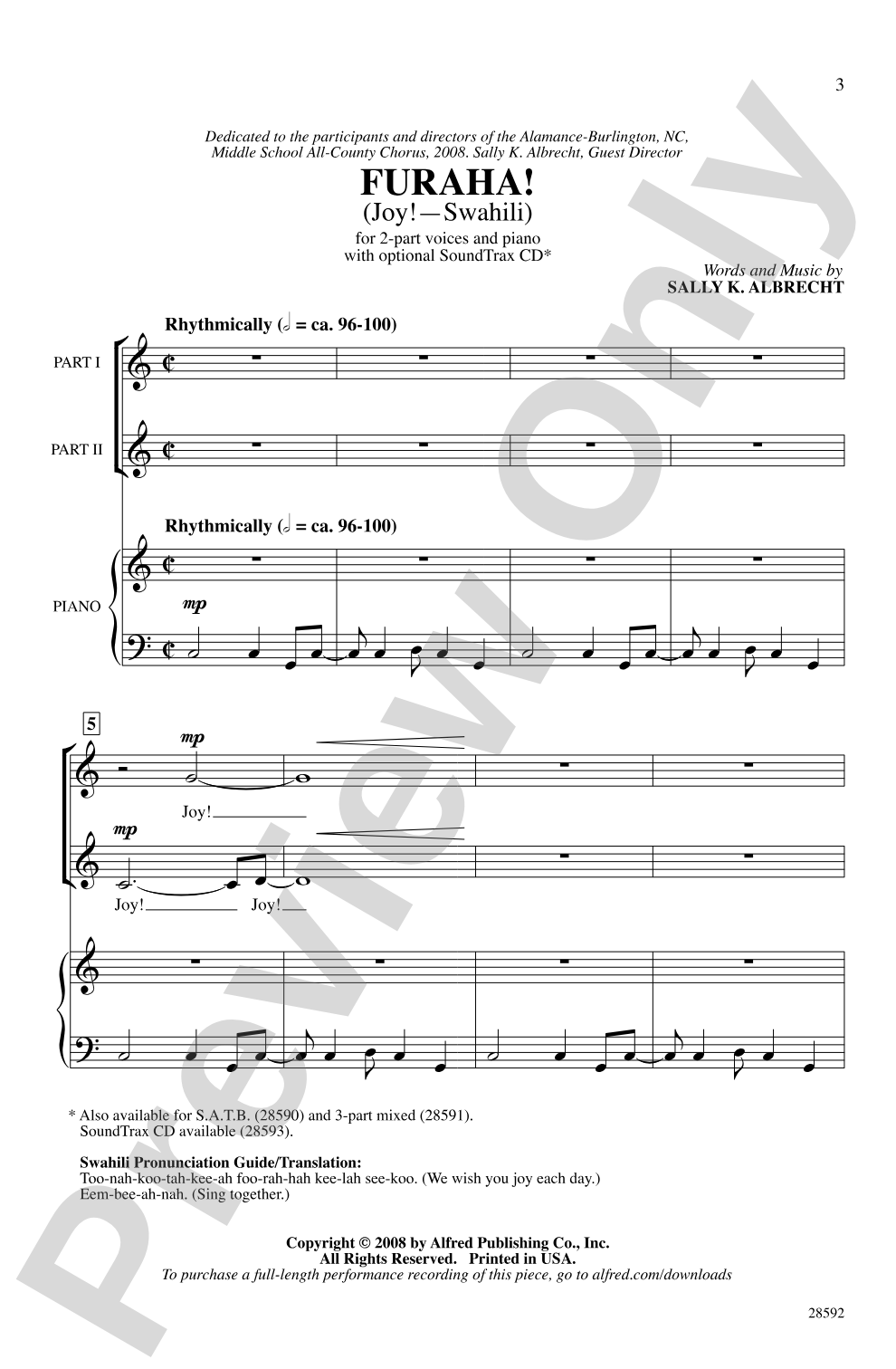
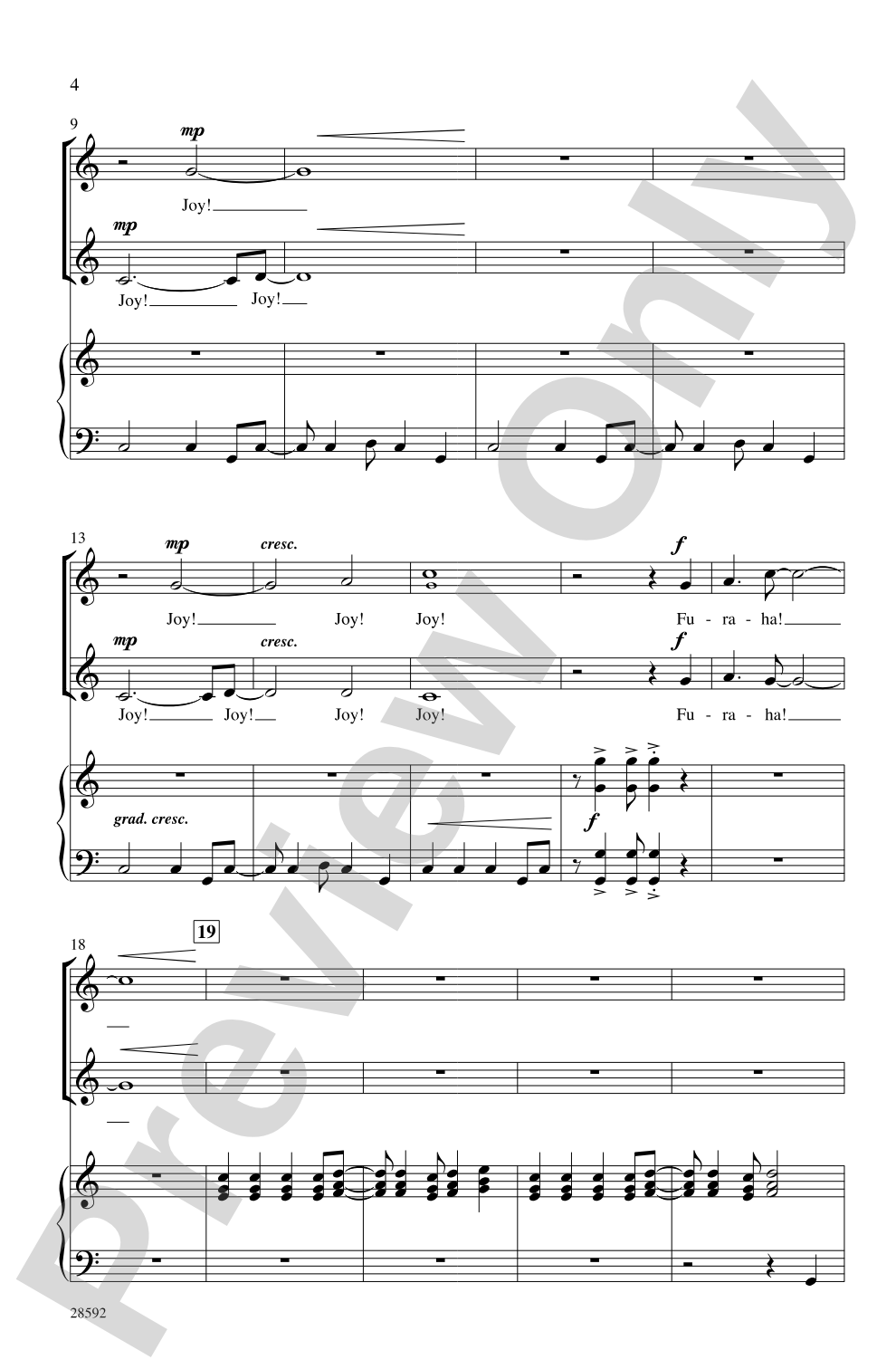

Furaha! (Joy! - Swahili): 2-Part Choral Octavo
(Joy! -- Swahili)
Words and music by Sally K. Albrecht
Item: 00-PO-0000501
$2.05
Minimum order quantity: 20 copies
Pickup currently not available
Related Items
Furaha!: SoundTrax Digital Audio Download |
$27.99
|
View | |
Furaha! (Joy! - Swahili): SATB Choral Octavo |
$1.75
|
View | |
Furaha! (Joy! - Swahili): 3-Part Mixed Choral Octavo |
$2.05
|
View | |
Furaha!: SATB Choral Octavo |
$1.75
|
View | |
Furaha!: 3-Part Mixed Choral Octavo |
$2.50
|
View | |
Furaha!: 2-Part Choral Octavo |
$2.05
|
View | |
Furaha!: Choral Octavo SoundTrax CD |
$27.99
|
View |
Description
This rhythmic African-style number is joyous from beginning to end! Use it for general concerts, or consider it for Christmas/Kwanzaa celebrations. The text alternates between English and Swahili. "We wish you joy each and every day." Featured on the "Hooray for Hollywood!" movement DVD #28868.


Furaha! (Joy! - Swahili): 2-Part Choral Octavo isn't in MakeMusic Cloud just yet...but it could be. Let us know you'd like to see it, and you'll help shape what comes next. In the meantime, start a free trial and dive into thousands of interactive titles your students can play along with today.
Request This Title
Tell us you want it.
Start Your Free Trial
Explore everything that's ready to play right now.
Sample Audio
1
Audio File
--:--
0:00
0:00
Sample Video
No sample videos found.
Additional Details
Series:
Alfred Choral Designs
Publisher:
Alfred Music
Page Count:
12
SKU:
00-PO-0000501
More about this title
About the Composer: Sally K. Albrecht

Sally K. Albrecht has shaped American choral music for over three decades, first as Director of School Choral, Vocal, and Elementary Publications at Alfred Music, then as a prolific composer in her own right. She has earned ASCAP Special Music Awards annually since 1987 and has more than 600 choral publications in print, along with 75 larger works including musicals and songbooks. Her reputation for integrating movement into choral performance has made her a sought-after clinician, conducting honor choirs at prestigious venues including Lincoln Center, Carnegie Hall, and The Kennedy Center.
Albrecht holds degrees from Rollins College (B.A. in Music and Theater, 1976), the University of Miami (M.A. in Drama, 1977; M.M. in Accompanying, 1979), and has taught at Oakland University, Jersey City State College, and Meredith College. A native of Cleveland, she has received the Distinguished Alumna Award from both the University of Miami Frost School of Music and Rollins College, where she serves on the Board of Trustees. She lives in North Carolina with her husband, composer and arranger Jay Althouse.
Why we love this
Albrecht builds genuine joy into the musical fabric here, not just the text. The rhythmic vitality and call-and-response energy keep students engaged while the bilingual approach opens doors to cultural conversation that extends beyond the piece itself. This works equally well as an energizer during a winter concert or as a centerpiece for a program celebrating diverse traditions.
What to expect
The music radiates celebration from the first beat, driven by rhythmic momentum and bright harmonic movement. Singing this piece feels like joining a joyful gathering; the alternating English and Swahili phrases create a sense of conversation and welcome that draws singers into genuine expression.
Who it's for
Any choir looking for a 2-part piece that energizes an ensemble and audience without sacrificing musical substance. It suits treble choirs, mixed choirs working at accessible ranges, or as a breakout section number in a larger program where you need contrast and joy.
How to get the most out of it
- Lean into the rhythmic precision of the African-style patterns; lock the ensemble on the underlying pulse before layering in the melodic material to ensure the groove locks in place
- Highlight the Swahili text with clear diction and appropriate stress patterns, treating those phrases with as much care as the English sections to honor the language
- Use the recorded accompaniment to establish the groove and keep energy consistent from rehearsal through performance
- Consider the movement and staging suggestions to amplify the piece's celebratory character; even simple gestures can transform the energy from the opening note
How to use it
Program this as an encore or finale when you need to send audiences home smiling, or feature it during winter holiday concerts as part of a multicultural focus that goes beyond traditional seasonal material. It also pairs naturally with other world music selections or serves as a strong opener that establishes an uplifting concert tone.
Skills your students will build
- Reading and performing rhythmic patterns in African-inspired style
- Pronunciation and diction in Swahili alongside English text
- Maintaining ensemble cohesion in syncopated, groove-based writing
- Coordinating melody and movement for enhanced performance impact
- Balancing two independent melodic lines in 2-part texture