
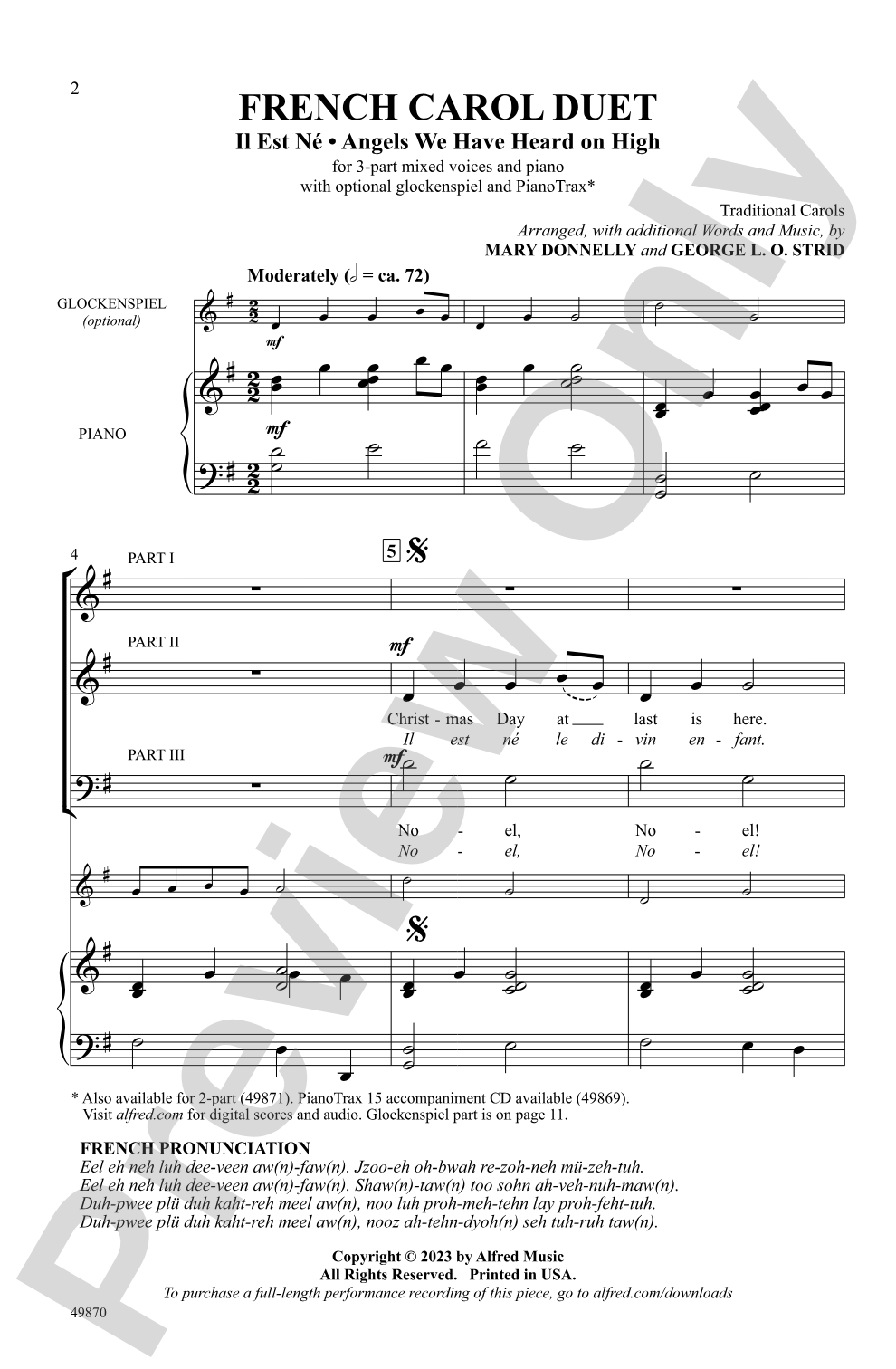

French Carol Duet: 3-Part Mixed Choral Octavo
Il Est Né * Angels We Have Heard on High
Arr., with additional words and music, by Mary Donnelly and George L. O. Strid
Item: 00-PO-0006994
$2.05
Minimum order quantity: 20 copies
Pickup currently not available
Description
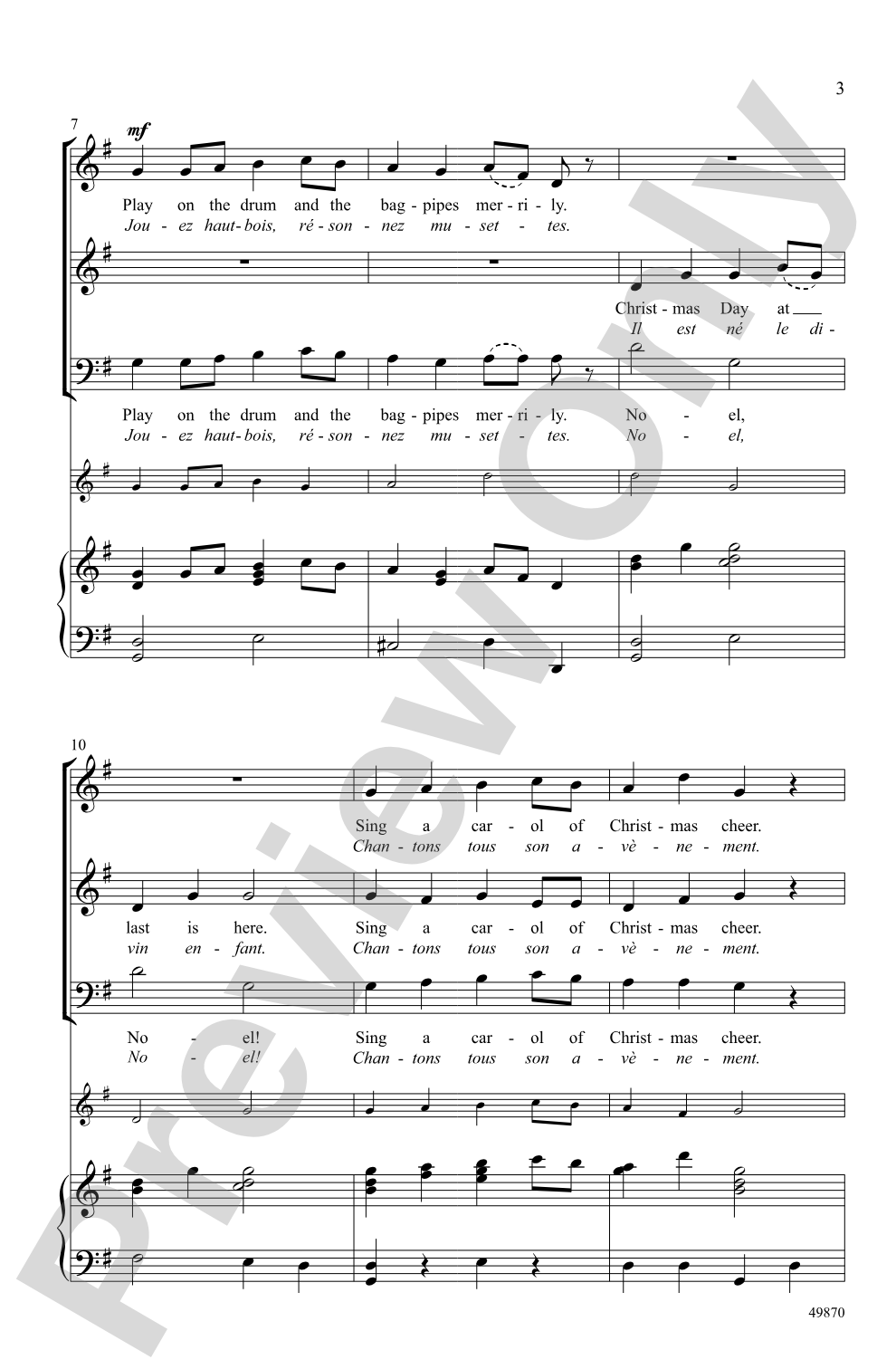
Seasoned directors know they can count on this writing team for quality developmental literature, like this piece---a perfect pairing for holiday concerts: "Il Est Né" and "Angels We Have Heard On High." Sing in English throughout, or include some French text using the included pronunciation guide. Optional lyrics allow you to sing some French or entirely in English.


Discover MakeMusic Cloud: thousands of interactive titles your students can play along with today.
Sample Audio
1
Audio File
--:--
0:00
0:00
Sample Video
Additional Details
Series:
Alfred Choral Designs
Publisher:
Alfred Music
Page Count:
12
SKU:
00-PO-0006994
Instrumentation:
Glockenspiel
More about this title
About the Arranger: Mary Donnelly

Mary Donnelly grew up in Reno, Nevada, and studied English and French at the University of Nevada, Reno. Her path to music education began unexpectedly when she organized children's choruses as an undergraduate; that experience sparked her decision to pursue formal music teacher certification. She earned a Master's Degree in Education from Lesley College in Cambridge, Massachusetts, with a focus on arts integration across the curriculum.
Donnelly spent three decades teaching general music and choir in Washoe County schools, building a reputation for accessible, pedagogically sound literature. In 1985, she began collaborating with George L. O. Strid while team-teaching sixth-grade music, initially writing a musical for Reading Week. That partnership flourished into one of the most prolific songwriting teams in choral education, producing over two hundred songs and twenty-five musicals. She holds memberships in ACDA, NEA, and ASCAP.
Why we love this
Donnelly and Strid understand the rhythms of a holiday rehearsal calendar. Rather than overwhelm singers with complex arrangements or dense voicing, they craft pieces that sound mature and concert-ready while remaining genuinely singable for mixed choirs at developmental levels. The dual-carol structure here gives you programming flexibility without requiring two separate selections.
What to expect
Warm and celebratory, with the familiar comfort of two beloved carols woven together. The arrangement respects the traditional character of the material while the optional French text adds cultural texture and a touch of sophistication that feels earned, not forced.
Who it's for
Mixed choirs in grades 5-8 and high school ensembles seeking accessible holiday literature that avoids oversimplification. Directors building holiday programs want pieces that balance musicality with realistic rehearsal demands and offer programmatic flexibility.
How to get the most out of it
- Balance the glockenspiel part to sparkle without overshadowing the voices; it's an ornamental layer, not a foundational accompaniment.
- Anchor the pronunciation guide work early in rehearsal so singers gain confidence with French text before combining it with musical demands.
- Consider rotating between the all-English version and the bilingual arrangement across performances to showcase your singers' versatility and the piece's adaptability.
How to use it
Program this as an anchor piece in a mixed-voice holiday concert, pairing it with a contrasting style (perhaps a contemporary carol or spiritual) to create programming variety. Its dual-carol framework makes it ideal for a segment of a larger concert without requiring additional rehearsal time for separate selections.
Skills your students will build
- Singing in two languages with accurate pronunciation and maintained musicality
- Balancing SAB voicing with awareness of individual line independence
- Blending with optional instrumental color (glockenspiel) while maintaining choral tone
- Interpreting text in two languages and conveying meaning regardless of language choice