
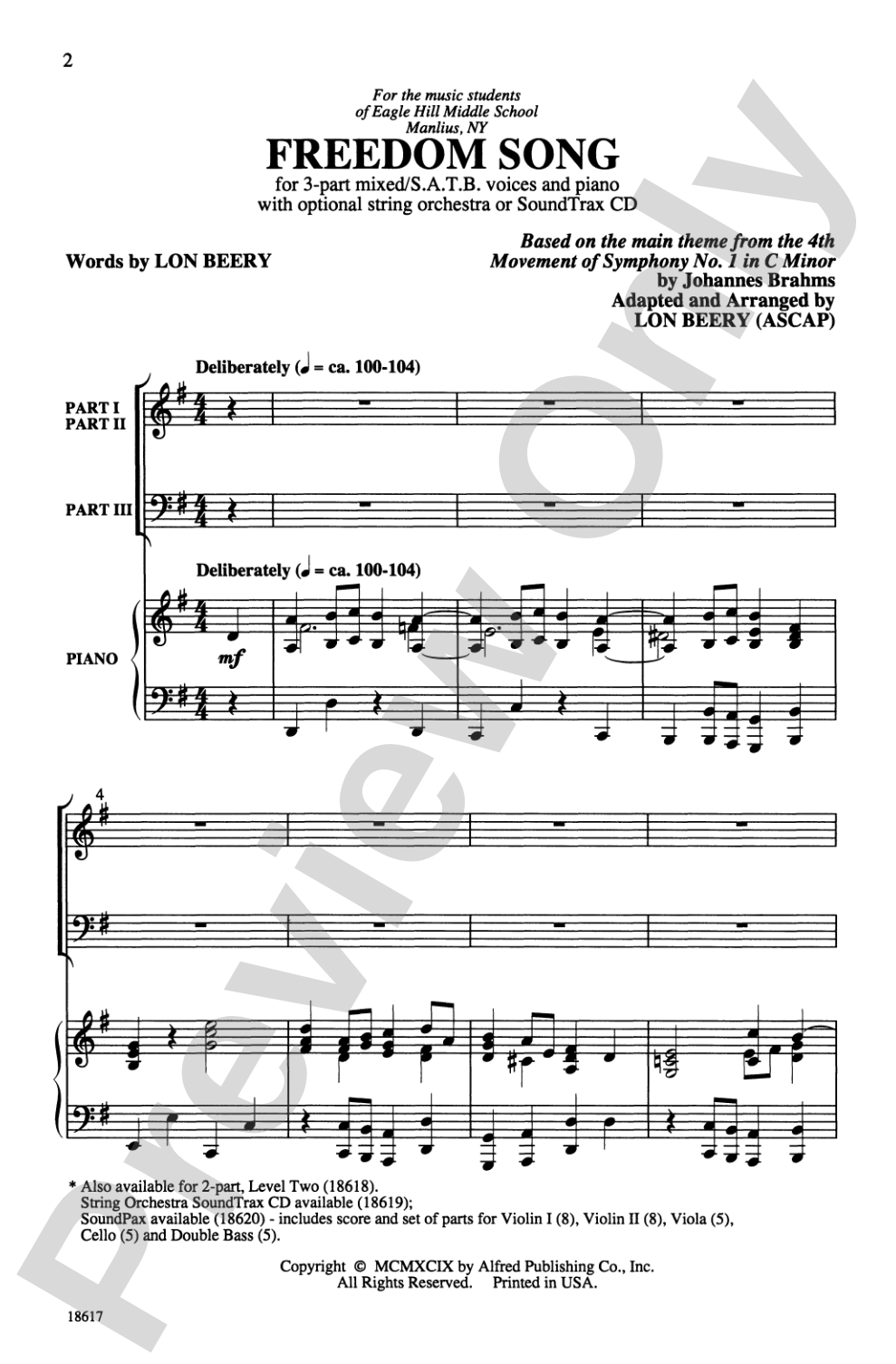
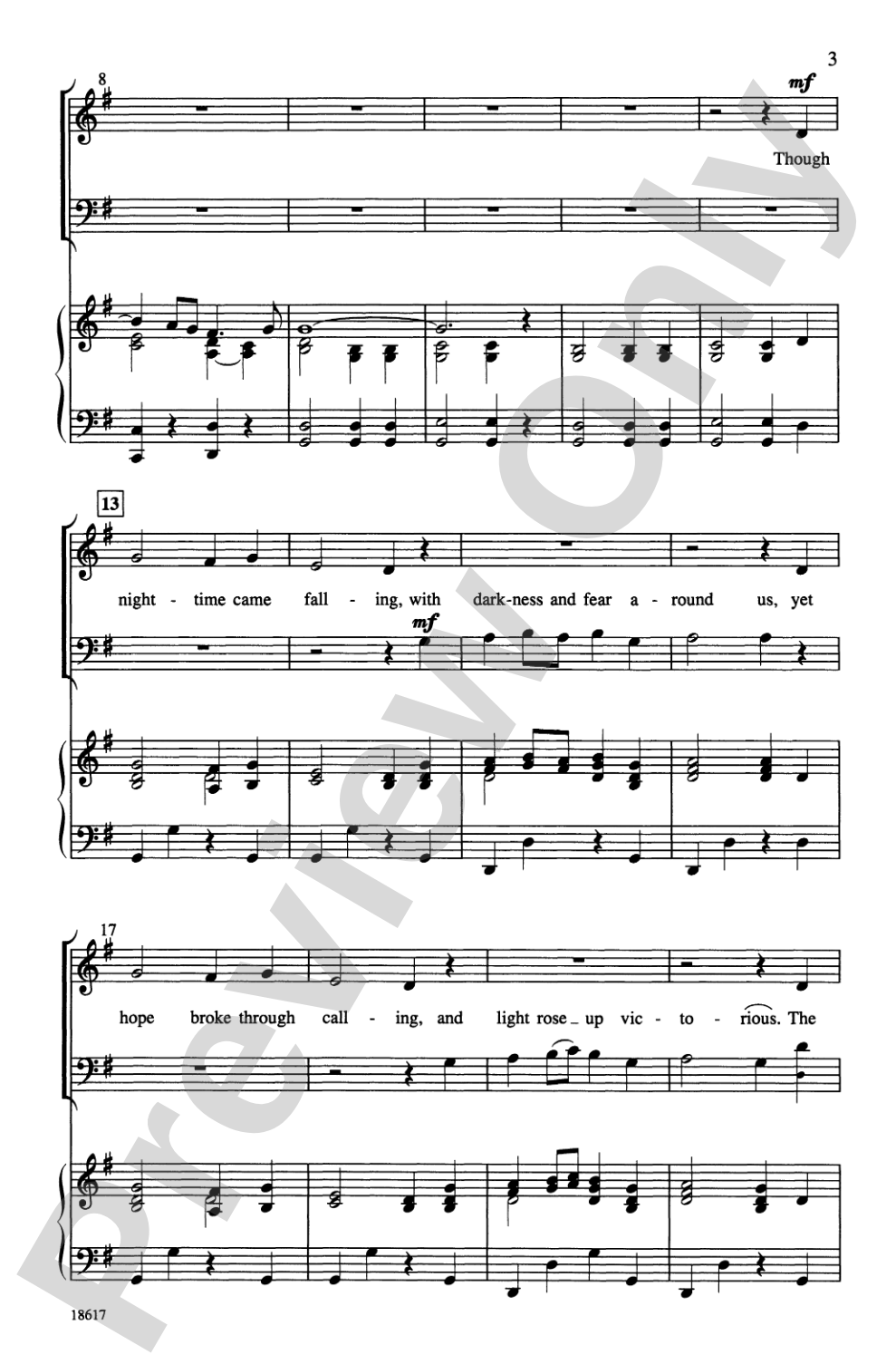

Freedom Song: 3-Part Mixed/SATB Choral Octavo
Music by Johannes Brahms / arr. Lon Beery
Item: 00-PO-0004068
$2.25
Minimum order quantity: 20 copies
Pickup currently not available
Description
Introduce your choir to an orchestral masterwork with this choral adaptation of the main theme from Brahm's Symphony No. 1. A new text exults the dream of freedom shared by all the world's peoples. SoundTrax CD features live strings, or add your own string orchestra.


Freedom Song: 3-Part Mixed/SATB Choral Octavo isn't in MakeMusic Cloud just yet...but it could be. Let us know you'd like to see it, and you'll help shape what comes next. In the meantime, start a free trial and dive into thousands of interactive titles your students can play along with today.
Request This Title
Tell us you want it.
Start Your Free Trial
Explore everything that's ready to play right now.
Sample Audio
1
Audio File
--:--
0:00
0:00
Sample Video
No sample videos found.
Additional Details
Series:
Alfred Archive Edition: Alfred Choral Designs
Publisher:
Alfred Music
Page Count:
8
SKU:
00-PO-0004068
More about this title
About the Composer: Johannes Brahms
Johannes Brahms (1833-1897) stands as one of the great synthesizers of the Romantic era, a composer who honored Classical form while expanding its emotional and harmonic vocabulary. His four symphonies remain cornerstones of the orchestral repertoire, each one demonstrating his gift for memorable thematic material that rewards both intimate listening and grand orchestral treatment. For educators, Brahms represents a crucial bridge in music history: his work shows students how 19th-century composers deepened their musical language while remaining grounded in rigorous structural thinking.
The First Symphony, premiered in 1876, took more than a decade to complete and emerged as Brahms's artistic statement after years of self-imposed pressure to meet Beethoven's legacy. Its main theme, now adapted here with new text celebrating human freedom, carries the weight of that ambition while remaining accessible and stirring. This accessibility makes the piece an ideal entry point for singers encountering Brahms's orchestral thinking in choral form.
Why we love this
This arrangement opens the door to Brahms's symphonic mastery without requiring an orchestra or advanced singers. The new text about universal freedom gives the melody contemporary resonance while keeping the harmonic integrity intact, and the optional string parts allow you to scale the accompaniment from intimate (recorded strings) to fully orchestrated depending on your resources.
What to expect
Singing this melody feels like stepping into a grand concert hall where strings swell around you. There's nobility in the opening gesture, a sense of aspiration that builds through the piece without becoming bombastic. The new text about freedom and brotherhood gives the lyrical momentum emotional weight, transforming a symphonic theme into something deeply human.
Who it's for
This octavo works well for intermediate to advanced high school choirs, community choirs with solid sight-reading skills, and college ensembles looking for accessible yet substantial Romantic-era repertoire. The dual voicing options (SATB and SAB/3-Part Mixed) let you program it across different choir levels or adapt to your singers' strengths without losing musical integrity.
How to get the most out of it
- Shape the melody with the warmth and weight of a string section in mind. Even with recorded accompaniment, sing through the phrases as if you're sustaining long bow strokes rather than articulating each note individually.
- If you add live strings, have the string players rehearse separately first so they lock the accompaniment before combining with chorus. This prevents rushing or dragging that can muddy the harmonic progression.
- Balance the harmony voices so the melody sits naturally on top without pulling away. Brahms's inner voices are written to support and color the main line, not compete with it.
- Take time with the text underlay in rehearsal. The new lyrics should feel as inevitable as the original melody, which requires careful enunciation and phrasing work beyond what notation alone shows.
How to use it
Program this as a concert centerpiece when you want to introduce audiences to how great orchestral themes translate to voices, or pair it with other peace-themed or brotherhood-themed repertoire for a thematic concert. Its moderate length and substantial but approachable musical content make it ideal for spring concerts where you've had time to develop ensemble blend and interpretive depth.
Skills your students will build
- Singing in the style of Romantic orchestral writing with long, sustained phrasing
- Balancing four-part harmony where inner voices support rather than distract from the primary melody
- Coordinating with recorded or live instrumental accompaniment
- Text declamation in adapted works where new lyrics must honor the original melodic shape