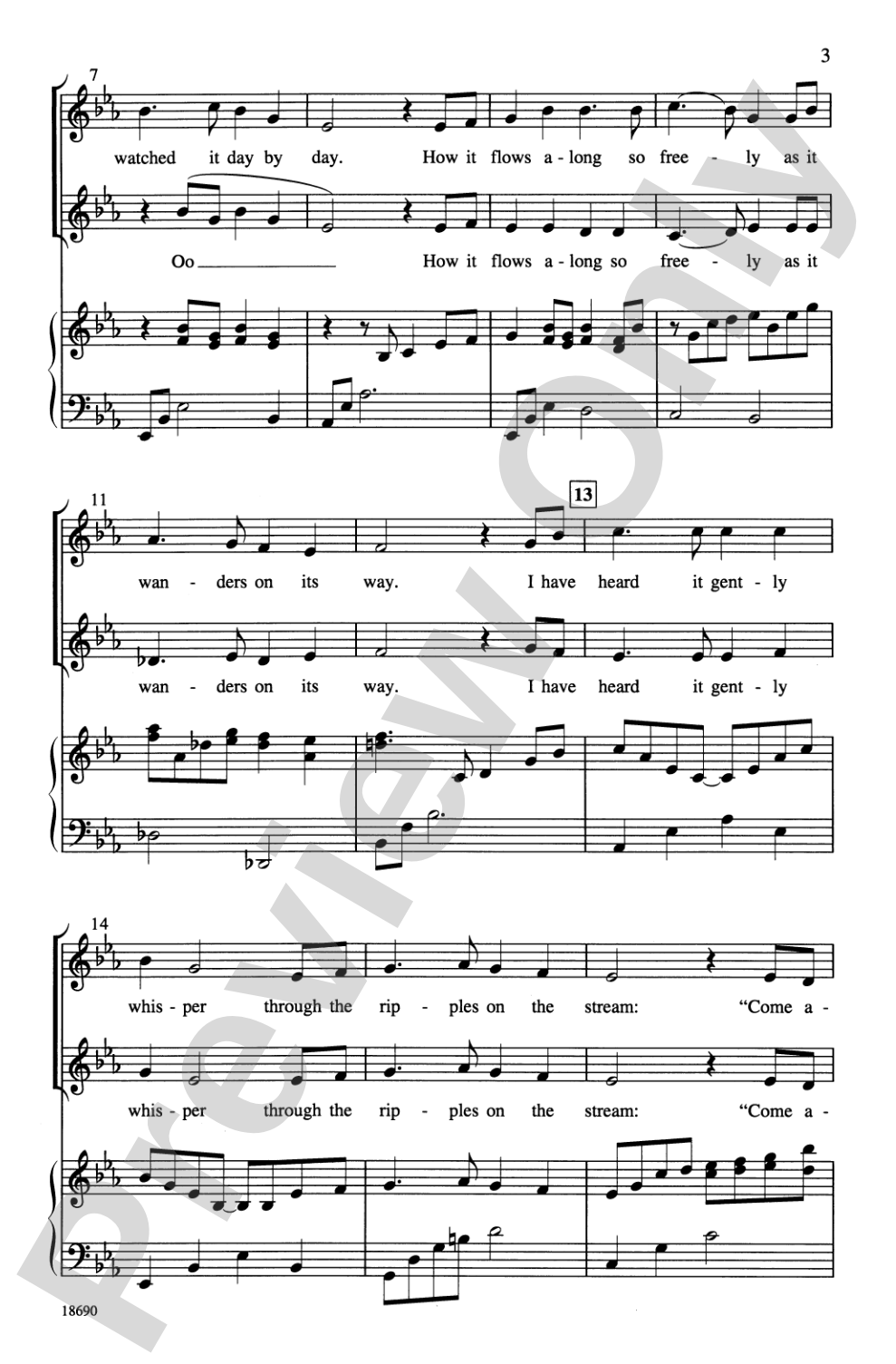
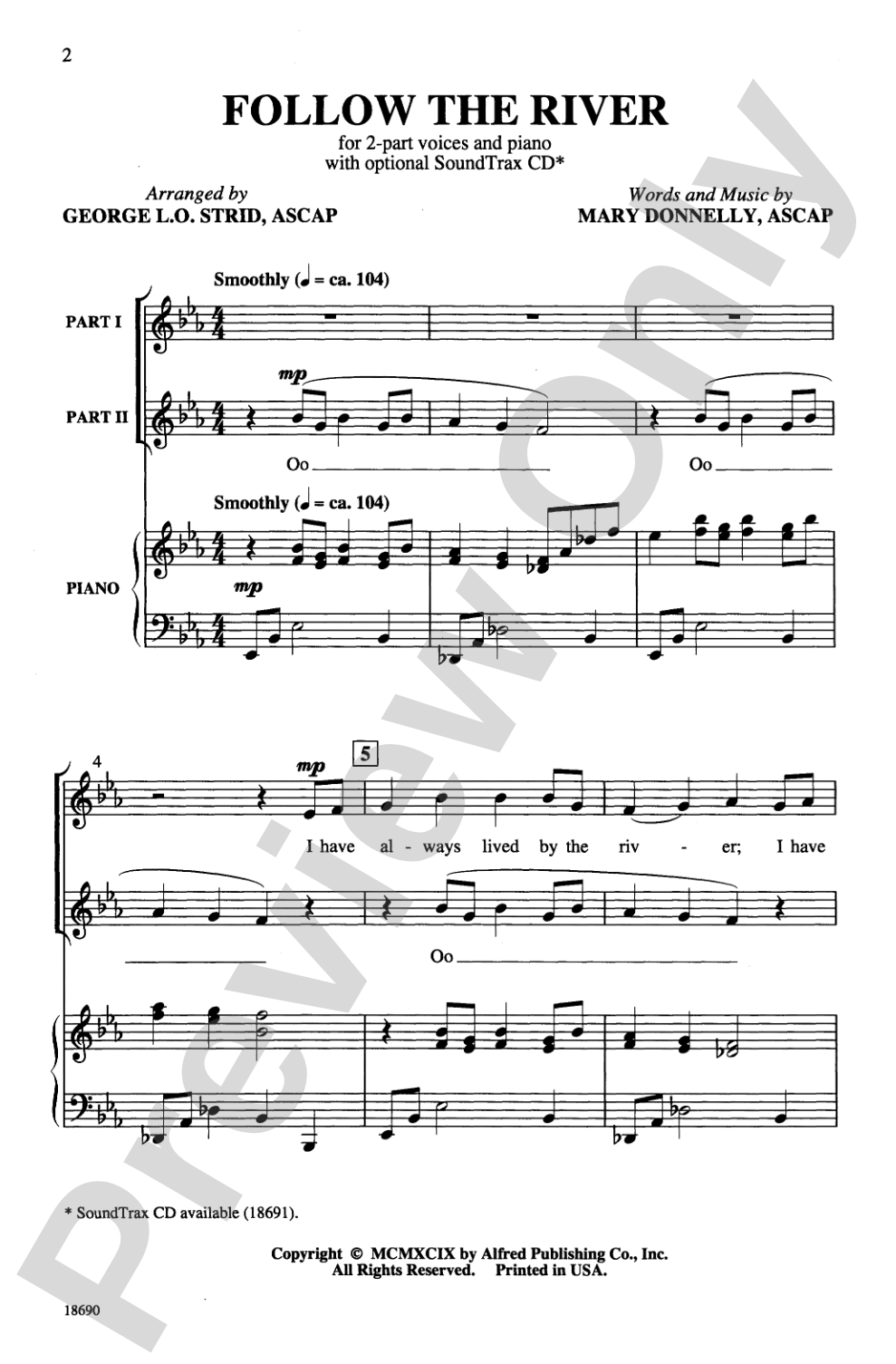
Follow the River Sheet Music Preview

Follow the River: 2-Part Choral Octavo

Music by Mary Donnelly and George L. O. Strid

Item: 00-PO-0004085

Digital Download
$2.25

Minimum order quantity: 20 copies

Description
Written in a folk song style, this two part choral work has the feel of a gently rolling river. A touching text and a flowing piano accompaniment enhance the echo vocal passages, making it a superb year round choice.

Follow the River: 2-Part Choral Octavo isn't in MakeMusic Cloud just yet...but it could be. Let us know you'd like to see it, and you'll help shape what comes next. In the meantime, start a free trial and dive into thousands of interactive titles your students can play along with today.

Sample Audio
0:00
0:00
Sample Video
Additional Details
Series: Alfred Archive Edition: Alfred Choral Designs
Publisher: Alfred Music
Page Count: 12
SKU: 00-PO-0004085

More about this title

About the Composer: Mary Donnelly

Mary Donnelly

Mary Donnelly grew up in Reno, Nevada, and earned her BA in English and French from the University of Nevada, Reno. While completing her undergraduate degree, she discovered her passion for music education by helping establish two children's choruses, a experience that led her back to graduate school at Lesley College in Cambridge, Massachusetts, where she studied Education with an emphasis on integrating the arts across disciplines.

Donnelly spent three decades teaching general music and choir in the Washoe County School District, retiring after a long career shaping young musicians. In 1985, she began a prolific collaboration with George Strid when their principal asked them to write a musical for Reading Week. The partnership produced over two hundred songs and twenty-five musicals. She holds memberships in ACDA, NEA, and ASCAP and continues to live in Reno with her husband.

Why we love this

This piece captures something essential about folk song writing: a melody that feels inevitable, a text that resonates without sentimentality, and an accompaniment that supports without overwhelming. The echo passages give singers a natural way to shape the phrase and create dialogue within the ensemble, and the 2-part texture keeps the focus on musicality rather than technical complexity.

What to expect

The piece evokes the steady, unhurried movement of water finding its course. There's a quiet confidence in the melody that unfolds naturally, and the echo passages create moments of reflection where voices gently call back to one another. The folk aesthetic brings warmth and human quality to an arrangement that feels both contemporary and timeless.

Who it's for

Middle school and early high school choirs seeking accessible, emotionally grounded repertoire that doesn't require extended vocal range or complex harmony. Choirs comfortable with basic 2-part writing who want to build musicality through thoughtful text setting and legit ensemble singing.

How to get the most out of it

  • Emphasize the legato line through the flowing melody by connecting phrases as if you're tracing water's gentle movement from measure to measure.
  • Let the echo passages breathe; resist the urge to rush back to the main section. These moments give singers time to listen and adjust blend.
  • Balance the piano accompaniment so it frames the voices without competing; the flowing figures should support the folk idiom, not overshadow it.
  • Explore different dynamic shapes in the repeated sections to reveal the text's emotional arc without overdoing interpretation.

How to use it

This works beautifully as a standalone concert piece during any season, or as part of a thematic program exploring water, nature, or folk traditions. Its moderate length and emotional accessibility make it an excellent choice for a mixed concert that needs a tender moment without requiring dramatic staging or specialized skills.

Skills your students will build

  • Singing sustained legit lines with consistent vowel shapes
  • Listening and responding to echo/call-and-response textures
  • Interpreting folk song style with appropriate phrasing
  • Blending in 2-part texture while maintaining individual line clarity

You May Also Like