
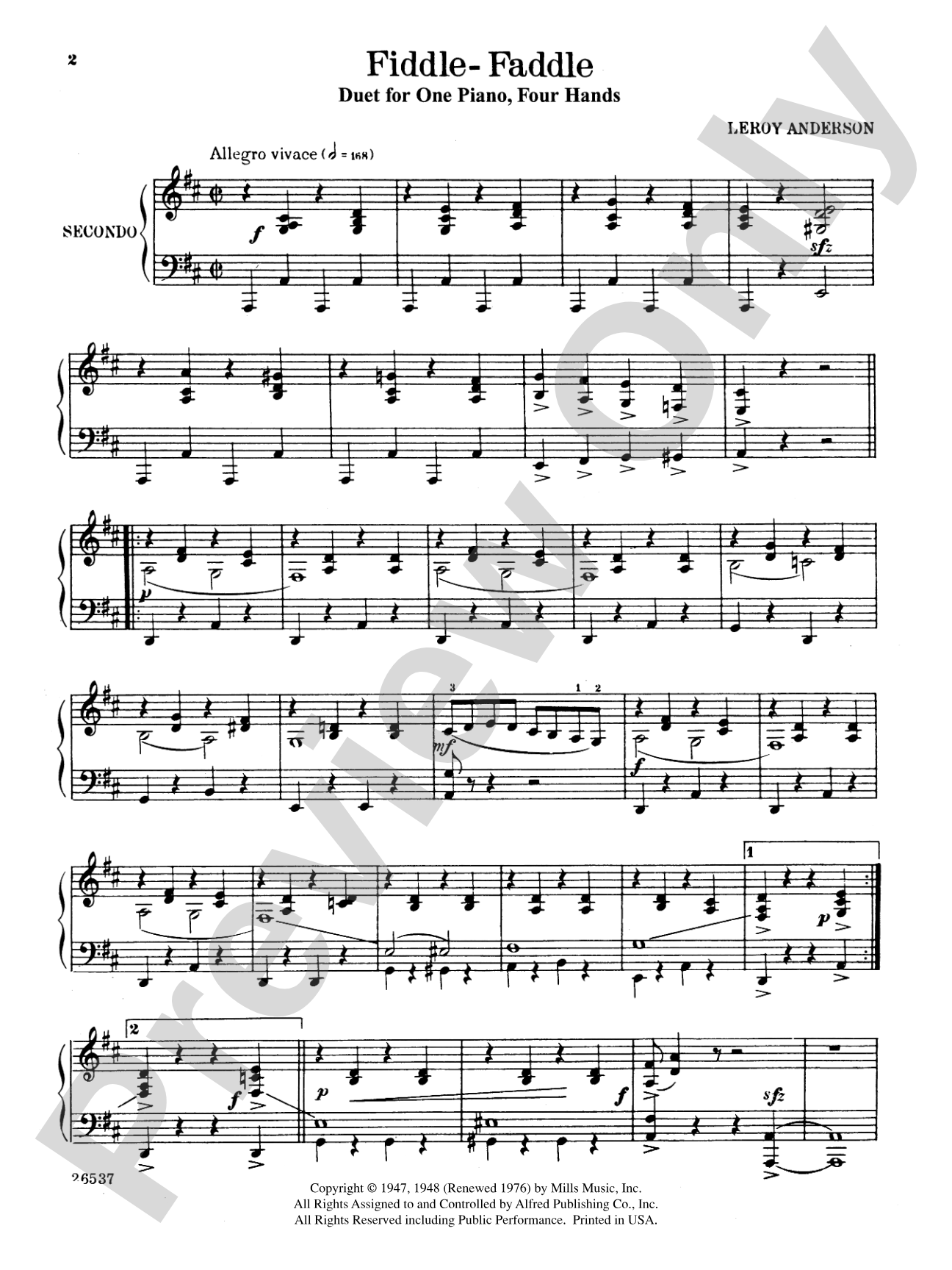
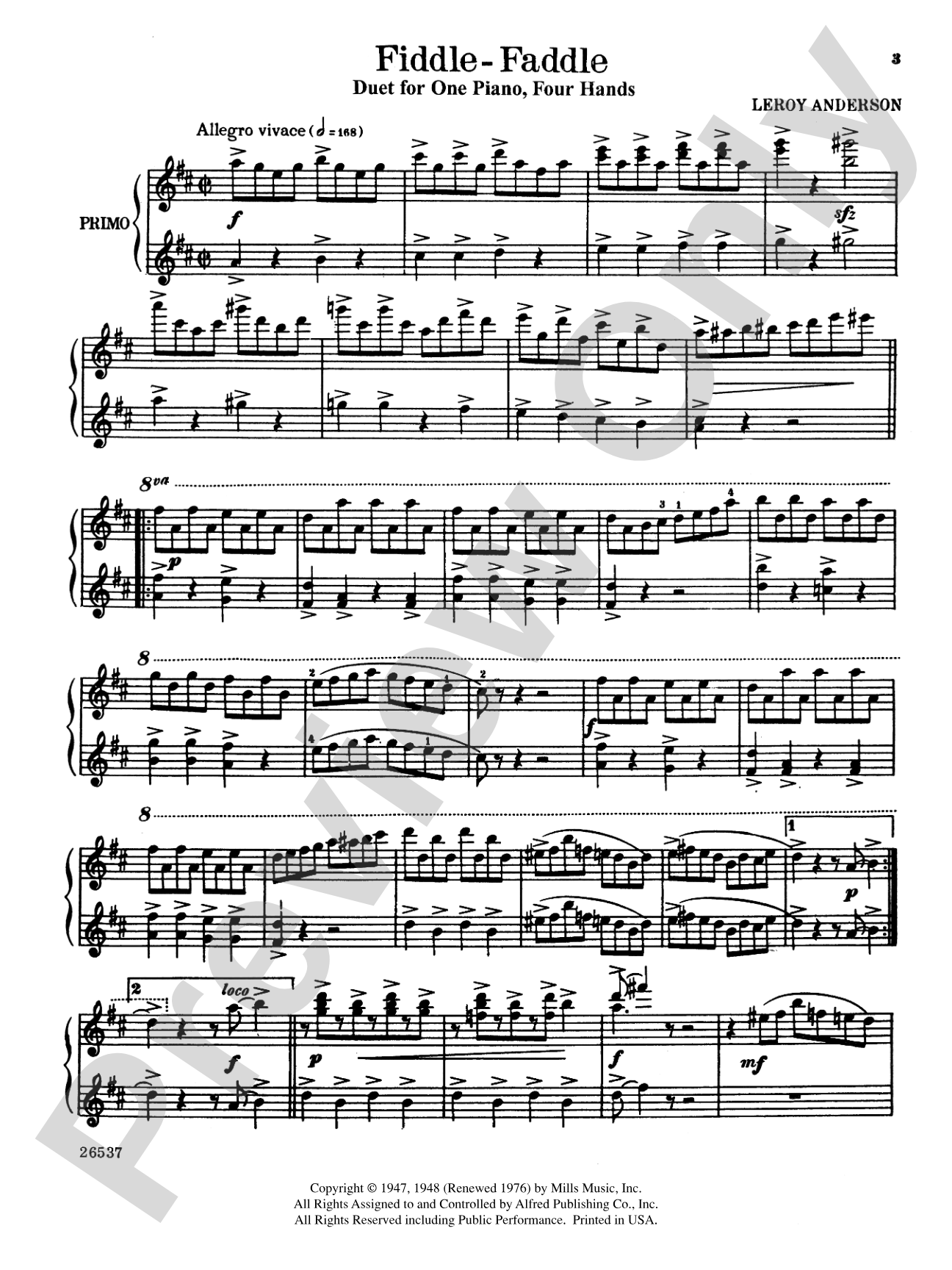

Fiddle-Faddle - Piano Duet (1 Piano, 4 Hands): Piano Duets & Four Hands
By Leroy Anderson
Level: Late Intermediate
Item: 00-PB-0000676
$5.50
Pickup currently not available
Related Items
Fiddle-Faddle: Full Orchestra Conductor Score & Parts |
$75.00
|
View | |
Fiddle-Faddle: Mallet Instrument Part(s) |
$8.99
|
View | |
Fiddle-Faddle: Full Orchestra Conductor Score & Parts |
$66.00
|
View | |
Fiddle-Faddle: Full Orchestra Conductor Score & Parts |
$75.00
|
View | |
Fiddle-Faddle: Full Orchestra Conductor Score |
$11.00
|
View | |
Fiddle-Faddle: Piano Duet (1 Piano, 4 Hands) Sheet |
$5.50
|
View | |
Fiddle-Faddle: Violin |
$6.99
|
View | |
Fiddle-Faddle: Mallet Instrument Part(s) |
$8.99
|
View | |
Fiddle-Faddle: Full Orchestra Conductor Score & Parts |
$66.00
|
View | |
Fiddle-Faddle: Full Orchestra Conductor Score |
$9.00
|
View |
Description
Students will enjoy this famous, exuberant duet with an allegro vivace tempo. Perfect for a recital encore. A Federation Festivals 2016-2020 selection. A Federation Festivals 2020-2024 selection.


Fiddle-Faddle - Piano Duet (1 Piano, 4 Hands): Piano Duets & Four Hands isn't in MakeMusic Cloud just yet...but it could be. Let us know you'd like to see it, and you'll help shape what comes next. In the meantime, start a free trial and dive into thousands of interactive titles your students can play along with today.
Request This Title
Tell us you want it.
Start Your Free Trial
Explore everything that's ready to play right now.
Sample Audio
No sample audio found.
Sample Video
No sample videos found.
Additional Details
Publisher:
Alfred Music
Page Count:
12
SKU:
00-PB-0000676
More about this title
About the Composer: Leroy Anderson
Leroy Anderson (1908-1975) was an American composer and conductor who became famous for his light orchestral works and pops arrangements. Working primarily in the mid-twentieth century, Anderson had an extraordinary gift for writing accessible, charming melodies that appealed to general audiences while maintaining genuine musical sophistication. His catalog includes some of the most performed concert pieces in American music education, many of which have been adapted across multiple instrumentations to reach student musicians.
Why we love this
This arrangement captures all the zany energy and rhythmic playfulness of Anderson's original orchestration while remaining entirely manageable for late intermediate duet partners. The piece practically teaches itself: the dialogue between primo and secondo parts keeps both players engaged and listening, and the tempo marking invites spirited, character-driven playing rather than just technical accuracy. Audiences consistently respond to Fiddle-Faddle with immediate delight, making it an ideal closer when you want students to leave the audience smiling.
What to expect
Fiddle-Faddle bounces with infectious energy and comic timing. The piece prances along in a bright, almost vaudeville-inspired spirit, full of unexpected rhythmic twists and playful dialog between the hands. You'll hear why Anderson was master of the musical joke: this piece makes listeners grin without ever winking at the audience.
Who it's for
Late intermediate pianists looking for a reliable recital duet with genuine crowd appeal. This works equally well for festival competitions, informal student recitals, or as a warm-up piece for more advanced students who want to enjoy themselves.
How to get the most out of it
- Establish the tempo during the opening measures so both players lock in immediately; once the allegro vivace rhythm is settled, the rest of the piece flows naturally.
- Bring out the staccato figures in the secondary melody to emphasize the playful, almost comedic character Anderson intended.
- Balance the parts so the primo doesn't overshadow the secondo during the busier passage work; the duet's charm depends on both players being heard clearly.
- Keep the articulation crisp and light throughout, resisting any urge to slow down during the more complex rhythmic sections.
How to use it
Reserve this for the final piece on a student recital, where its exuberant personality provides the perfect send-off. It also pairs well on festival programs where you're programming a mix of classical and twentieth-century American works, offering a tonal and temperamental contrast to more serious repertoire.
Skills your students will build
- Rhythmic precision in fast tempos (allegro vivace)
- Part independence between primo and secondo voices
- Balancing articulation and texture in a duet setting
- Musical characterization through tempo and dynamic control
- Reading and executing staccato and legato markings with clarity