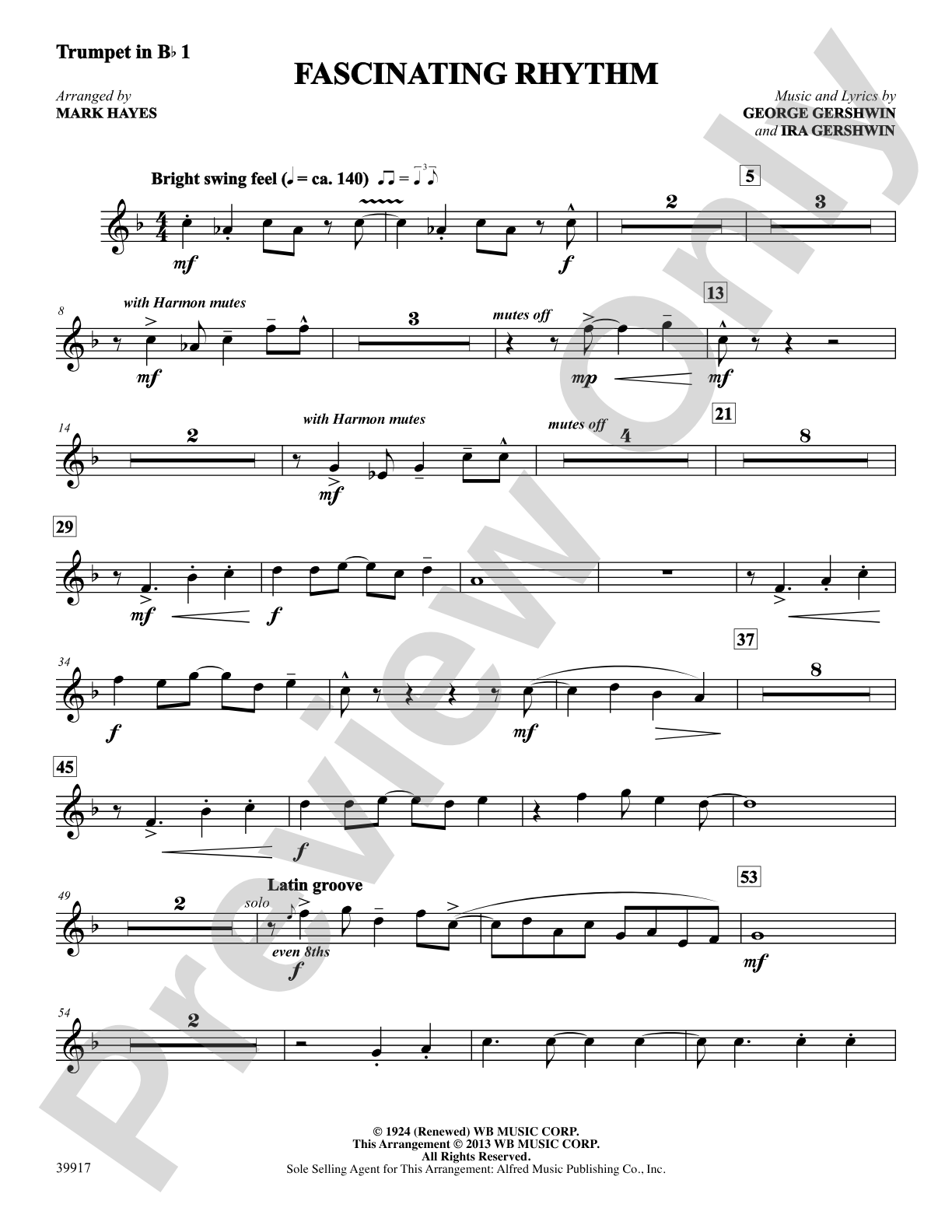
Fascinating Rhythm: 1st B-flat Trumpet Sheet Music Preview

Fascinating Rhythm: 1st B-flat Trumpet: Choral SoundPax

Music and lyrics by George Gershwin and Ira Gershwin / arr. Mark Hayes

Item: 00-PC-0015933_T1

Digital Download
$3.00
Description
First introduced in the Broadway musical Lady Be Good, this Gershwin hit has been covered by Rosemary Clooney, Michael Feinstein, The Four Tops, and many more. Mark's exciting arrangement effectively includes everything from Latin rhythm to Swing!

Don't just read it, hear it, play along with it, and watch your students grow with it. In MakeMusic Cloud, Fascinating Rhythm: 1st B-flat Trumpet: Choral SoundPax comes alive with professional accompaniment, adjustable tempo, and built-in practice tools that turn solo practice into real progress.

Sample Audio
0:00
0:00
Sample Video
Additional Details
Series: Alfred Pop Choral Series
Publisher: Alfred Music
Page Count: 144
SKU: 00-PC-0015933_T1
Instrumentation: SoundPax

More about this title

About the Composer: George Gershwin

George Gershwin (1898-1937) bridged classical composition and popular song with extraordinary fluency. His works for Broadway and concert hall established a distinctly American voice that drew from jazz, blues, and vernacular idioms while maintaining structural sophistication. Gershwin's melodies became standards because they balance immediate appeal with harmonic complexity; they're as rewarding to study as they are to perform.

Ira Gershwin, George's brother and lyricist, crafted witty, conversational lyrics that served the music without overwhelming it. Together they created some of America's most durable songs, many of which have become foundational to the American songbook and remain central to music education across styles.

Why we love this

Mark Hayes's arrangement captures the sophisticated energy that makes "Fascinating Rhythm" endure: the syncopated melody sits perfectly in choral voices, and the mix of Latin and swing textures gives singers multiple rhythmic and stylistic worlds to inhabit. Choirs rarely get pieces that are this intellectually satisfying and this much fun simultaneously.

What to expect

Rhythmically alive and sophisticated, with the confidence of a song that survived nearly a century of reinterpretation. You hear the heartbeat of Tin Pan Alley modernism: clever, energetic, rooted in vernacular speech patterns yet shaped by real harmonic and melodic craft. The Latin and swing textures add welcome color without obscuring the clarity that makes Gershwin writing so singable.

Who it's for

Choirs with solid rhythmic security and enough rehearsal time to explore style nuance. This works well for high school choirs moving beyond ballads, college ensembles wanting accessible showpiece material, and community choirs that value the American songbook. The SoundPax format makes it accessible to singers of varying part-reading levels.

How to get the most out of it

  • Lock the swing eighth-note feel early in rehearsal; the contrast between swing and Latin sections depends on precision from the whole choir, not just the rhythm section.
  • Highlight the recorded accompaniment during early rehearsals to anchor the harmonic progression, then gradually reduce its use so the choir owns the harmonic responsibility.
  • Treat the syncopated passages as speech-rhythm, not mathematical. Gershwin's melody wants conversational lift, not mechanical precision.
  • Balance solo moments (if the arrangement includes them) with full-choir texture so the arrangement's internal variety reads clearly to the audience.

How to use it

Pair this with other American standards or jazz-influenced choral writing to build a program celebrating American musical theater and songbook traditions. It works equally well as a concert centerpiece or as a strategic placement late in a set where the choir's confidence and style sophistication can shine. Consider positioning it alongside instrumental jazz or light classical work to build continuity.

Skills your students will build

  • Swing rhythm and syncopation
  • Rapid style shifts between Latin and swing feels
  • Harmonic awareness in jazz-influenced progressions
  • Conversational phrasing and musical syntax
  • Balance between rhythmic precision and stylistic freedom

You May Also Like