

Fair Phyllis: 3-Part Mixed, a cappella Choral Octavo
English Madrigal by John Farmer / arr. Russell Robinson
Item: 00-PO-0002200
$2.25
Minimum order quantity: 20 copies
Pickup currently not available
Description
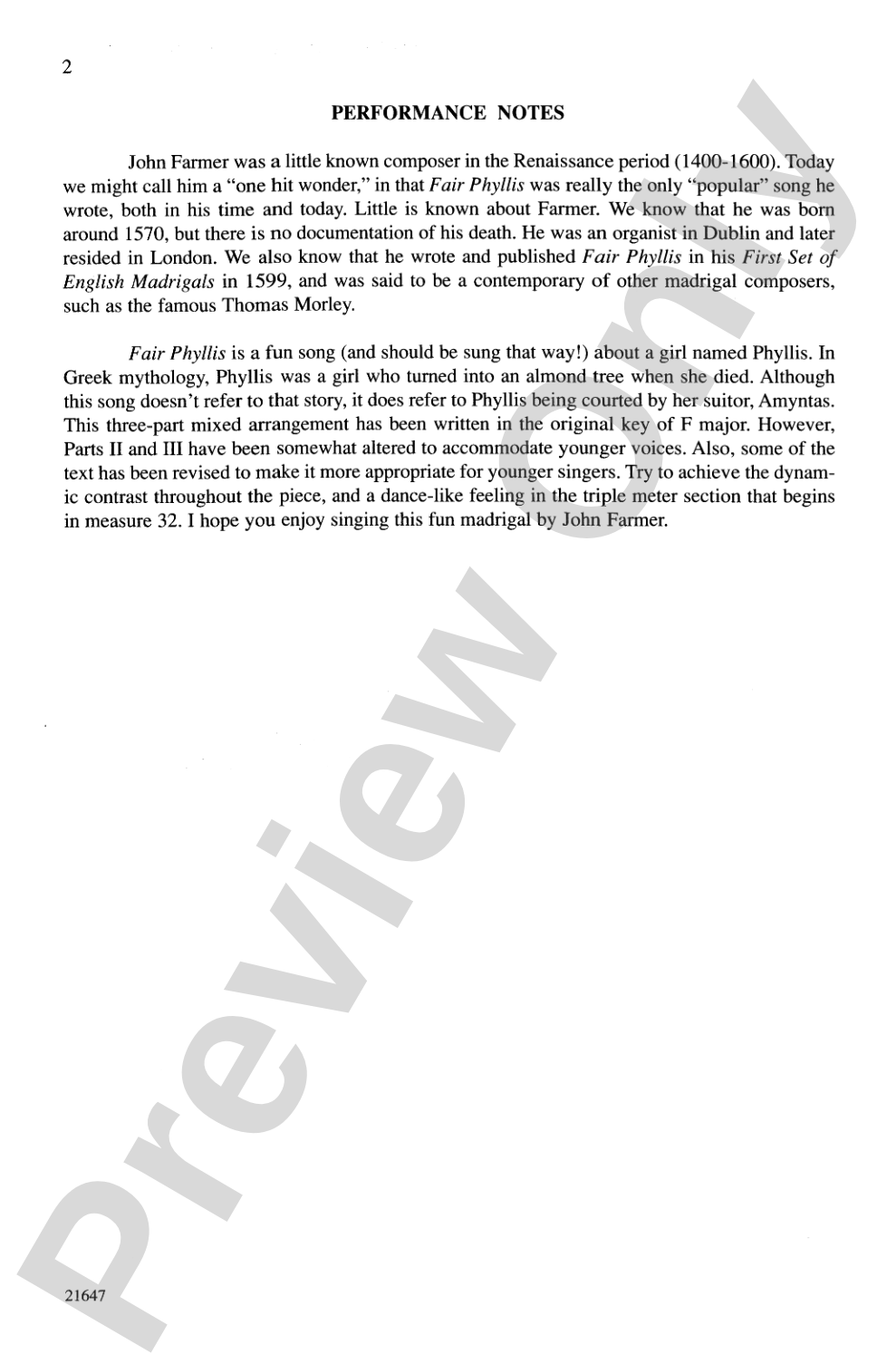
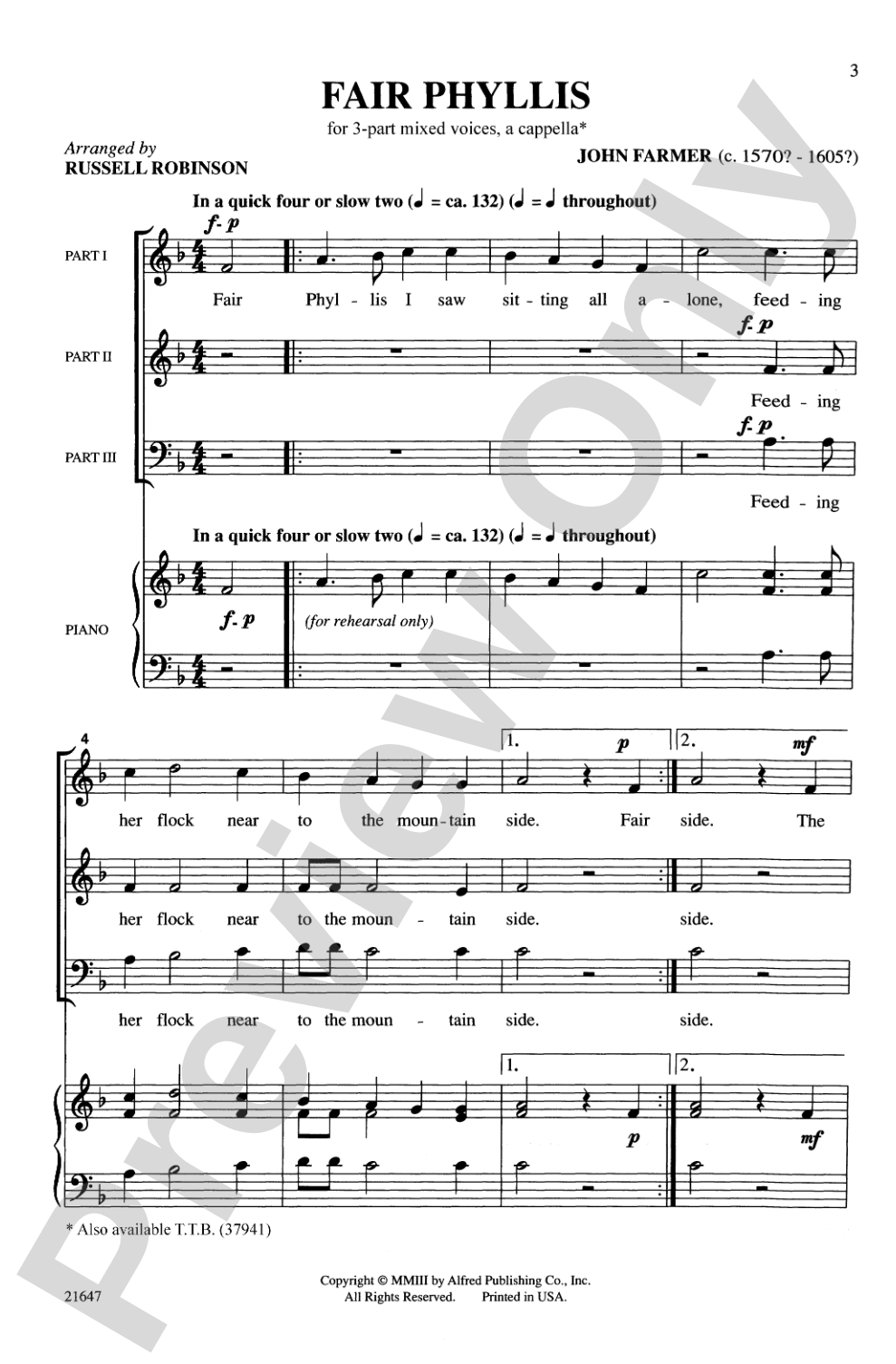
Another well-edited arrangement by Russell Robinson from the madrigal repertoire. Sung a cappella, or with the piano, the men's part spans only six notes in an easy range for changing voices. Charming secular text, light polyphonic texture, changing meters, and contrasting dynamics. Fair Phyllis is perfect as a first madrigal or as a Renaissance feature on any program.


Fair Phyllis: 3-Part Mixed, a cappella Choral Octavo isn't in MakeMusic Cloud just yet...but it could be. Let us know you'd like to see it, and you'll help shape what comes next. In the meantime, start a free trial and dive into thousands of interactive titles your students can play along with today.
Request This Title
Tell us you want it.
Start Your Free Trial
Explore everything that's ready to play right now.
Sample Audio
1
Audio File
--:--
0:00
0:00
Sample Video
No sample videos found.
Additional Details
Series:
Alfred Archive Edition: Alfred Choral Designs
Publisher:
Alfred Music
Page Count:
12
SKU:
00-PO-0002200
More about this title
About the Composer: John Farmer
John Farmer was an English composer and musician active during the late 16th century, a period when the madrigal flourished as the dominant form of secular vocal music in England. He contributed significantly to the madrigal repertoire alongside contemporaries like Thomas Morley and Orlando di Lasso, composing works that balanced accessibility with genuine musical sophistication. His madrigals remain valued in educational settings for their elegant counterpoint and singable lines.
Why we love this
Russell Robinson's arrangement opens the madrigal tradition to younger ensembles without sacrificing the genre's characteristic charm. The men's part sits comfortably for changing voices while maintaining authentic polyphonic texture, making this a genuinely singable entry point rather than a simplified approximation of Renaissance style.
What to expect
Bright and conversational, with the kind of elegant simplicity that Renaissance madrigals achieve when they avoid over-sentimentality. The interplay between voices feels like a musical conversation unfolding naturally, with shifting meters and dynamics keeping the texture alive without becoming fussy.
Who it's for
This arrangement serves emerging choirs ready to explore Renaissance polyphony and singers with limited madrigal experience. The accessible men's range and straightforward three-part texture make it ideal for middle or early high school ensembles, while the authentic musical content keeps it rewarding for more advanced groups seeking a manageable Renaissance feature.
How to get the most out of it
- Shape phrases through vowel consistency rather than excessive dynamic contrast; the text's bright, playful quality emerges naturally from clear articulation and rhythmic precision.
- Balance the three parts so the treble line carries the melody without drowning out the harmonic foundation in lower voices; this clarity matters especially when singing a cappella.
- Attend to the meter changes as structural moments that refresh the musical phrase rather than obstacles; let them feel inevitable within the musical line.
How to use it
Position this as a Renaissance anchor in a mixed program, or pair it with other three-part arrangements to showcase stylistic range within a single concert. Its modest length and a cappella flexibility make it well-suited to festival appearances or as a palate-cleanser between longer, more demanding works.
Skills your students will build
- Reading changing meters in a polyphonic context
- Balancing three independent melodic lines without instrumental support
- Sustaining Renaissance counterpoint and phrasing conventions
- Singing with confidence in a cappella settings
- Managing dynamic contrast while maintaining textural integrity