
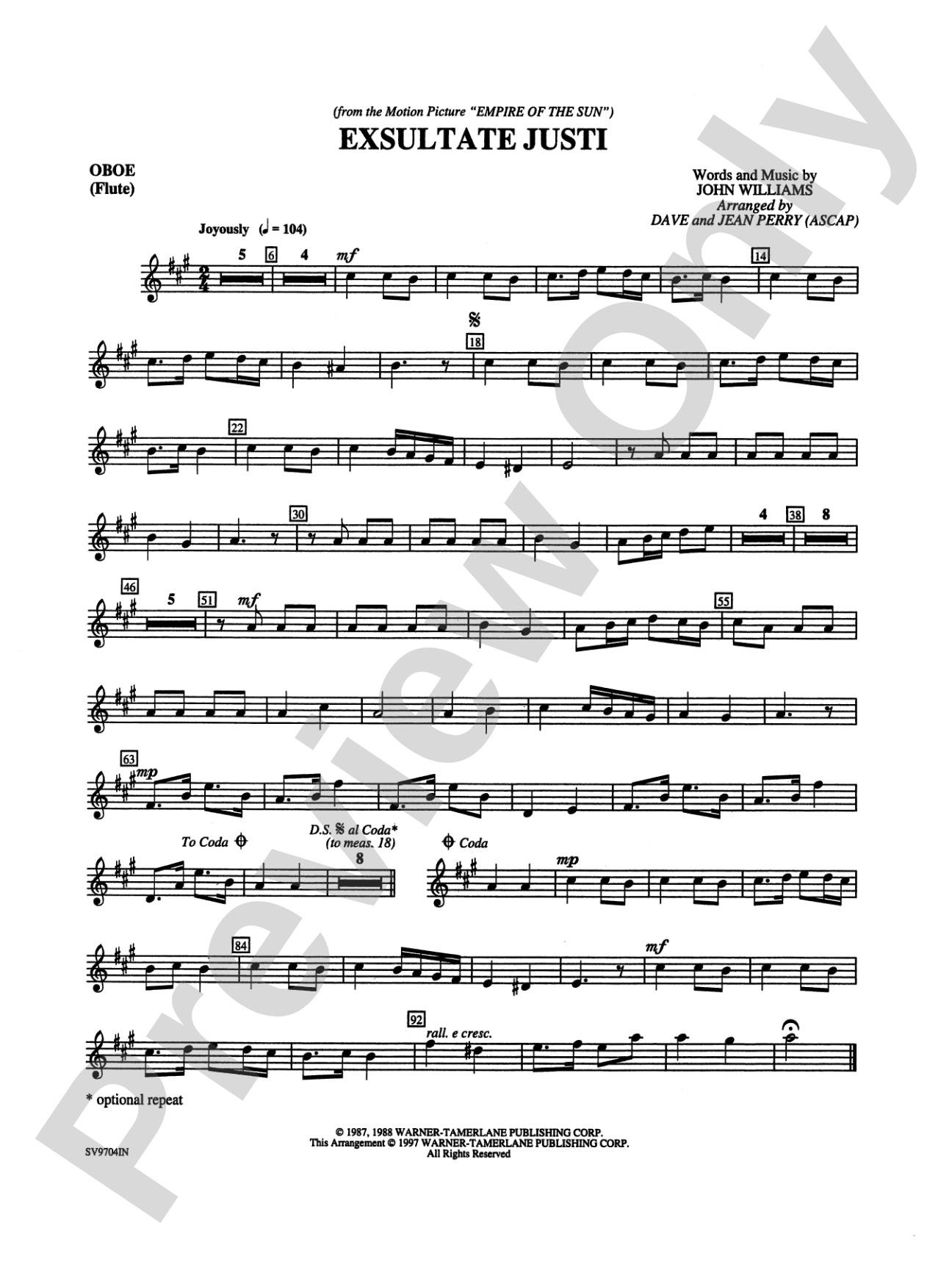

Exsultate Justi: Choral Instrumental Parts
Words and music by John Williams / arr. Dave and Jean Perry
Item: 00-PK-0002643

$15.00
Pickup currently not available
Buy Extra Parts (Digital PDF Download)
| Product | Price | Quantity |
|---|---|---|
| Exsultate Justi: Oboe: Choral Instrumental Parts | $3.00 | |
| Exsultate Justi: String Bass: Choral Instrumental Parts | $3.00 | |
| Exsultate Justi: Hand Drum: Choral Instrumental Parts | $3.00 |
Parts Added to Cart!
Related Items
Exsultate Justi: SATB Choral Octavo |
$2.05
|
View | |
Exsultate Justi: SAB Choral Octavo |
$2.25
|
View | |
Exsultate Justi: 2-Part Choral Octavo |
$2.25
|
View | |
Exsultate Justi: SATB Choral Octavo |
$2.05
|
View | |
Exsultate Justi: SAB Choral Octavo |
$2.25
|
View | |
Exsultate Justi: 2-Part Choral Octavo |
$2.25
|
View | |
Exsultate Justi: Choral Instrumental Parts |
$15.00
|
View |
Description
Originally featured in the motion picture Empire of the Sun, this John Williams original is simply a wonderful choral work. Every choir should strive to perform this rich addition to the choral repertoire. Dave and Jean Perry have not only captured the original intent of the Williams score, but have enhanced the choral sound for choirs of all levels.


Don't just read it, hear it, play along with it, and watch your students grow with it. In MakeMusic Cloud, Exsultate Justi: Choral Instrumental Parts comes alive with professional accompaniment, adjustable tempo, and built-in practice tools that turn solo practice into real progress.
Open in the Player
Jump straight in and assign it today.
Start Your Free Trial
Open this title and explore the full library in minutes.
Sample Audio
No sample audio found.
Sample Video
No sample videos found.
Additional Details
Publisher:
Alfred Music
Page Count:
4
SKU:
00-PK-0002643
Instrumentation:
Oboe/Flute, Double Bass, & Hand Drum, Tambourine
More about this title
About the Composer: John Williams
John Williams stands among the most prolific and celebrated film composers of our time, with a career spanning more than six decades. His gift for melody and orchestration has defined the soundtracks of some of cinema's most iconic moments, from Star Wars to Schindler's List, and his work consistently demonstrates the power of music to elevate narrative and emotion.
Why we love this
Williams's film music translates beautifully to the choral stage, and this arrangement by Dave and Jean Perry preserves the sweeping lyricism of the original while making it genuinely accessible to school and community choirs. The orchestration for oboe, double bass, and hand percussion supports rather than overwhelms the singers, letting the choir's sound take center stage without requiring a full orchestra.
What to expect
The piece carries a luminous, almost transcendent quality. Williams's gift for soaring melody meets sacred text, creating moments of genuine uplift that resonate long after the final note. There's an emotional directness here, uncluttered and sincere, that connects singers and audiences alike.
Who it's for
This works well for mixed choirs of intermediate to advanced ability, including high school and college ensembles, as well as strong community choirs. The arrangement scales meaningfully, making it suitable for groups with varying levels of instrumental support.
How to get the most out of it
- Balance the oboe line carefully against the choir; it should enhance the melodic contour without drowning out the singers, especially in thinner textures.
- Treat the hand percussion (tambourine and hand drum) as rhythmic and textural support rather than mere accompaniment; these colors matter to the overall shape.
- Shape phrases generously. Williams's melodic writing rewards singers who think in long arcs rather than measure-by-measure.
- Work the double bass part as an independent voice with the singers; it grounds the harmonic foundation and should remain audible even in full sections.
How to use it
This pairs naturally with other sacred or contemplative works on a concert program, particularly if you're already programming twentieth-century or film-influenced choral music. It also works as a standalone feature, where a good choir can let the beautiful melody and Williams's harmonic language speak for themselves without competing contexts.
Skills your students will build
- Blending choral voices with small instrumental ensembles
- Sustaining long melodic phrases with legit breath support
- Balancing ensemble texture across multiple voice parts and instruments
- Interpretive choices within a contemporary classical context