
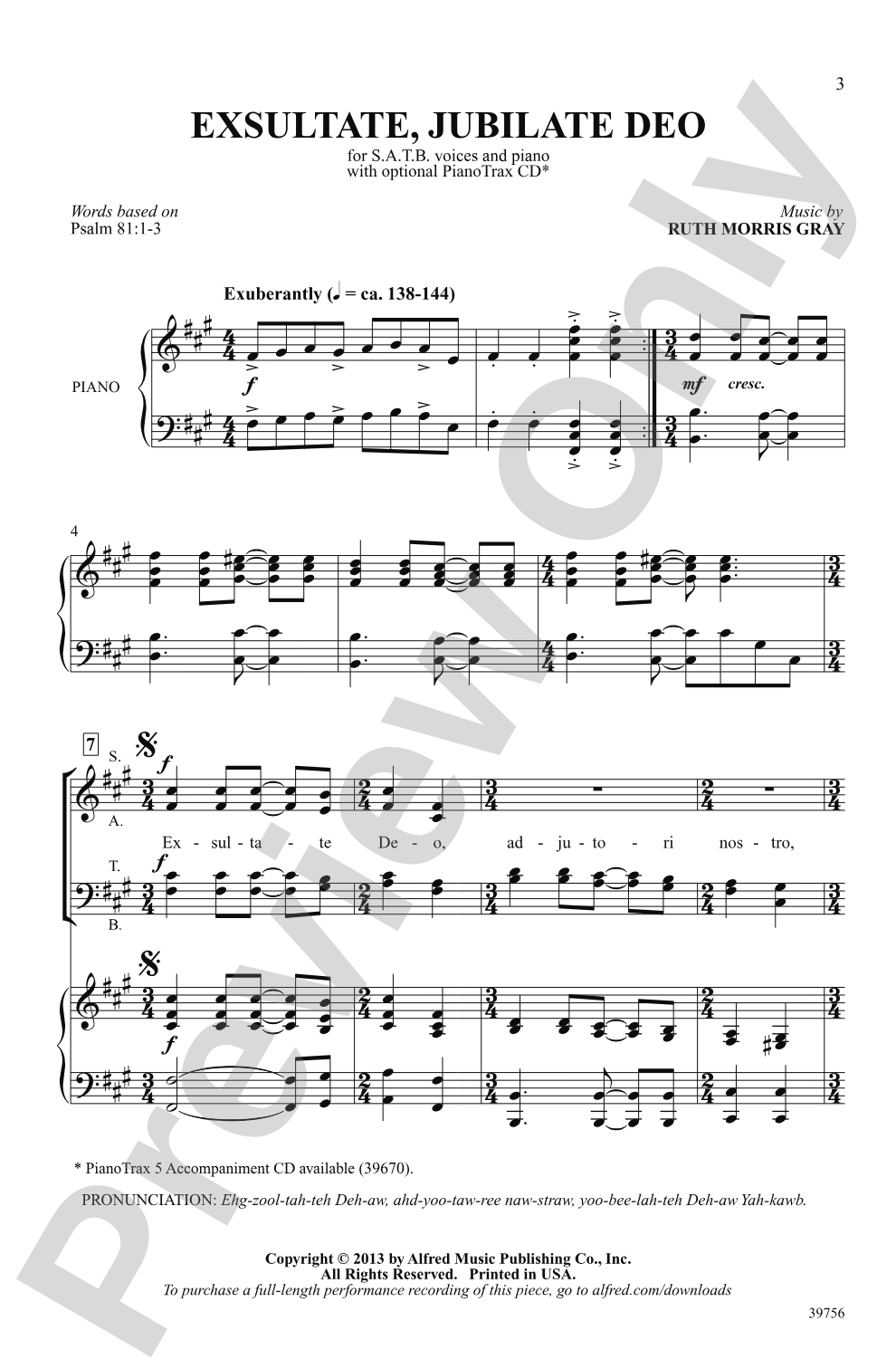
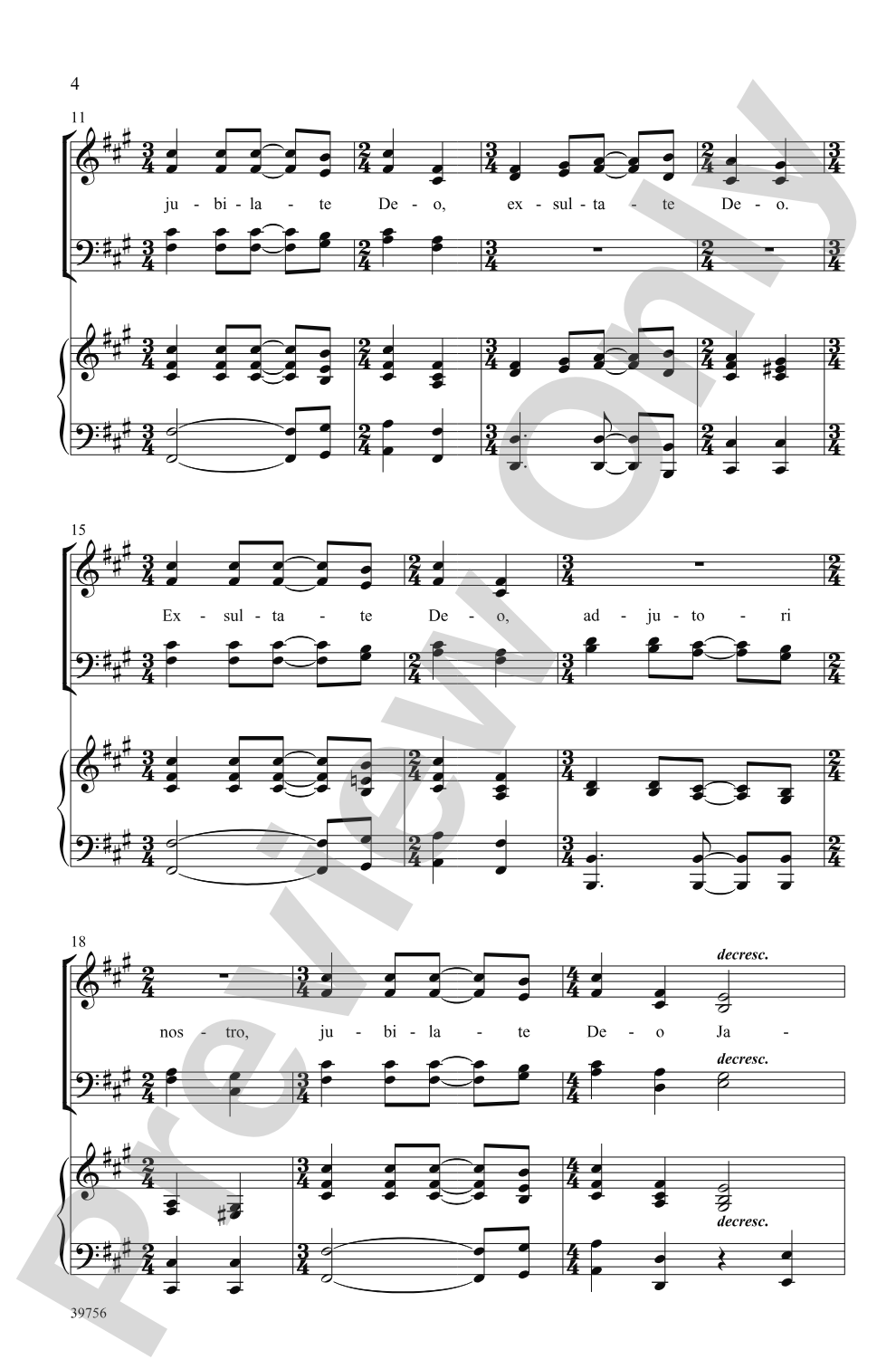

Exsultate, Jubilate Deo: SATB Choral Octavo
Words based on Psalm 81: 1-3, music by Ruth Morris Gray
Item: 00-PO-0001586
$2.25
Minimum order quantity: 20 copies
Pickup currently not available
Description
An exuberant mixed-meter exposition returns at the conclusion of this dynamic choral work. Contrasting sections add to the thrilling effect, and a percussive piano accompaniment provides equal doses of support and interest.


Exsultate, Jubilate Deo: SATB Choral Octavo isn't in MakeMusic Cloud just yet...but it could be. Let us know you'd like to see it, and you'll help shape what comes next. In the meantime, start a free trial and dive into thousands of interactive titles your students can play along with today.
Request This Title
Tell us you want it.
Start Your Free Trial
Explore everything that's ready to play right now.
Sample Audio
1
Audio File
--:--
0:00
0:00
Sample Video
No sample videos found.
Additional Details
Series:
Alfred Choral Designs
Publisher:
Alfred Music
Page Count:
12
SKU:
00-PO-0001586
More about this title
About the Composer: Ruth Morris Gray

Ruth Morris Gray has directed choirs at Rosemead High School in California since 2004, where she also teaches piano. Her compositional output spans more than 100 published choral works, reflecting a deep commitment to expanding the repertoire available to secondary school and community choirs.
Gray holds a Bachelor of Music in Piano Performance and Composition from Biola University and a Master of Arts in Music Composition from UC Santa Barbara. She earned her California Single Subject Music Credential from California State University, Northridge. Beyond her work as a composer, director, and performer, she is an avid traveler, swimmer, and cyclist.
Why we love this
Gray writes for singers with genuine understanding of what works in the rehearsal room and on stage. The shifting meters and contrasting sections here create real musical interest without overcomplicating the learning process, and the piano part is genuinely engaging rather than merely supportive, which keeps accompanists invested too.
What to expect
Bright, propulsive, and celebratory. The mixed-meter framework keeps the piece moving forward with restless energy, while contrasting sections create peaks and valleys that prevent the exuberance from becoming static. The piano accompaniment pulses underneath, adding harmonic color and rhythmic drive.
Who it's for
Intermediate to advancing SATB choirs with secure rhythmic readers and the stamina to sustain excitement across shifting meters. This works equally well in secondary school concert settings, community choirs seeking fresh sacred repertoire, and churches seeking energetic liturgical music.
How to get the most out of it
- Map the meter changes early in rehearsal so singers recognize the rhythmic shape rather than fighting it. Isolate sections that toggle between meters and drill them as rhythmic patterns before adding full harmonic complexity.
- Balance the energy between choir and piano; Gray's percussive accompaniment is written as an equal partner. Resist the urge to keep the ensemble soft just because the texture is transparent.
- Shape the return of the opening material at the end with fresh intensity. This is not a simple reprise; the context has shifted, so inflect it accordingly.
How to use it
Place this as a high-energy centerpiece in a sacred choral concert, especially alongside more introspective works that need this kind of contrast. It works well in spring programs where choirs want to end on an affirmative, celebratory note, and fits naturally into liturgical settings requiring uplifting repertoire.
Skills your students will build
- Reading and performing mixed meters (coordination between sections in complex metric shifts)
- Maintaining ensemble focus through rhythmic instability
- Sustaining lyrical energy across longer phrases without sacrificing clarity
- Responding to and balancing against an active, percussion-inflected accompaniment