

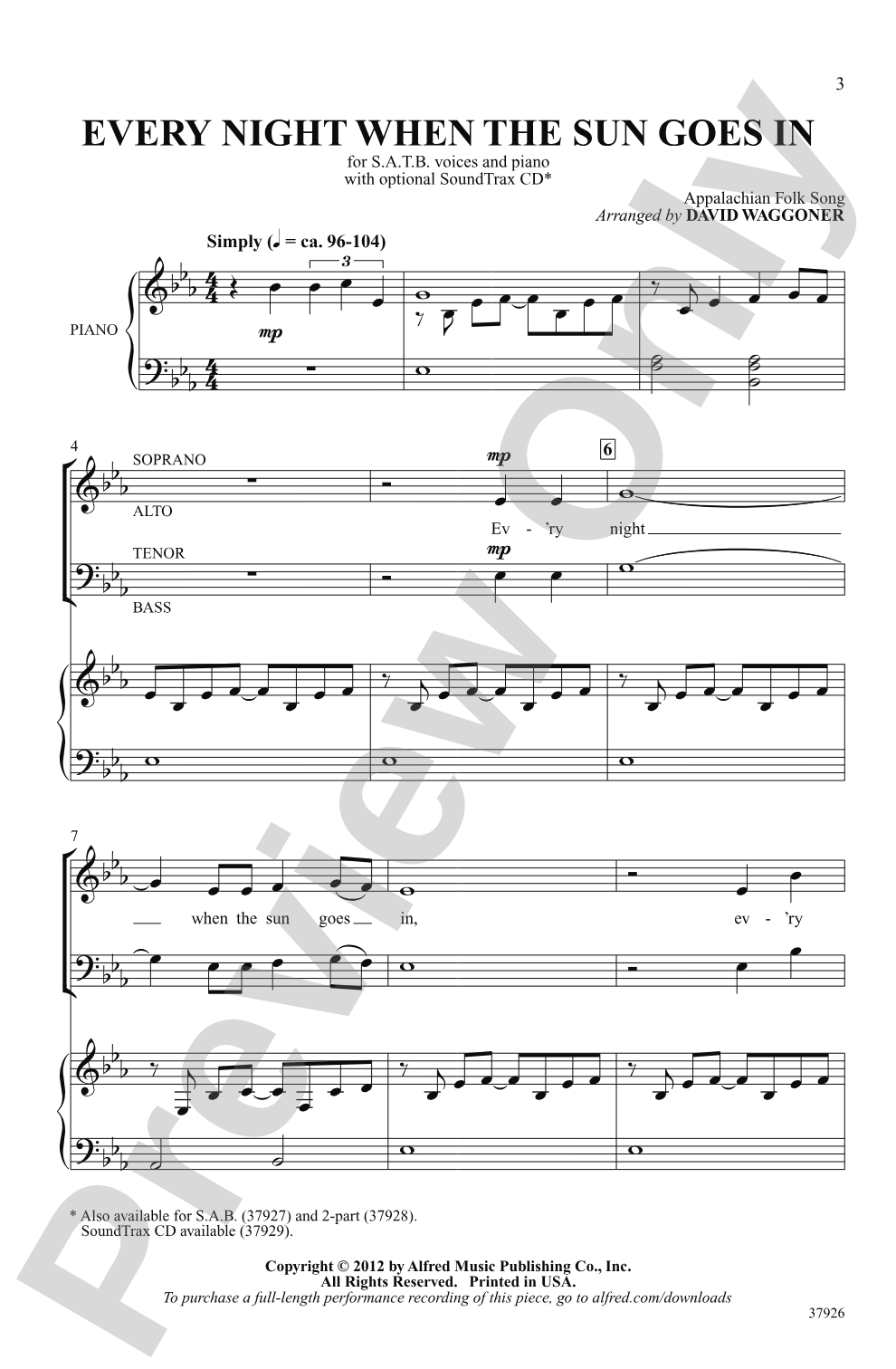

Every Night When the Sun Goes In: SATB Choral Octavo
Appalachain Folk Song / arr. David Waggoner
Item: 00-PO-0001275
$1.80
Minimum order quantity: 20 copies
Pickup currently not available
Related Items
Every Night When the Sun Goes In: SoundTrax Digital Audio Download |
$27.99
|
View | |
Every Night When the Sun Goes In: SAB Choral Octavo |
$1.80
|
View | |
Every Night When the Sun Goes In: 2-Part Choral Octavo |
$2.05
|
View | |
Every Night When the Sun Goes In: SATB Choral Octavo |
$1.80
|
View | |
Every Night When the Sun Goes In: SAB Choral Octavo |
$1.80
|
View | |
Every Night When the Sun Goes In: 2-Part Choral Octavo |
$2.05
|
View | |
Every Night When the Sun Goes In: Choral Octavo SoundTrax CD |
$27.99
|
View |
Description
A winsome Appalachian folk melody, tastefully arranged for choirs at any level. First in unison, then in rhythmic canon, and finally developing into full choral harmonies, this setting achieves beauty from simplicity.


Every Night When the Sun Goes In: SATB Choral Octavo isn't in MakeMusic Cloud just yet...but it could be. Let us know you'd like to see it, and you'll help shape what comes next. In the meantime, start a free trial and dive into thousands of interactive titles your students can play along with today.
Request This Title
Tell us you want it.
Start Your Free Trial
Explore everything that's ready to play right now.
Sample Audio
1
Audio File
--:--
0:00
0:00
Sample Video
No sample videos found.
Additional Details
Series:
Alfred Choral Designs
Publisher:
Alfred Music
Page Count:
12
SKU:
00-PO-0001275
More about this title
About the Arranger: David Waggoner

David Waggoner holds degrees from the University of Michigan School of Music and earned a master's degree in music from Eastern Michigan University. His work spans multiple genres and ensembles, with a catalog that includes compositions for choirs, handbells, and various instrumental combinations.
Waggoner serves as Director of Music at the First United Methodist Church in Wyandotte, Michigan, and teaches elementary music in Woodhaven, Michigan. He lives in the Wyandotte area with his wife Heidi and three children.
Why we love this
Waggoner's arrangement unfolds with genuine pedagogical intelligence, moving singers from unison into rhythmic canon before settling into four-part harmony. This architecture lets your choir experience the melody's strength at every level while building confidence across a range of abilities. The folk tune itself carries warmth without sentimentality, making it genuinely rewarding to sing together.
What to expect
There's an honest simplicity here that feels settled and reflective, like sitting on a porch at dusk. The melody itself carries the kind of quiet dignity that folk tunes often possess, and Waggoner's approach lets it breathe rather than embellish. Harmonically, the writing sits comfortably in the voice range while adding warmth without complexity.
Who it's for
This octavo works for any choir seeking an accessible folk arrangement that doesn't sacrifice musicality. Whether you're building skills in a developing ensemble or refreshing fundamentals in an experienced group, the progressive structure meets singers where they are. The piece also fits nicely into programs where you want genuine Americana without arrangements that feel overly elaborate.
How to get the most out of it
- Shape the unison opening with subtle dynamic shifts to establish the melody's character before voices divide; this foundation carries the energy through the canon section.
- In the rhythmic canon, clarify each voice entry without dragging the tempo; a light touch maintains the tune's natural lilt and prevents the texture from feeling static.
- Allow the full harmony section to breathe, particularly at cadence points, so the choral color emerges without forcing the blend.
- If using the recorded accompaniment, have singers internalize their unison line first so they can anchor themselves when voices begin to separate.
How to use it
Consider pairing this with other American folk settings to build a thematic concert segment, or program it as a standout moment in a mixed repertoire concert where it offers contrast through its restraint. The piece also works well in services or community events where accessibility and sincerity matter more than virtuosity, and the recorded accompaniment makes it practical for smaller programs or school assemblies.
Skills your students will build
- Singing independent melodic lines within a canon texture
- Blending unison singing into four-part harmony
- Phrasing folk melody with authentic inflection
- Part independence while maintaining ensemble cohesion
- Dynamic control across varied harmonic textures