
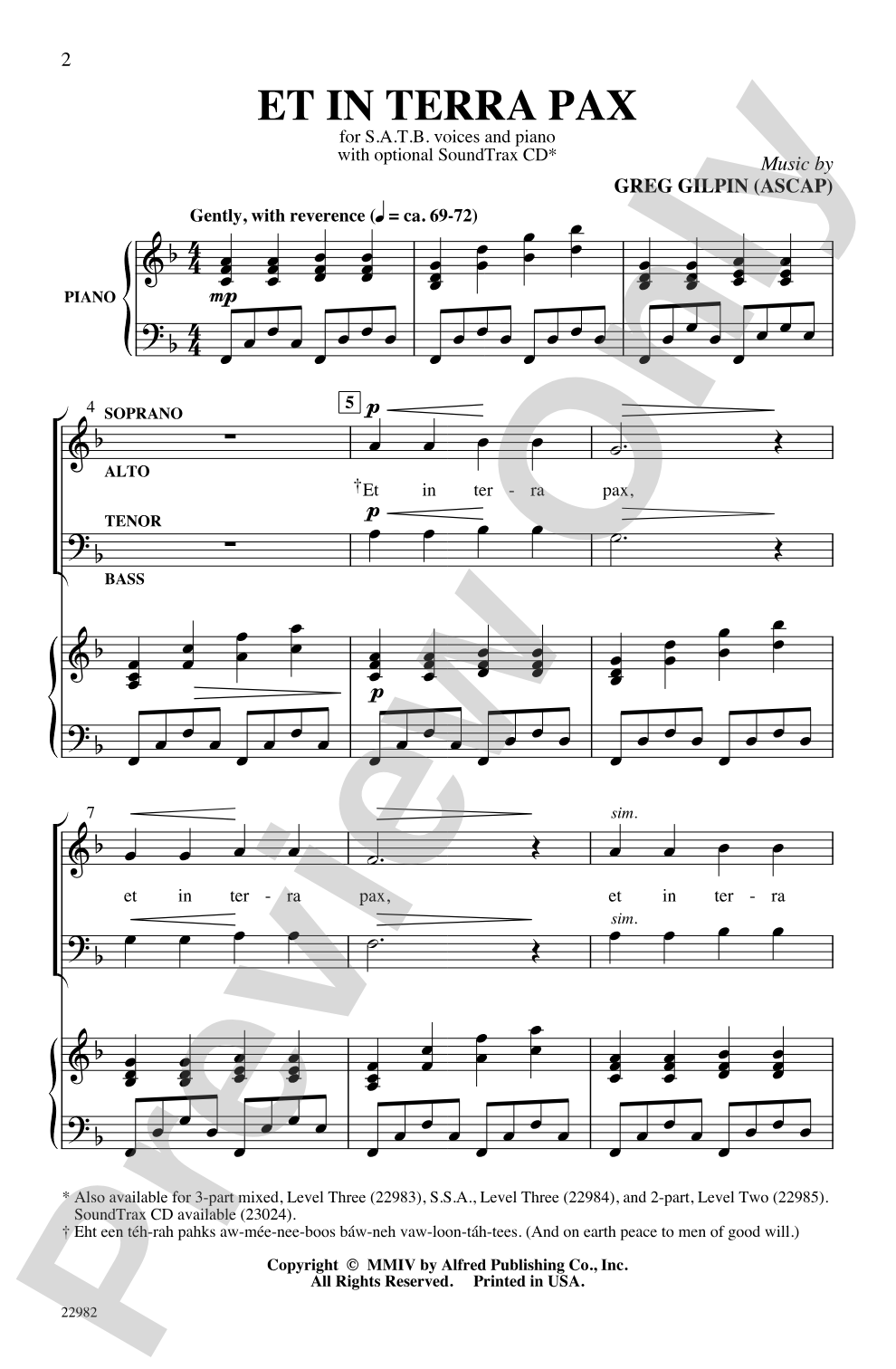
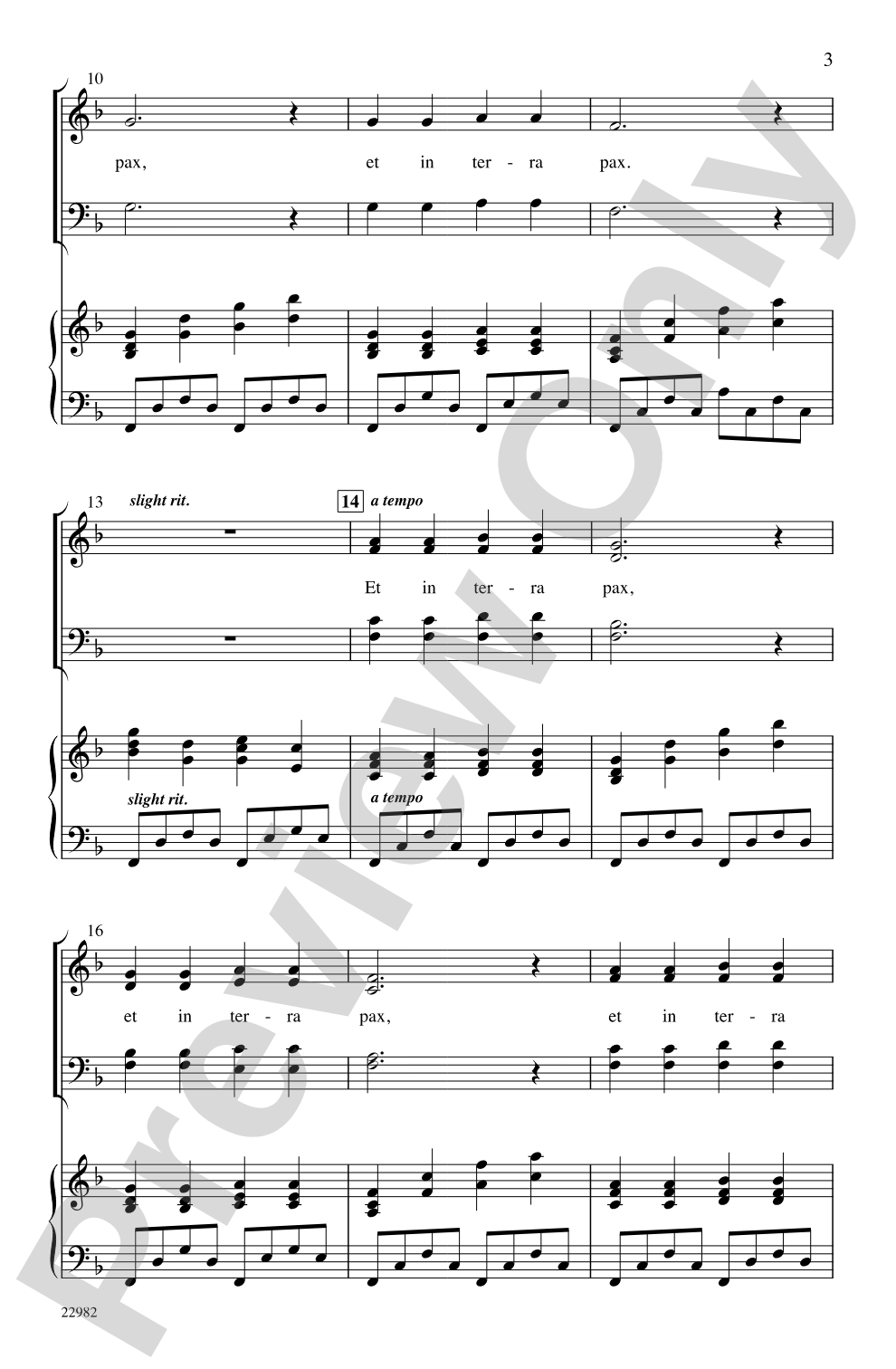

Et In Terra Pax: SATB Choral Octavo
Music by Greg Gilpin
Item: 00-PO-0006532
$1.65
Minimum order quantity: 20 copies
Pickup currently not available
Related Items
Et In Terra Pax: 3-Part Mixed Choral Octavo |
$1.65
|
View | |
Et In Terra Pax: 2-Part Choral Octavo |
$1.65
|
View | |
Et In Terra Pax: SATB Choral Octavo |
$1.65
|
View | |
Et In Terra Pax: 3-Part Mixed Choral Octavo |
$1.65
|
View | |
Et In Terra Pax: SSA Choral Octavo |
$1.65
|
View | |
Et In Terra Pax: 2-Part Choral Octavo |
$1.65
|
View | |
Et In Terra Pax: Choral Octavo SoundTrax CD |
$27.99
|
View |
Description
Uncomplicated, homophonic vocal writing provides the foundation of this unique, well-crafted work for concerts, festivals, contests, and adjudications. Perfect for choirs that are just starting to sing in two, three, or four parts. A helpful translation/pronunciation guide makes it easy to learn the Latin text, and Greg Gilpin's excellent voice leading and use of occasional unison and welcomed repetition insure that your group will sound its best without any trouble. An optional SoundTrax CD will allow the director to be away from the piano in rehearsal and performance.


Et In Terra Pax: SATB Choral Octavo isn't in MakeMusic Cloud just yet...but it could be. Let us know you'd like to see it, and you'll help shape what comes next. In the meantime, start a free trial and dive into thousands of interactive titles your students can play along with today.
Request This Title
Tell us you want it.
Start Your Free Trial
Explore everything that's ready to play right now.
Sample Audio
1
Audio File
--:--
0:00
0:00
Sample Video
No sample videos found.
Additional Details
Series:
Alfred Choral Designs
Publisher:
Alfred Music
Page Count:
8
SKU:
00-PO-0006532
More about this title
About the Composer: Greg Gilpin

Greg Gilpin is an ASCAP award-winning composer and arranger whose choral works are performed across the country and internationally. He has conducted at venues including Carnegie Hall, Lincoln Center, Ryman Auditorium, Sydney Opera House, Royal Festival Hall, and Harpa Concert Hall. As Director of Educational Choral Publications for Shawnee Press, Gilpin shapes the landscape of accessible choral literature for developing ensembles.
Beyond composition, Gilpin has expanded into film scoring, earning Best Score for the award-winning short film "Rosie's Rescue" in 2021, and collaborated with opera singer Angela Brown on a contemporary arrangement of "What Child is This?" premiered by the Indianapolis Symphonic Choir. He holds memberships in ACDA, NAfME, SAG-AFTRA, and is a Life Loyal Member of Phi Mu Alpha Sinfonia.
Why we love this
Gilpin writes for the choir that's ready to grow into four-part harmony without overwhelming them. The homophonic texture and strategic use of unison create confidence-building moments, while his voice leading ensures voices move naturally and rest where they need to. This is the kind of piece that makes young singers feel accomplished and sounds genuinely musical on stage.
What to expect
The piece unfolds with gentle clarity, its homophonic writing creating transparency and warmth. The Latin text carries reverence without demanding technical virtuosity, allowing the choir to focus on ensemble cohesion and the spiritual character of the music.
Who it's for
This octavo fits developing SATB choirs that are establishing ensemble singing skills and building confidence in multi-part repertoire. It works equally well for mixed choirs in school settings, church music programs, or festival contexts where straightforward, singable music is valued.
How to get the most out of it
- Use the translation and pronunciation guide during initial rehearsals to help singers commit the Latin text quickly, freeing rehearsal time for musical refinement.
- Lean into the moments of unison to reset ensemble focus and create dynamic contrast within the piece.
- If using the optional SoundTrax accompaniment, rehearse with it early enough that singers internalize the harmonic support before removing it in final rehearsals.
- Balance the homophonic sections by encouraging singers to listen across parts rather than within their own line, creating blend without sacrificing clarity.
How to use it
Position this as an opening or closing number on a concert featuring sacred repertoire, where its accessibility allows the program to build toward more complex pieces. It also serves well in adjudication settings where clear, well-balanced singing speaks louder than technical difficulty.
Skills your students will build
- Singing in four parts with clear voice independence
- Latin diction and text underlay in sacred repertoire
- Homophonic texture and blend across the ensemble
- Managing dynamic shape in simpler harmonic structures
- Responding to unison resets as an ensemble refinement tool