
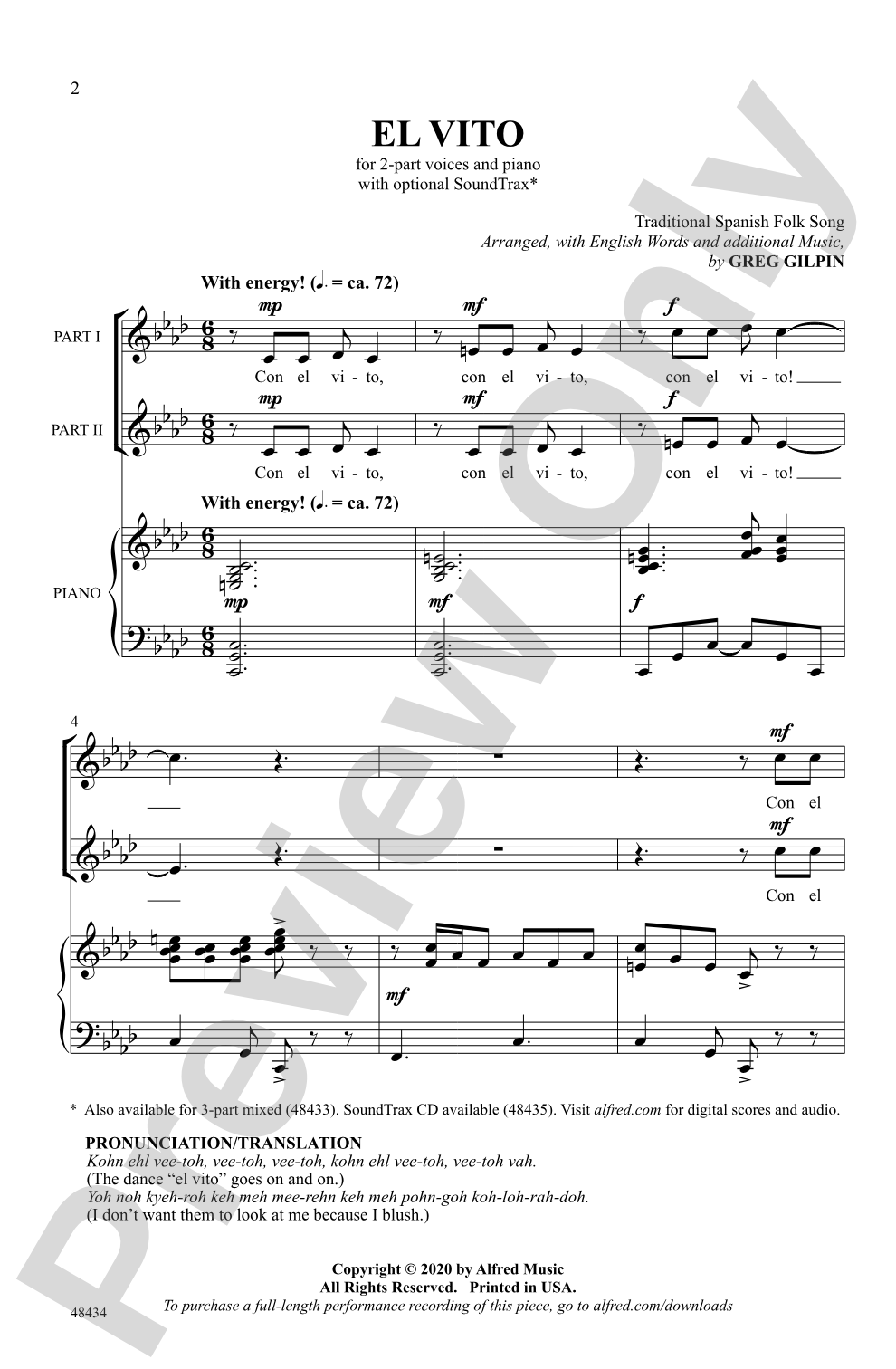
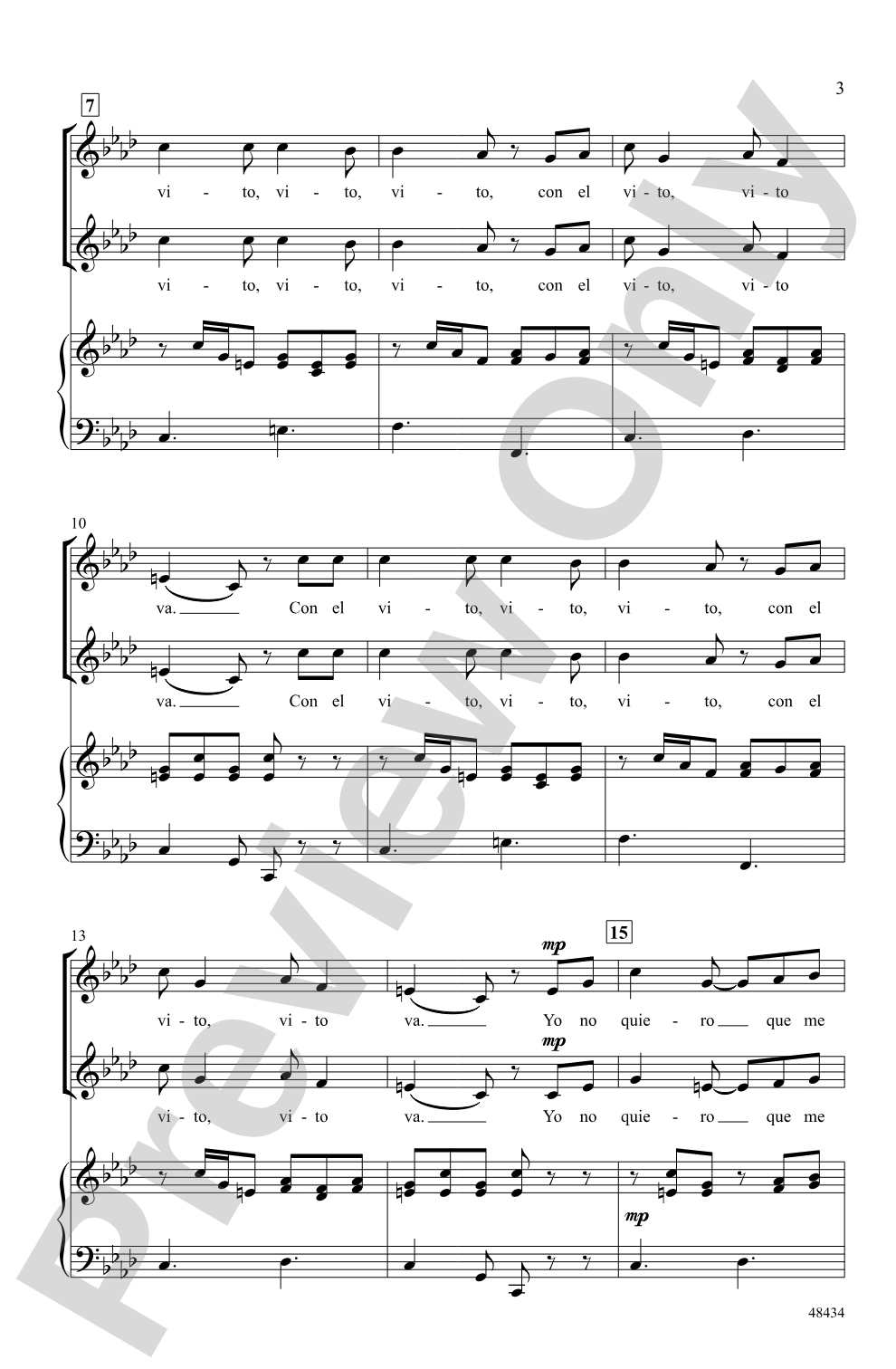

El Vito: 2-Part Choral Octavo
Traditional Spanish Folk Song / arr., with English words and additional music, by Greg Gilpin
Item: 00-PO-0006426
$2.05
Minimum order quantity: 20 copies
Pickup currently not available
Description
This energetic arrangement of the traditional Spanish folk song is infused with the characteristic dance rhythms of Andalusia. Easy-to-learn phrases in the original language roll off the tongue and alternate with some English text, painting a picture of the vibrant dance. Add accessible choreography taught on the downloadable ChoreoTrax video.


El Vito: 2-Part Choral Octavo isn't in MakeMusic Cloud just yet...but it could be. Let us know you'd like to see it, and you'll help shape what comes next. In the meantime, start a free trial and dive into thousands of interactive titles your students can play along with today.
Request This Title
Tell us you want it.
Start Your Free Trial
Explore everything that's ready to play right now.
Sample Audio
1
Audio File
--:--
0:00
0:00
Sample Video
Additional Details
Series:
Alfred Choral Designs
Publisher:
Alfred Music
Page Count:
12
SKU:
00-PO-0006426
More about this title
About the Arranger: Greg Gilpin

Greg Gilpin brings decades of choral leadership and compositional expertise to his work as an arranger. His conducting career has taken him to some of the world's most prestigious venues, including Carnegie Hall, Lincoln Center, the Sydney Opera House, and Royal Festival Hall. As Director of Educational Choral Publications for Shawnee Press, he combines his performance experience with a deep commitment to creating repertoire that works in real rehearsal rooms.
Beyond the choral world, Gilpin has expanded his creative reach into film scoring and beyond. His award-winning score for the short film "Rosie's Rescue" and his world premiere arrangement of "What Child is This?" with opera singer Angela Brown demonstrate his versatility as a musician. An ASCAP award winner and active member of ACDA and NAfME, Gilpin continues to teach, conduct, and compose while bringing his distinctive voice to educational choral literature.
Why we love this
Gilpin's arrangement captures the infectious energy of Spanish folk tradition without overwhelming younger singers. The blend of Spanish and English text gives students authentic cultural material while keeping the piece accessible, and the included choreography transforms a simple choral warm-up into a full sensory experience that middle school and early high school singers genuinely enjoy performing.
What to expect
El Vito radiates the warmth and movement of a traditional Spanish celebration. Sung in Spanish and English, it transports singers to Andalusia with characteristic rhythmic patterns that feel natural to the voice and irresistible to the body.
Who it's for
This piece suits developing choirs in grades 6-9 and early high school groups seeking genuine folk material that engages singers beyond traditional art song. The simple two-part voicing and straightforward ranges make it accessible while the cultural and kinesthetic components keep rehearsals fresh and performance engaging.
How to get the most out of it
- Teach the Spanish pronunciation first by isolating key phrases and having students echo repeatedly before introducing the full melodic line; this builds confidence and frees singers to focus on pitch and phrasing.
- The alternating Spanish and English sections work best when you clearly articulate the vowel shapes in each language rather than applying one vowel consistency throughout.
- Layer in the choreography gradually during rehearsal, beginning with the basic step patterns in isolation before combining movement with singing, so neither element compromises the other.
- Lean into the rhythmic vitality of the Andalusian dance style by asking singers to feel the pulse in their bodies first, then let that physical awareness inform their vocal rhythms and dynamic shaping.
How to use it
Program this piece as a concert centerpiece or encore where you want singers and audiences to feel genuinely connected to something alive and celebratory. It pairs beautifully on programs exploring global folk traditions or as a festival selection where multicultural repertoire is encouraged; the kinesthetic element also makes it ideal for family concerts or community performances where audience engagement enhances the experience.
Skills your students will build
- Singing in Spanish with accurate pronunciation and vowel placement
- Performing rhythmic patterns characteristic of Spanish folk idiom
- Integrating choreography with singing while maintaining vocal focus
- Moving fluidly between Spanish and English text
- Building ensemble blend across two-part voicing in a high-energy context