
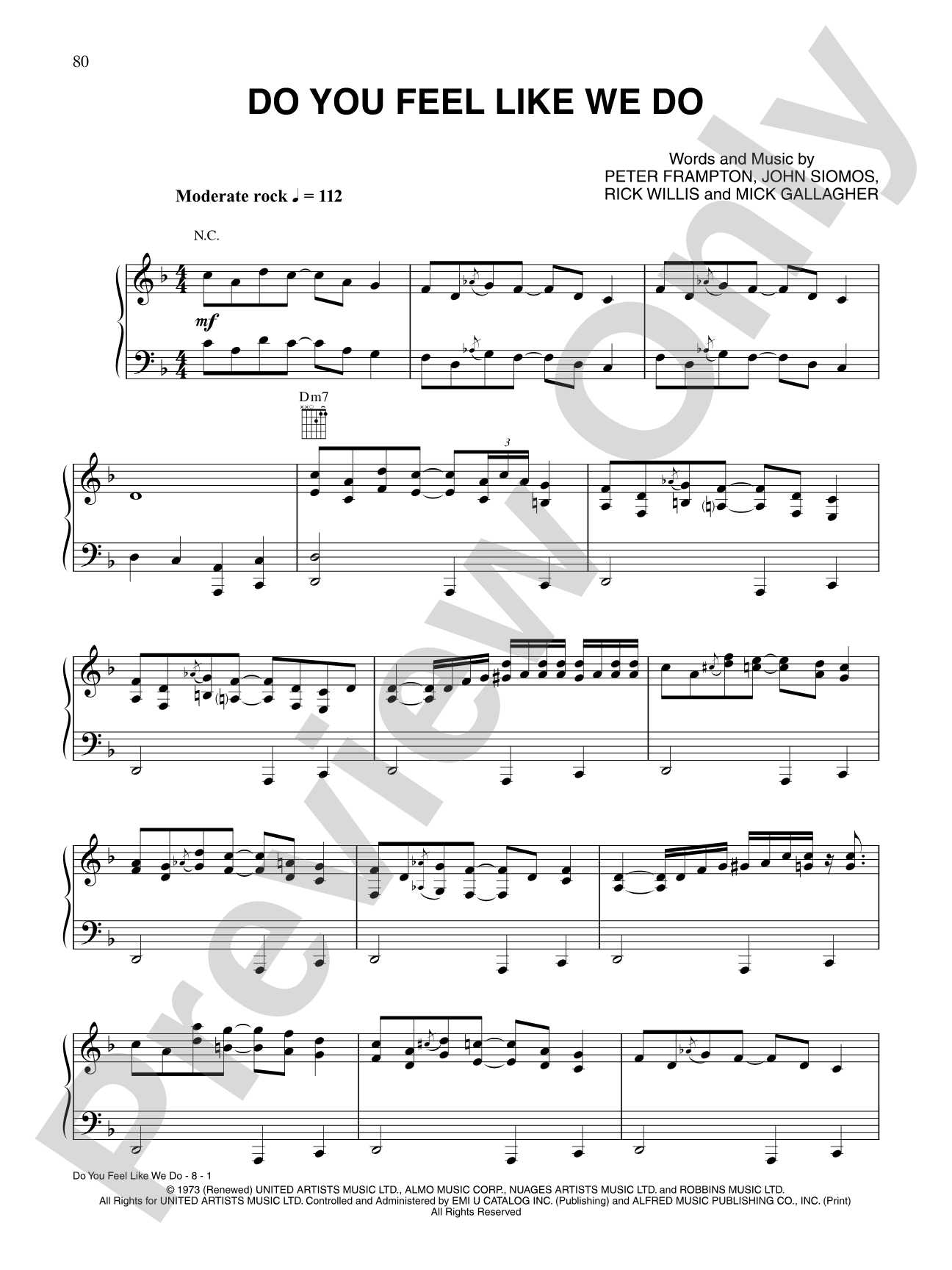
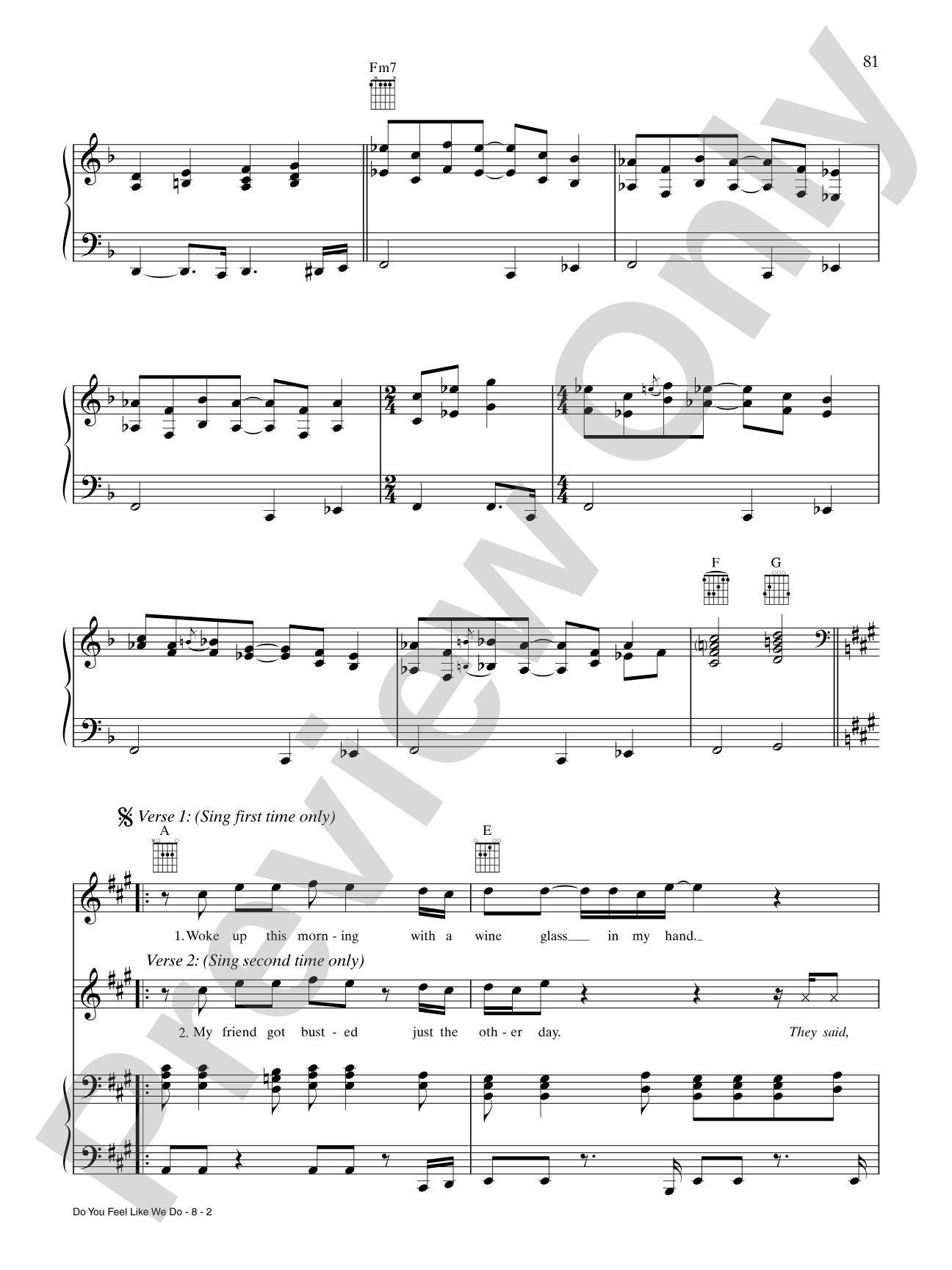

Do You Feel Like We Do: Piano/Vocal/Chords
Item: 00-PS-0015544
$5.99
One moment…
Related Items
Live and Let Die: Piano/Vocal/Chords |
$4.99
|
View | |
Big Yellow Taxi: Piano/Vocal/Chords |
$4.99
|
View | |
From Me to You: Piano/Vocal/Chords |
$4.99
|
View | |
I Saw Her Standing There: Piano/Vocal/Chords |
$5.99
|
View | |
She Loves You: Piano/Vocal/Chords |
$4.99
|
View | |
Dancing in the Moonlight: Piano/Vocal/Chords |
$5.99
|
View | |
The Giant Book of Classic Rock Sheet Music: Piano/Vocal/Guitar Book |
$34.99
|
View |
Description
Play everybody's favorite songs! The 300 pages of piano/vocal/guitar sheet music in this collection allow music makers to bring dozens of the most memorable songs of the 1960s, '70s, and early '80s to life. Classic rock fans who love to play will have a blast applying their talent to more than 40 enduring songs made famous by legendary artists like The Beatles, David Bowie, Journey, Led Zeppelin, Pink Floyd, The Rolling Stones, Rush, The Who, and many more. The arrangements feature piano parts that accurately reflect each song's familiar original recording. Basic chord fingering grids are provided for optional guitar accompaniment, along with vocal melodies and complete lyrics. Titles: 50 Ways to Leave Your Lover (Paul Simon) * Africa (Toto) * All Along the Watchtower (Jimi Hendrix) * All My Love (Led Zeppelin) * Behind Blue Eyes (The Who) * Big Yellow Taxi (Joni Mitchell) * Blinded by the Light (Manfred Mann's Earth Band) * Blowin' in the Wind (Bob Dylan) * Born to Run (Bruce Springsteen) * Bridge Over Troubled Water (Simon and Garfunkel) * Closer to the Heart (Rush) * Dancing in the Moonlight (King Harvest) * Do You Feel Like We Do (Peter Frampton) * Don't Stop Believin' (Journey) * Faithfully (Journey) * Fool in the Rain (Led Zeppelin) * From Me to You (The Beatles) * Give Up the Funk (Tear the Roof off the Sucker) (Parliament) * Going Up the Country (Canned Heat) * The Great Gig in the Sky (Pink Floyd) * I Love L.A. (Randy Newman) * I Saw Her Standing There (The Beatles) * Like a Rolling Stone (Bob Dylan) * Live and Let Die (Paul McCartney) * The Load Out (Jackson Browne) * Love Reign O'er Me (The Who) * Money (Pink Floyd) * Nights in White Satin (The Moody Blues) * Paranoid (Black Sabbath) * P-Funk (Wants to Get Funked Up) (Parliament) * Pinball Wizard (The Who) * River (Joni Mitchell) * Saturday in the Park (Chicago) * She Loves You (The Beatles) * She's a Rainbow (The Rolling Stones) * The Sound of Silence (Simon and Garfunkel) * Space Oddity (David Bowie) * St. Stephen (Grateful Dead) * Stairway to Heaven (Led Zeppelin) * Thunder Road (Bruce Springsteen) * Tom Sawyer (Rush) * Uncle John's Band (Grateful Dead) * A Whiter Shade of Pale (Procol Harum) * Wild Horses (The Rolling Stones) * Woodstock (Crosby, Stills, Nash & Young) * You Can't Always Get What You Want (The Rolling Stones).


Do You Feel Like We Do: Piano/Vocal/Chords isn't in MakeMusic Cloud just yet...but it could be. Let us know you'd like to see it, and you'll help shape what comes next. In the meantime, start a free trial and dive into thousands of interactive titles your students can play along with today.
Request This Title
Tell us you want it.
Start Your Free Trial
Explore everything that's ready to play right now.
Sample Audio
No sample audio found.
Sample Video
No sample videos found.
Additional Details
Series:
The Giant Book of Sheet Music
Publisher:
Alfred Music
Page Count:
304
SKU:
00-PS-0015544
More about this title
About the Composer: Peter Frampton
Peter Frampton emerged as one of rock's most distinctive voices in the 1970s, bringing technical virtuosity and emotional directness to arena rock. His 1976 album "Frampton Comes Alive!" became a cultural phenomenon, establishing him as a guitarist and vocalist of exceptional range. Beyond performing, Frampton's influence on rock music education extends through his willingness to make complex arrangements accessible to musicians at various skill levels.
Why we love this
This collection captures the DNA of classic rock in a format that works for pianists, vocalists, and guitarists simultaneously. The piano voicings stay true to the original recordings while remaining playable, and the dual instrumentation approach means a single book serves multiple musicians in your studio or ensemble. You get 40+ songs spanning five decades of rock history, all arranged with enough authenticity to satisfy players who know these records inside and out.
What to expect
Opening this book is like walking into a jukebox filled with your favorite songs from the golden age of rock radio. The writing honors the original production without overwhelming the page; you hear the iconic moments (the piano riff from "Don't Stop Believin'," the atmospheric sweep of "The Great Gig in the Sky") rendered playable. Whether you're recalling the first time you heard these songs or discovering them fresh, the arrangements deliver the recognition and emotional impact that made them last.
Who it's for
Pianists and singer-pianists who grew up on classic rock and want to play the music they love. Guitarists adding keyboard players to their projects will find this resource invaluable for arranging sessions. Voice teachers and private studio instructors can use these arrangements for pop-leaning repertoire that engages students who might otherwise resist traditional classical material.
How to get the most out of it
- Study the original recordings before diving into the arrangements. These piano parts are designed to reflect the studio versions, so listening first will clarify which elements matter most in your interpretation.
- Balance the vocal melody against the piano part carefully. The lyrics are full, giving singers plenty of space, but the keyboard foundation needs to stay grounded and present beneath the vocal line.
- If adding guitar, use the chord grids as a starting point rather than a limitation. Many of these songs benefit from fingerpicking or specific rhythmic approaches that go beyond basic strumming.
How to use it
Build a rock retrospective recital by selecting songs that span the artists and decades represented. Pair this book with a mix of your own original material or other contemporary songs to create a concert program that speaks to students who live and breathe this music. Use it in studio sessions where you're accompanying vocalists, or as a resource for pianists preparing repertoire for auditions and performance exams that welcome popular music.
Skills your students will build
- Reading chord charts alongside standard notation
- Balancing melody, harmony, and accompaniment texture as a pianist
- Interpreting vocal phrasing and dynamics from lead sheets
- Sight-reading rock-era harmonic progressions and rhythmic patterns
- Coordinating keyboard and guitar parts in ensemble contexts