
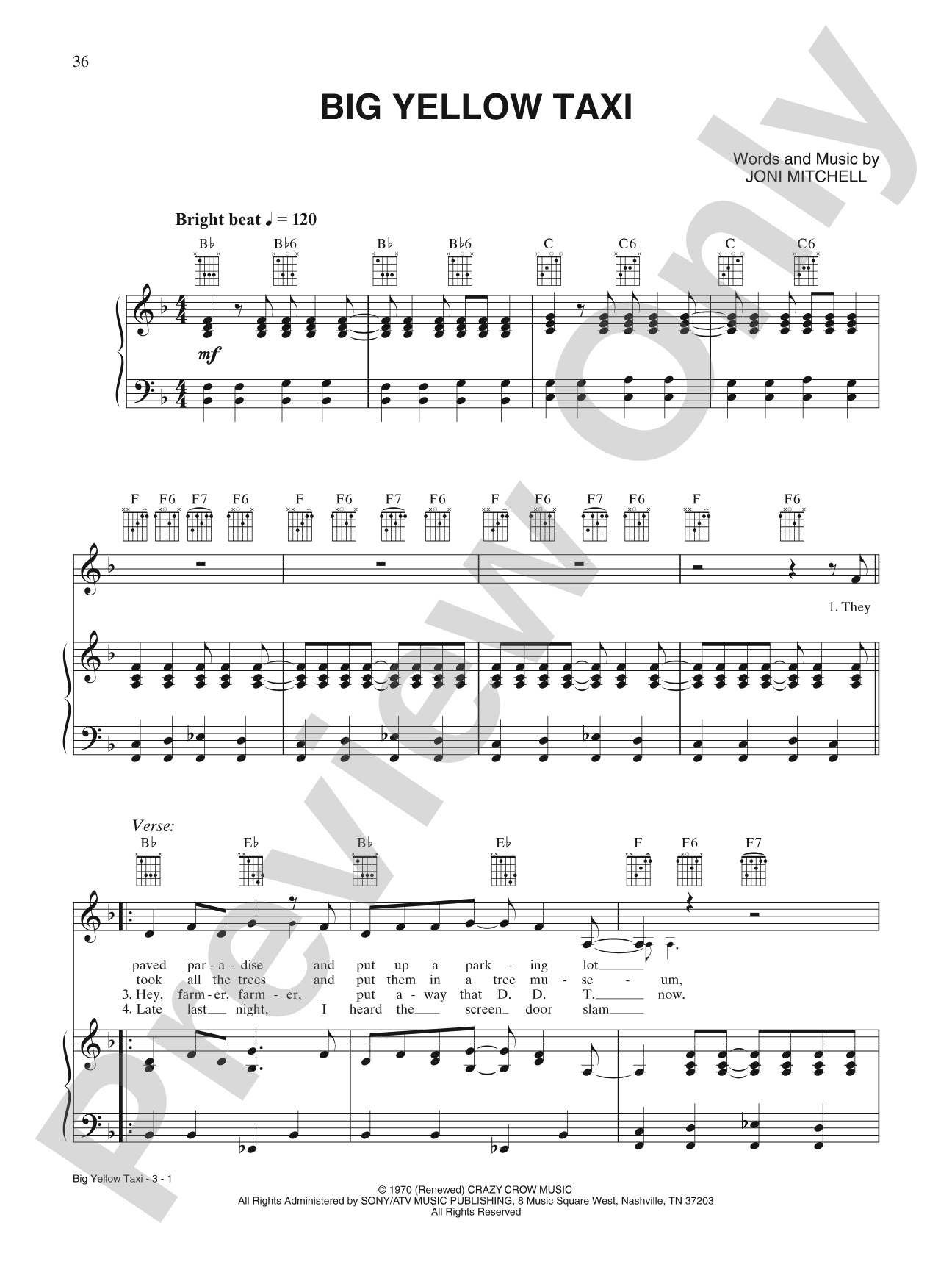

Big Yellow Taxi: Piano/Vocal/Chords
Item: 00-PS-0015545
$4.99
One moment…
Related Items
Live and Let Die: Piano/Vocal/Chords |
$4.99
|
View | |
Do You Feel Like We Do: Piano/Vocal/Chords |
$5.99
|
View | |
From Me to You: Piano/Vocal/Chords |
$4.99
|
View | |
I Saw Her Standing There: Piano/Vocal/Chords |
$5.99
|
View | |
She Loves You: Piano/Vocal/Chords |
$4.99
|
View | |
Dancing in the Moonlight: Piano/Vocal/Chords |
$5.99
|
View | |
The Giant Book of Classic Rock Sheet Music: Piano/Vocal/Guitar Book |
$34.99
|
View |
Description
Play everybody's favorite songs! The 300 pages of piano/vocal/guitar sheet music in this collection allow music makers to bring dozens of the most memorable songs of the 1960s, '70s, and early '80s to life. Classic rock fans who love to play will have a blast applying their talent to more than 40 enduring songs made famous by legendary artists like The Beatles, David Bowie, Journey, Led Zeppelin, Pink Floyd, The Rolling Stones, Rush, The Who, and many more. The arrangements feature piano parts that accurately reflect each song's familiar original recording. Basic chord fingering grids are provided for optional guitar accompaniment, along with vocal melodies and complete lyrics. Titles: 50 Ways to Leave Your Lover (Paul Simon) * Africa (Toto) * All Along the Watchtower (Jimi Hendrix) * All My Love (Led Zeppelin) * Behind Blue Eyes (The Who) * Big Yellow Taxi (Joni Mitchell) * Blinded by the Light (Manfred Mann's Earth Band) * Blowin' in the Wind (Bob Dylan) * Born to Run (Bruce Springsteen) * Bridge Over Troubled Water (Simon and Garfunkel) * Closer to the Heart (Rush) * Dancing in the Moonlight (King Harvest) * Do You Feel Like We Do (Peter Frampton) * Don't Stop Believin' (Journey) * Faithfully (Journey) * Fool in the Rain (Led Zeppelin) * From Me to You (The Beatles) * Give Up the Funk (Tear the Roof off the Sucker) (Parliament) * Going Up the Country (Canned Heat) * The Great Gig in the Sky (Pink Floyd) * I Love L.A. (Randy Newman) * I Saw Her Standing There (The Beatles) * Like a Rolling Stone (Bob Dylan) * Live and Let Die (Paul McCartney) * The Load Out (Jackson Browne) * Love Reign O'er Me (The Who) * Money (Pink Floyd) * Nights in White Satin (The Moody Blues) * Paranoid (Black Sabbath) * P-Funk (Wants to Get Funked Up) (Parliament) * Pinball Wizard (The Who) * River (Joni Mitchell) * Saturday in the Park (Chicago) * She Loves You (The Beatles) * She's a Rainbow (The Rolling Stones) * The Sound of Silence (Simon and Garfunkel) * Space Oddity (David Bowie) * St. Stephen (Grateful Dead) * Stairway to Heaven (Led Zeppelin) * Thunder Road (Bruce Springsteen) * Tom Sawyer (Rush) * Uncle John's Band (Grateful Dead) * A Whiter Shade of Pale (Procol Harum) * Wild Horses (The Rolling Stones) * Woodstock (Crosby, Stills, Nash & Young) * You Can't Always Get What You Want (The Rolling Stones).


Big Yellow Taxi: Piano/Vocal/Chords isn't in MakeMusic Cloud just yet...but it could be. Let us know you'd like to see it, and you'll help shape what comes next. In the meantime, start a free trial and dive into thousands of interactive titles your students can play along with today.
Request This Title
Tell us you want it.
Start Your Free Trial
Explore everything that's ready to play right now.
Sample Audio
No sample audio found.
Sample Video
No sample videos found.
Additional Details
Series:
The Giant Book of Sheet Music
Publisher:
Alfred Music
Page Count:
304
SKU:
00-PS-0015545
More about this title
About the Composer: Joni Mitchell
Joni Mitchell stands as one of the most influential singer-songwriters of the late 20th century, known for her sophisticated harmonic language, introspective lyrics, and innovative guitar tunings. Her career spanning from the 1960s onward established her as a musician's musician, admired by peers across genres for her compositional depth and willingness to evolve artistically.
Why we love this
This collection captures the DNA of classic rock in one accessible volume. The piano arrangements stay true to the original recordings while the chord grids offer flexibility for guitarists, making it genuinely useful for musicians who want to perform these songs with accuracy and personality.
What to expect
Opening this collection is like holding a musical time capsule of the era when piano and guitar shaped rock's backbone. From the ethereal passages in Pink Floyd to the driving grooves of Journey, each song carries the unmistakable texture of its original era while remaining immediate and playable.
Who it's for
Pianists and keyboardists who love the rock repertoire of the 1960s through early 1980s and want fully notated arrangements that reflect the original recordings. It's equally valuable for guitarists seeking chord-based approaches and singers looking for complete vocal scores with lyrics and piano accompaniment.
How to get the most out of it
- Study the original recordings before diving into these arrangements. Hearing how the piano part sits in the mix will help you balance accompaniment with vocal clarity.
- Treat the chord grids as a starting point rather than a ceiling. Many of these songs benefit from subtle reharmonization or fingerpicking variations that suit your playing style.
- Lock in rhythmically with a vocalist or guitarist early in rehearsal. The interplay between piano and other parts drives the groove in songs like 'Don't Stop Believin'' and 'Africa.'
How to use it
Feature individual songs in recitals alongside contemporary pieces to show how rock vocabulary fits within a broader performance context. A pianist could program 'Bridge Over Troubled Water' for a singer alongside art song, or guitarists might use multiple selections for a thematic concert exploring the evolution of songwriting across the decades.
Skills your students will build
- Reading piano/vocal/guitar scores in mixed ensemble contexts
- Balancing vocal support with independence in the piano part
- Interpreting chord symbols and exploring voicing options
- Understanding rhythmic groove and pocket playing in rock idioms
- Coordinating melodic, harmonic, and rhythmic layers across multiple instruments