

Do Not Weep: SSAA Choral Octavo
By Sally K. Albrecht
Item: 00-PO-0000102
$1.65
Minimum order quantity: 20 copies
Pickup currently not available
Description
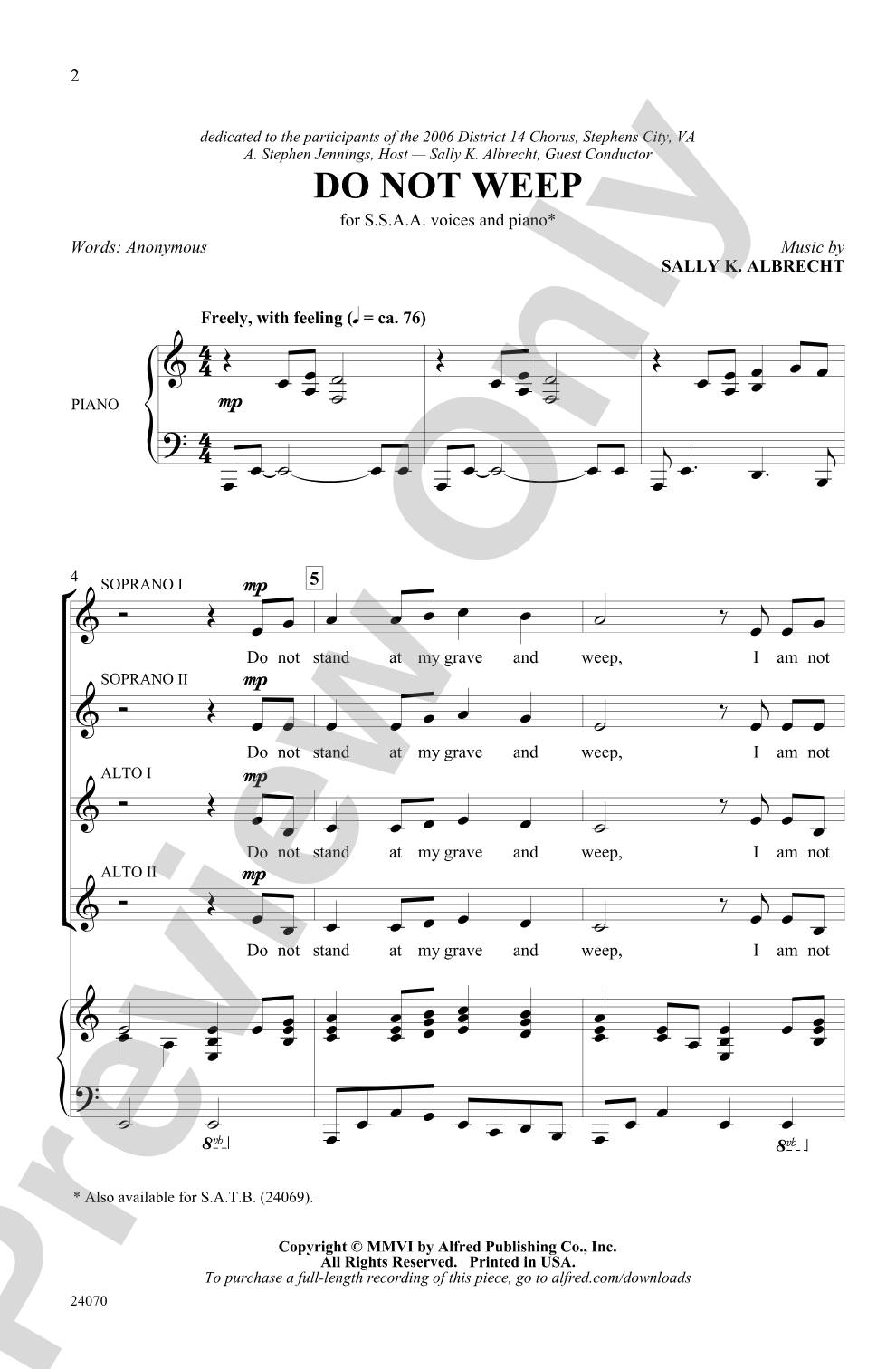
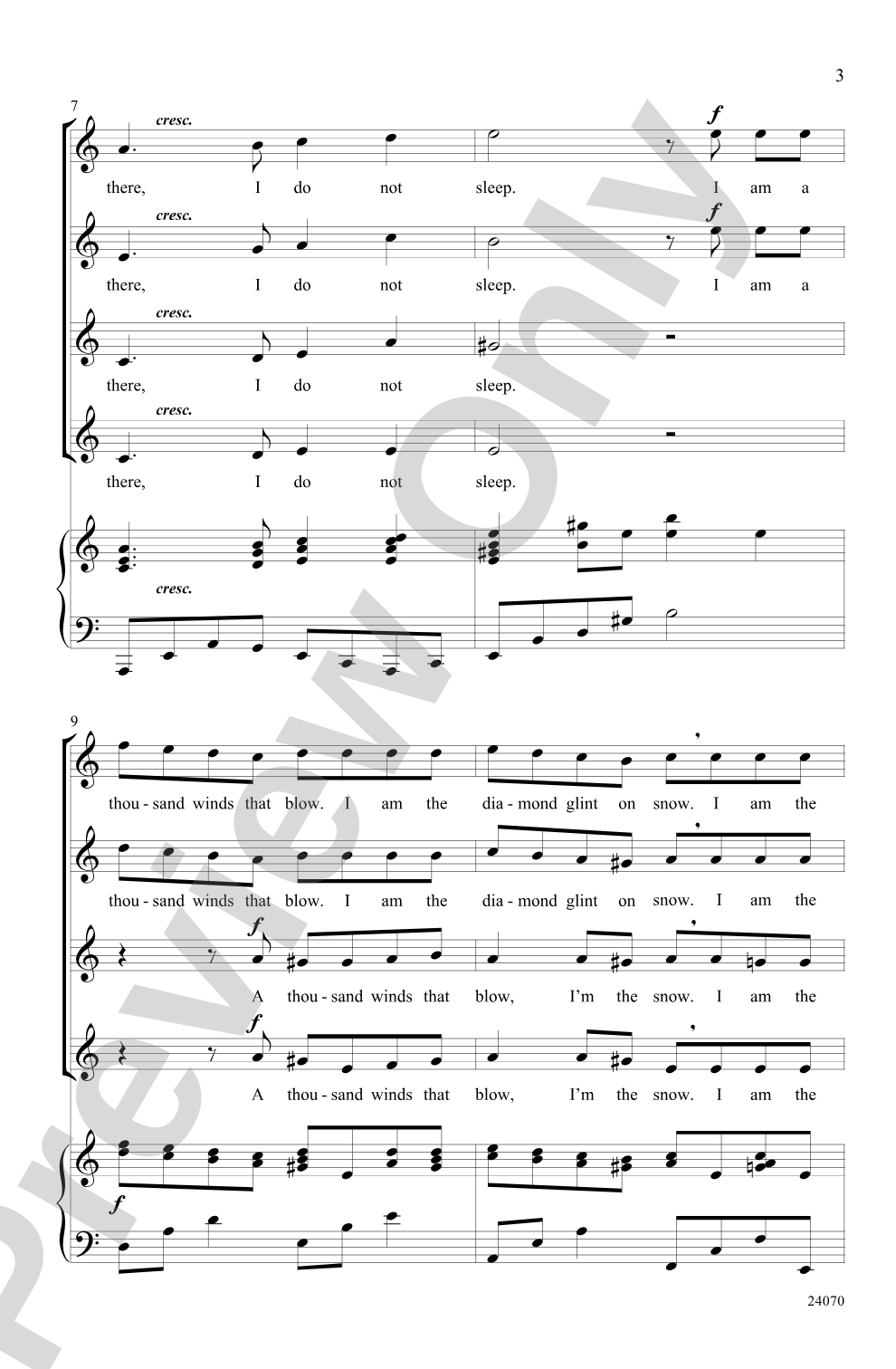
An outstanding concert work with a powerful text for SATB and SSAA choirs. Careful attention is paid to the text with mostly homophonic writing and an A-B-A form. The piano part is not difficult and supports the voices throughout. A strong concert or contest number, and a fine selection for a festival choir.


Do Not Weep: SSAA Choral Octavo isn't in MakeMusic Cloud just yet...but it could be. Let us know you'd like to see it, and you'll help shape what comes next. In the meantime, start a free trial and dive into thousands of interactive titles your students can play along with today.
Request This Title
Tell us you want it.
Start Your Free Trial
Explore everything that's ready to play right now.
Sample Audio
1
Audio File
--:--
0:00
0:00
Sample Video
No sample videos found.
Additional Details
Series:
Alfred Choral Designs
Publisher:
Alfred Music
Page Count:
12
SKU:
00-PO-0000102
More about this title
About the Composer: Sally K. Albrecht

Sally K. Albrecht has spent over three decades shaping choral music education as a composer, conductor, and clinician. Her catalog includes more than 600 choral works and 75 larger stage pieces, all grounded in her deep understanding of what singers need and audiences want to hear. A consistent ASCAP award recipient since 1987, she has led honor choirs at prestigious venues including Lincoln Center, Carnegie Hall, and The Kennedy Center, and served as Director of School Choral and Vocal Publications for Alfred Music.
Albrecht holds degrees from Rollins College (B.A. in Music and Theater, 1976), the University of Miami (M.A. in Drama, 1977; M.M. in Accompanying, 1979), and has taught in the music departments at Oakland University, Jersey City State College, and Meredith College. Her contributions to music education have been recognized with the Distinguished Alumna Award from both the University of Miami Frost School of Music and Rollins College, as well as the Pillar of Leadership Award from the Omicron Delta Kappa National Leadership Honor Society. She lives in Wake Forest, North Carolina, with her husband, composer and arranger Jay Althouse.
Why we love this
Albrecht writes with absolute respect for the text, allowing the words to shape every musical gesture. The mostly homophonic setting keeps the focus on meaning and allows singers to connect emotionally with the piece, while the A-B-A structure gives it formal clarity and a satisfying arc. A piano part that actually supports rather than complicates makes this accessible for most choirs while sounding polished enough for competition or festival adjudication.
What to expect
This is music that breathes. The homophonic writing creates moments of transparency and directness, inviting the listener into a quiet conversation with the text rather than a showy vocal display. The A-B-A journey gives the piece an intimate quality that builds toward genuine emotional resonance.
Who it's for
SSAA choirs seeking meaningful concert or festival repertoire with musical substance and emotional depth. The piece works for advanced high school choirs, college programs, and community choirs with solid fundamental skills. Its accessible vocal range and clear harmonic language make it rewarding to sing without requiring virtuosic technique.
How to get the most out of it
- Respect the text's weight by cultivating sustained, supported tone throughout the A sections. This piece relies on vocal beauty and line, not clever part-writing, to move an audience.
- Work the middle B section carefully to establish its contrasting character. The textural shift should feel intentional and planned, not like a sudden surprise.
- Balance the piano part so it colors the harmonic landscape without overshadowing the choir. Albrecht has already done the mixing for you; trust it.
- Use the A-B-A form as your rehearsal roadmap. Secure the A material thoroughly first, then tackle the B section as a distinct learning block.
How to use it
Position this as a centerpiece in a sacred or secular concert program, where its reflective character will land fully with an attentive audience. It pairs well alongside spirituals, contemporary choral works, or classical motets as part of a thematic program exploring faith, loss, or resilience.
Skills your students will build
- Sustaining legit tone while singing homophonic textures
- Shaping phrase architecture across the A-B-A form
- Balancing ensemble blend with clear diction in reflective settings
- Collaborating with the piano to create unified musical phrasing