
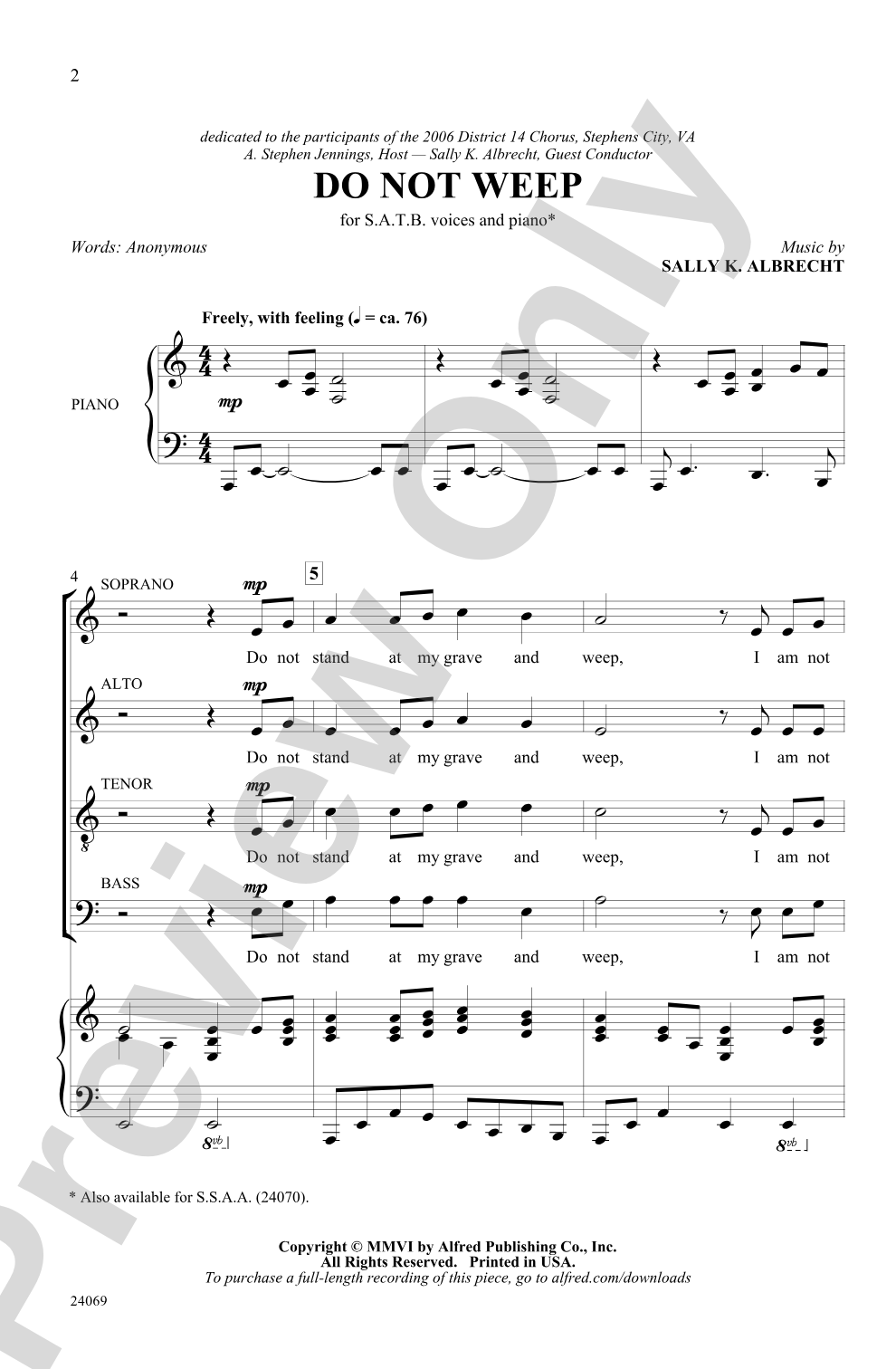
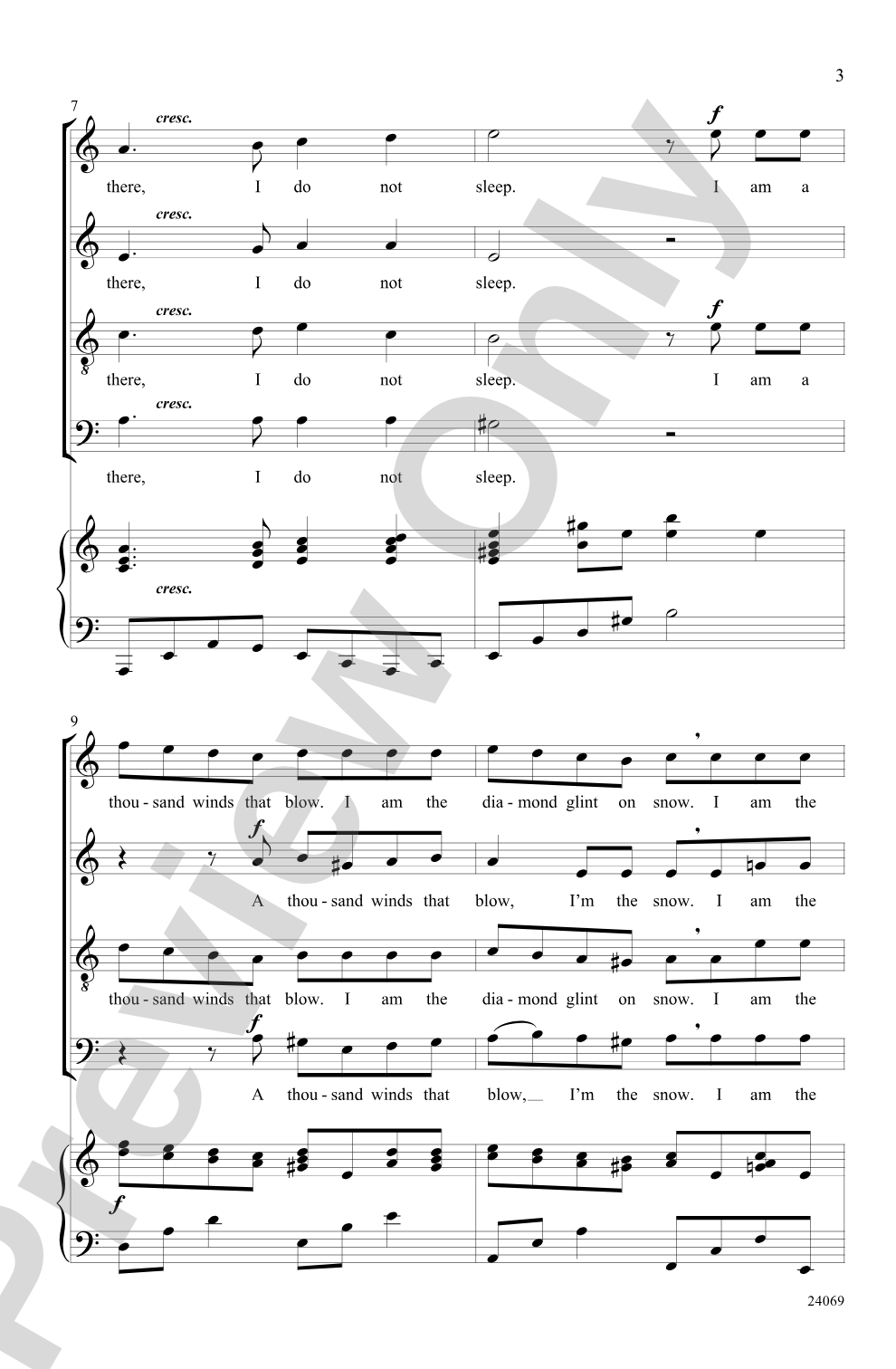

Do Not Weep: SATB Choral Octavo
By Sally K. Albrecht
Item: 00-PO-0000101
$2.25
Minimum order quantity: 20 copies
Pickup currently not available
Description
An outstanding concert work with a powerful text for SATB and SSAA choirs. Careful attention is paid to the text with mostly homophonic writing and an A-B-A form. The piano part is not difficult and supports the voices throughout. A strong concert or contest number, and a fine selection for a festival choir.


Do Not Weep: SATB Choral Octavo isn't in MakeMusic Cloud just yet...but it could be. Let us know you'd like to see it, and you'll help shape what comes next. In the meantime, start a free trial and dive into thousands of interactive titles your students can play along with today.
Request This Title
Tell us you want it.
Start Your Free Trial
Explore everything that's ready to play right now.
Sample Audio
1
Audio File
--:--
0:00
0:00
Sample Video
No sample videos found.
Additional Details
Series:
Alfred Archive Edition: Alfred Choral Designs
Publisher:
Alfred Music
Page Count:
12
SKU:
00-PO-0000101
More about this title
About the Composer: Sally K. Albrecht

Sally K. Albrecht has shaped American choral music for over four decades as a composer, conductor, and clinician with particular expertise in choral movement. Since 1987, she has received annual ASCAP Special Music Awards, and her catalog includes more than 600 published choral works alongside 75 larger songbooks and musicals. She served as Director of School Choral, Vocal, and Elementary Publications for major educational publishers, overseeing the development of repertoire for thousands of school choirs.
Albrecht's conducting career includes honor choirs and festivals at prestigious venues including Lincoln Center, Carnegie Hall, and The Kennedy Center. She earned her B.A. from Rollins College (FL) in Music and Theater, followed by an M.A. in Drama and M.M. in Accompanying from the University of Miami. Both institutions recognized her distinguished contributions by awarding her their alumni honors. She lives in North Carolina with her husband, composer and arranger Jay Althouse.
Why we love this
Albrecht writes with deep understanding of how text drives choral writing. The homophonic approach here keeps the powerful message front and center while the A-B-A structure gives the work memorable shape. A manageable piano part means your accompanist won't overshadow the voices, and the piece carries enough artistic weight to earn a spot on either a concert or contest program.
What to expect
The careful text setting creates moments of real intimacy within the homophonic texture. There's clarity and directness here, yet the work never feels simple. The A-B-A form gives it the satisfying architecture of a well-crafted concert piece.
Who it's for
SATB choirs at the secondary and collegiate level who want substantial repertoire with artistic credibility but aren't ready for dense polyphonic writing. Festival choirs, honor ensembles, and contest-ready groups all benefit from a piece that balances accessibility with genuine musical substance.
How to get the most out of it
- Invest time in the text before diving into notes. The message anchors every phrase, so singers who understand the emotional arc will shape their lines with purpose rather than mechanical precision.
- Balance the homophonic writing carefully. Even when all voices move together, slight dynamic shading between voice parts prevents a flat, uniform sound.
- Use the contrasting B section to breathe new energy into the return of A material. The structural pivot is only effective if audiences hear it as a genuine shift.
How to use it
Pair this with lighter, faster material to let it anchor a concert's second half. Its emotional weight and structural clarity make it an ideal closing number for a set, or a compelling centerpiece around which you build contrasting works. Contest programs benefit from its combination of accessibility and substance.
Skills your students will build
- Interpreting text through vocal line shaping and dynamic control
- Maintaining blend and balance in homophonic writing
- Recognizing and performing sectional forms (A-B-A)
- Coordinating with piano accompaniment in a supported texture