Dindirin Sheet Music Preview

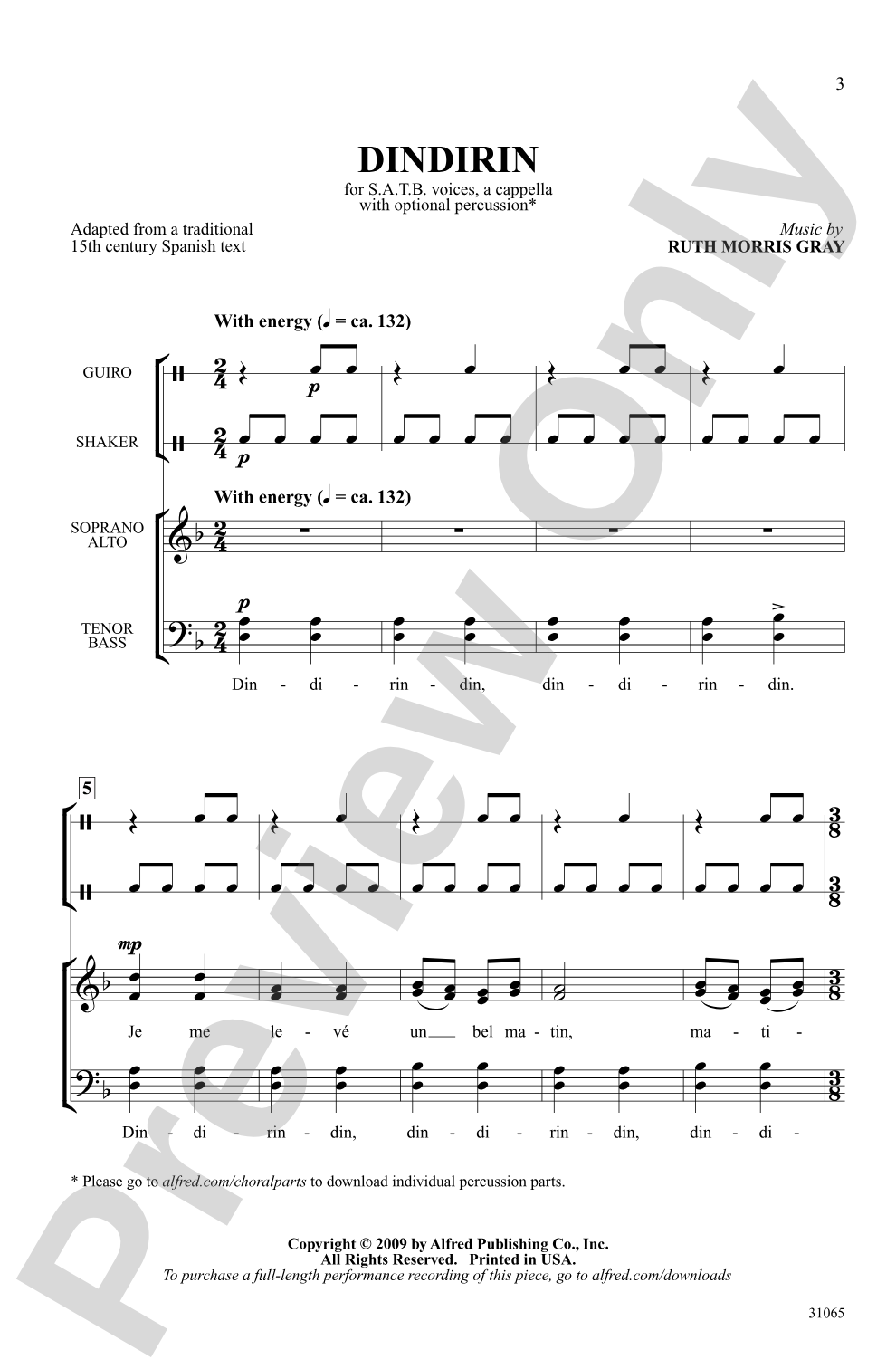
Dindirin: SATB a cappella Choral Octavo

Text adapted from a traditional 15th-century Spanish text, music by Ruth Morris Gray

Item: 00-PO-0000766

Digital Download
$1.75

Minimum order quantity: 20 copies

Description
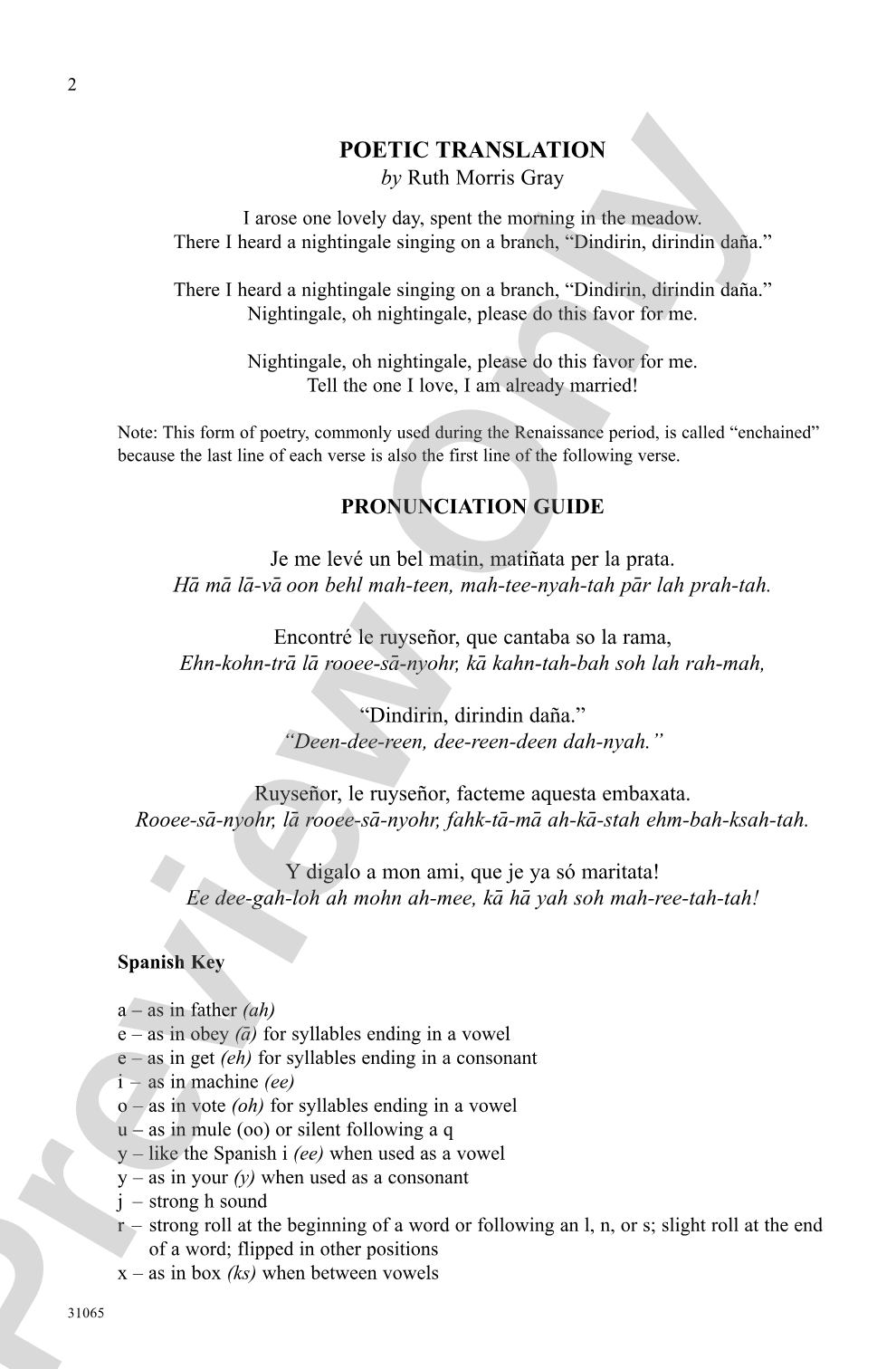
This playful lyric, adapted from a traditional 15th century Spanish text, tells of a nightingale singing on a branch, "Dindirin, dirindin, daña." Perform this wonderful mixed-meter setting with the effective guiro and shaker parts, which are available free, online.

Dindirin: SATB a cappella Choral Octavo isn't in MakeMusic Cloud just yet...but it could be. Let us know you'd like to see it, and you'll help shape what comes next. In the meantime, start a free trial and dive into thousands of interactive titles your students can play along with today.

Sample Audio
0:00
0:00
Sample Video
Additional Details
Series: Lawson-Gould
Publisher: Alfred Music
Page Count: 12
SKU: 00-PO-0000766

More about this title

About the Composer: Ruth Morris Gray

Ruth Morris Gray

Ruth Morris Gray has served as Director of Choirs at Rosemead High School in California since 2004, where she also teaches piano. She holds a Bachelor of Music in Piano Performance and Composition from Biola University, a Master of Arts in Music Composition from UC Santa Barbara, and a California Single Subject Music Credential from Cal State Northridge.

With over 100 published choral compositions to her name, Gray has established herself as a prolific voice in contemporary choral writing. Her work balances accessibility with musical sophistication, making her pieces valuable resources for high school and community choirs seeking repertoire that engages singers while remaining performance-ready.

Why we love this

Gray's setting captures the whimsy of a 15th-century Spanish text with genuine musical wit. The mixed-meter framework keeps the piece rhythmically fresh without demanding technical heroics, and the optional percussion parts (available online at no extra cost) add color and character without requiring a pianist or accompanist. This is the kind of piece that energizes a rehearsal room.

What to expect

Imagine a nightingale calling from a branch on a spring morning, its song both delicate and insistent. The piece moves with buoyant energy, its mixed meters and shifting vocal textures creating a sense of gentle motion rather than rigidity. There's warmth in the harmonies and a playful spirit that invites singers to smile as they work.

Who it's for

This piece serves mixed choirs at the high school level and above who want accessible repertoire with personality. Directors seeking material for festivals, concerts, or informal performances will find a work that's both musically satisfying and genuinely fun to rehearse and perform.

How to get the most out of it

  • Treat the meter shifts as natural musical phrasing rather than technical obstacles; let the text guide your groupings and the rhythm will follow.
  • If using the guiro and shaker parts, introduce them early in rehearsal so singers hear the full texture and can lock into the rhythmic pocket.
  • Balance the four voices carefully in passages where the text breaks into independent lines; clarity matters more than volume.
  • Encourage singers to commit fully to the playful character; the effectiveness of the piece depends on a spirit of lightness and joy.

How to use it

This works beautifully as a festival selection, a concert opener that sets a lighter tone, or a standalone piece for pops-style programming. Its modest length and contest-friendly setup make it ideal for festivals where quick turnarounds matter, though its character is equally at home in a spring concert celebrating Renaissance influences or humor in choral music.

Skills your students will build

  • Reading and performing mixed meters (transitions between different time signatures)
  • Independence within four-part texture (maintaining individual lines while blending harmonically)
  • Rhythmic precision and synchronization with optional percussion accompaniment
  • Textual clarity and articulation in a language-forward setting
  • Expressive interpretation and character work in secular, folk-based material

You May Also Like