Daydreams Sheet Music Preview

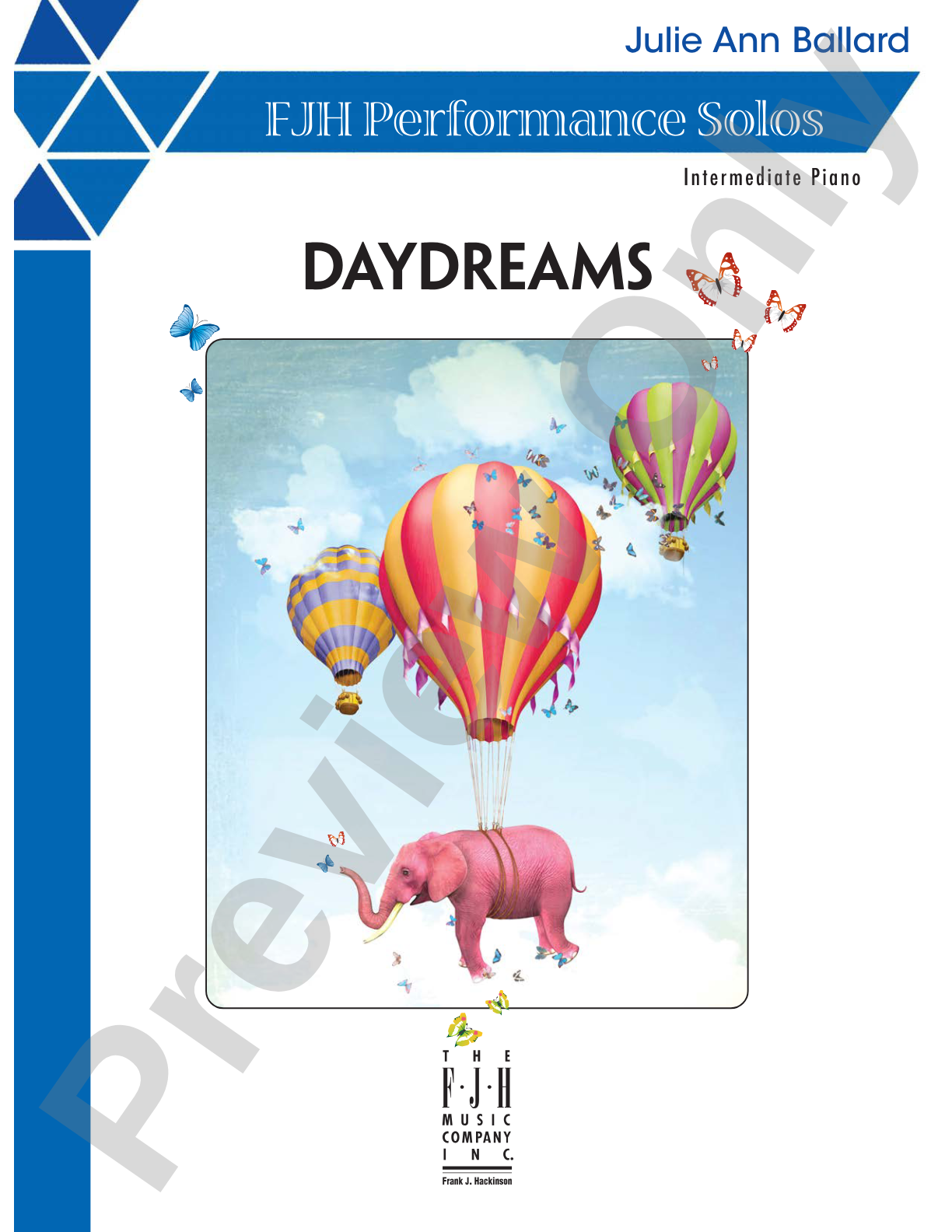
Daydreams: Piano

By Julie Ann Ballard

Item: 98-DP2032

Digital Download
$2.95
Description
Left-hand broken chords create a warm harmonic texture in this reflective piece. Section A is in A minor in 3/4 time while the contrasting Section B is in A major in 4/4 time with both hands playing thick, sonorous chords. It calls for expressive playing, legato pedaling, and voicing an expressive, cantabile melody.

Daydreams: Piano isn't in MakeMusic Cloud just yet...but it could be. Let us know you'd like to see it, and you'll help shape what comes next. In the meantime, start a free trial and dive into thousands of interactive titles your students can play along with today.

Sample Audio
No sample audio found.
Sample Video
Additional Details
Series: FJH Performance Solos
Publisher: The FJH Music Company, Inc.
SKU: 98-DP2032

More about this title

About the Composer: Julie Ann Ballard

Julie Ann Ballard is a composer and educator whose works emphasize lyrical writing and harmonic color. Her pieces for intermediate pianists balance technical development with genuine musicality, giving students repertoire that rewards both careful practice and expressive interpretation.

Why we love this

Ballard's approach to key and meter contrast makes this piece memorable without relying on virtuosity. The shift from A minor's introspective mood to A major's brightness gives intermediate players a meaningful compositional concept to explore, and the broken-chord writing in the left hand is generous enough to let students focus on pedaling technique and right-hand melody.

What to expect

Daydreams opens in quiet contemplation, with gentle broken chords cradling a wistful line in A minor. The second section brightens into a fuller, warmer sound in A major, as if memory and daydream have shifted into something more resolute and present.

Who it's for

This piece suits intermediate pianists who are developing pedal control and learning to balance accompaniment and melody. It works especially well for students beginning to understand harmonic color and its emotional effect.

How to get the most out of it

  • Shape the left-hand broken chords as a continuous harmonic wash rather than individual notes; think of them as the foundation that allows the melody to float above.
  • Experiment with pedal changes aligned to harmonic shifts within Section A, lifting briefly when the harmony moves to sustain clarity.
  • Move into Section B's thicker textures deliberately, allowing the tempo or weight to settle slightly to emphasize the tonal shift from minor to major.
  • Let the cantabile melody breathe; resist playing straight through without phrase breaks, even though the accompaniment pattern wants to stay consistent.

How to use it

Pair this with other reflective solos in a recital to create a thematic arc around introspection and mood. It also works well as a teaching piece within a unit on harmonic function and tonal relationships, since the A minor to A major relationship is clear and purposeful.

Skills your students will build

  • Sustaining legato broken-chord patterns while maintaining rhythmic evenness
  • Coordinate left-hand accompaniment with right-hand melodic phrasing
  • Manage pedal changes across harmonic shifts in 3/4 and 4/4 time
  • Shape and voice a cantabile melody over accompanimental texture
  • Execute expressive playing across tonal contrast and key changes

You May Also Like